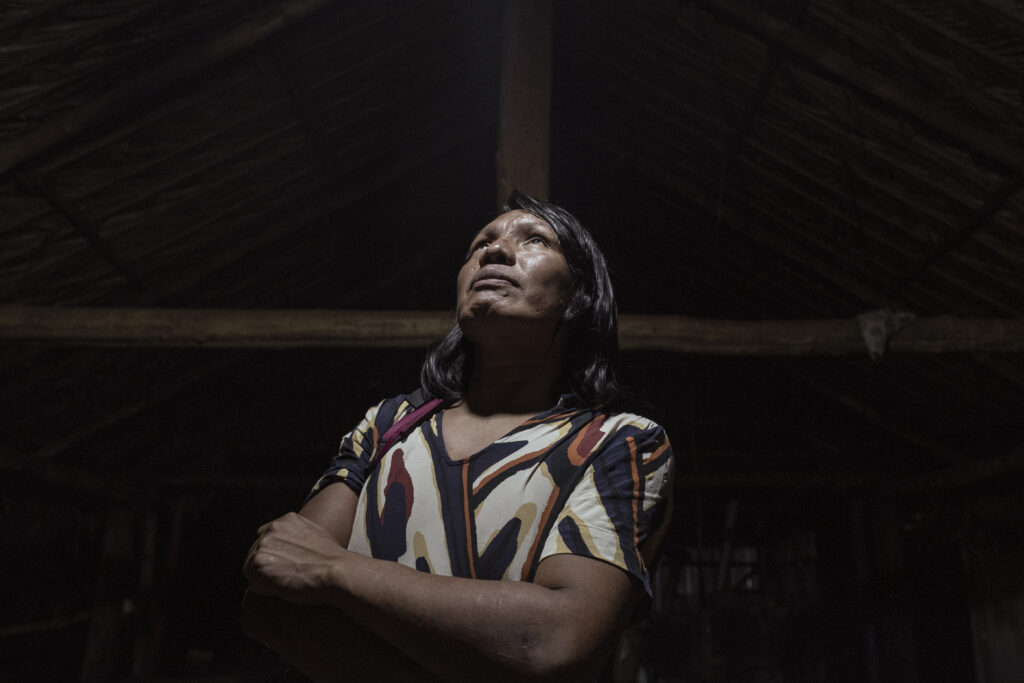
TADARIMANA INDIGENOUS TERRITORY, Brazil — As the sun sets, Majur Traytowu stirs beef ribs in the heavy iron pot on the wood stove. The table holds a small portion of rice and beans — enough for her family’s only meal that day in Apido Paru, her Indigenous village here in central Brazil.
She tucks her chin-length dark hair behind her ear, wipes her hands on her yellow shorts. “I’ll make sugarcane juice,” she announces. She grabs a machete and pulls her friend along.
Kiga Boe follows. They’ve known each other since they were children. It was Traytowu who helped Boe understand that she, like herself, didn’t recognize herself in the body into which she was born. Now, Traytowu is 35, Boe, 29. “Even before the transition,” Boe says, “Majur already carried herself like a woman meant to lead.”
Five years ago, Traytowu, the daughter of Apido Paru’s previous chief, succeeded him as the first transgender Indigenous leader in Brazil, a symbol and source of inspiration far beyond her village. She‘s respected, her mother says, for her deep knowledge of their Bororo culture and her fluency in Portuguese, a rare combination.
It wasn’t enough. Traytowu has also struggled with alcohol, she says, and late last year, she was removed from her position by her own mother. Jurema Adugo Oro says she had no choice. “If she doesn’t step away from her addiction,” Oro says, “she will lose everything.”
Now Traytowu is working to earn the job back.
She lives between two worlds. Outside this territory in central Brazil, she‘s celebrated as proof that trans people can lead in traditional communities. Inside it, she’s struggling to hold on to influence and authority as addiction ravages her territory — and her own life.
For decades, Brazil has ranked consistently as the world’s deadliest country for trans people — and it isn’t particularly close. According to the National Association of Transvestites and Transgender People, 122 were killed here in 2024 and 80 last year.
Tadarimana, a territory of some 37 square miles, lies inside the conservative state of Mato Grosso, a stronghold of Brazil’s rapidly growing evangelical population. It‘s home to 636 Indigenous people, spread among 10 villages, each with its own chief.
The central village, also called Tadarimana, with about 200 residents, elects its chief by majority vote. The other villages choose or remove their leaders through decisions made among the main families.
When Traytowu took the position at Apido Paru, the village had 70 people. Today, about 30 remain, living in six thatched houses along the Tadarimana River.
Leadership positions in Indigenous villages are typically held by married men with authority often shared within the couple. The choice of an unmarried trans woman was unexpected, analysts say, but not unthinkable.
Gender and sexual diversity have long been recognized in the country’s native societies. Discrimination against trans people, according to the Ministry of Indigenous Peoples, was introduced “alongside European moral and religious values, particularly those tied to Catholicism, which imposed more restrictive views.”
“Majur is an important representation of Bororo culture, a population that already challenges traditional gender roles,” says anthropologist André Drago, who has studied the Bororo people for 15 years. “But she was able to rise in this way because she comes from a family of leaders and knows how to maneuver both inside and outside the village.”
In Bororo culture, a person’s identity is tied to their role in the community. Since childhood, Traytowu has performed tasks associated with women. She cooks meat, rice and beans, when they’re available, and cares for her sister’s children.
During funerals, her community’s most important ceremony, she chants the pranto, a role reserved for women — a “very sad and very beautiful” recounting of the deceased, she says, and the void their death leaves.
It requires fluency in the language she learned from her father, Raimundo Itogoga, a powerful cultural leader who, on falling ill in 2021, chose the youngest of his 15 children to succeed him. He saw in her a natural leader, her mother says, and that she could navigate two worlds and two languages better than anyone else.
As a young adult, Traytowu wore feminine clothes, shaped her eyebrows and watched videos of people who looked like her. She didn’t yet understand the concept of being transgender, she says, but “I just wasn’t myself when I was among men. It wasn’t where I wanted to be.”
In 2018, when she was 27, she began seeing a psychologist. Asked about her aspirations, she said for the first time out loud that she wanted a woman’s body and a new name.
One day, someone called her “Majur,” and she felt immediately the name was hers. “It’s a strong name, a leader’s name, and I felt it resonate within me.”
Given logistical challenges and lack of money, she didn’t begin hormone transition until October 2021, three months after she became chief. She started treatment at a private clinic in Rondonópolis, a 90-minute drive from her village, using savings from her former job as a health agent.
Soon her voice softened, her breasts grew, and the little body hair she had thinned or fell away. She was happy, but she was forced to stop the medication when the money ran out. The role of chief brought no salary, and the nearest public health system offering the treatment was nearly 500 miles away.
But by then, she was already Majur. She had changed her name legally and introduced herself that way.
Adugo Oro, Traytowu’s mother, says her daughter’s identity is accepted by the village. Transgender people have long been visible in Bororo culture, she says; she knew a trans woman married to a cultural leader many years ago.
“My mom told me I’m not the first transgender woman among my people,” Traytowu says, “but I am an inspiration for those who come next. Girls who are afraid to come out find courage in me. They think, if she can do it, so can I.”
Some transgender Indigenous people have been rejected or even expelled from their territories.
Nat Kuparaka, a 24-year-old member of the Pataxó people, says she was cast out by her family for being a trans woman. “My parents became evangelical pastors, and they believe what I did is a sin,” she says. “Those who remain more closely tied to Indigenous traditions tend to be more accepting of different gender identities.”
At least two other trans women live in Tadarimana Indigenous Territory. Traytowu says she has never faced prejudice within her family or village, only outside it. “In the city, people look at me with anger. It is a double prejudice, for being Indigenous and for being trans.”
Boe, her childhood friend, reports a similar experience. She left 10 years ago to pursue a doctorate in anthropology.
“I don’t want us to be seen through this negative lens of prejudice, marginalization and death,” Boe says. “I want us to be seen for who we are. I’m a PhD student. Majur is a leader. And by being a leader, she challenges a system that would rather we didn’t exist.”
As chief, Traytowu mediated conflicts, secured food aid during and after the pandemic, and helped to bring a water distribution system to the village.
She traveled across Brazil and to France to promote Bororo culture and transgender Indigenous leadership.
She enjoys the spotlight, she says, but the constant demands of the role and the hormone treatment were stressful.
She thought she would find a solution in alcohol. “I started drinking about five years ago,” she says, around the time she became chief. “It was a hard time, so I drank all out.”
Geni Nuñez, a psychologist who has studied Indigenous culture, sees alcoholism among Indigenous communities as a symptom of chronic strain, particularly in territories under pressure and, like Tadarimana, near urban centers.
“In Majur’s case, the burden could be even heavier,” Nuñez says. “Leaders are always under scrutiny, but when someone comes from a marginalized position, as an exception, the demand is even greater.”
Among the Bororo, Drago says, alcohol has a violent history. Introduced by white military forces in the 19th century as a tool of pacification, it became part of a broader strategy of dispossession. “Non-Indigenous actors sought to reduce the Bororo population and take their land, and alcohol was used as an instrument in that process.”
Over the past year, relatives and friends say, Traytowu grew increasingly volatile, shouting, fighting at home and in the streets, unsettling a community that looked to her for guidance.
“Everyone respects Majur,” said Ruth Aranu, who lives in the central village. “She performs in our mourning rituals beautifully, speaks our language, she’s good to us. But the drinking gets in the way.”
At the end of last year, Adugo Oro made what she describes as a painful decision. Her daughter had drawn too much attention, she says. People felt envy, perhaps even used dark magic against her. “She wasn’t herself. I had never seen her like that,” she says. “I was heartbroken, but there was no other way.”
She summoned Cícero Kudoropa, then the chief of the central village and Traytowu’s godfather, and told him Traytowu would no longer lead Apido Paru. With her husband bedridden, she said, all matters would go through her. Kudoropa agreed.
Traytowu did not. Mother and daughter clashed. After a fierce argument in February, Traytowu says, her mother told her it would be best to leave the village for a while.
“I felt the ground disappear beneath me,” she says. “It was a pain I’ve never felt before. Nothing could fill the sadness and anguish. I was no one anymore.”
She begged for one last chance, she says. She promised to stop drinking and help again at home and with the family. Her mother agreed. “I like having Majur helping me here, sweeping the house, cooking, bringing us food and helping take care of the children,” Adugo Oro says.
Traytowu says she is now trying to get sober again. She had been sober for months, she said, before relapsing.
Twenty days after the fight between Traytowu and her mother, Kudoropa called a general assembly under a rain-heavy sky in the central village to address, among other challenges, the growing drinking problem in the Bororo community. Standing in a concrete hall with a microphone in his hand, he warned that more alcohol was reaching the territory more frequently.
“This has been a problem for 15 years, but it’s getting worse,” he said. “People from our own community are now buying it in the city and reselling it here for three or four times the price.”
He said he knew the sellers and had warned them before. He was reluctant to punish his own people, he said, but this was the final notice.
“If they keep selling alcohol here, we will notify the Federal Police and Funai,” the federal agency for Indigenous affairs, “and expel them from our land.”
His term ended this spring, and he had no plans to run again. Being a chief brings too many problems, he says. He, too, struggled with alcohol, he says. He nearly died in a car accident last year, he says, and has been sober since then. Now he wants to take care of his family.
“It’s too many demands, we’re constantly worried, we barely sleep,” he says.
Traytowu hopes to run for his job soon. She wants to build a movement to raise the visibility of transgender people within Indigenous communities and secure partnerships that would give young villagers more opportunities and less idle time with alcohol.
“I prepared myself for a long time, and I believe I’m ready to try to take on a role of this magnitude,” she says.
Kudoropa thinks she needs a little more. “I know the pain,” he says. “Majur is a good person and has a whole life ahead of her. If she gives up drinking, she could lead this entire territory one day.”
Majur seems to grasp what lies ahead. “Alcohol pushed people away from me,” she says. “I want to leave this life behind, learn from my mistakes and get back to work.”
Her mother looks out at the dark night and takes Majur’s hands. They set out for Apido Paru.
The post She made history as a trans Indigenous chief. Then addiction cost her the job. appeared first on Washington Post.