Climate change is heating up the Himalayas and supercharging the risk of disasters like the deadly flash flooding in Nepal and Tibet, though scientists are still determining the exact cause of this week’s catastrophe.
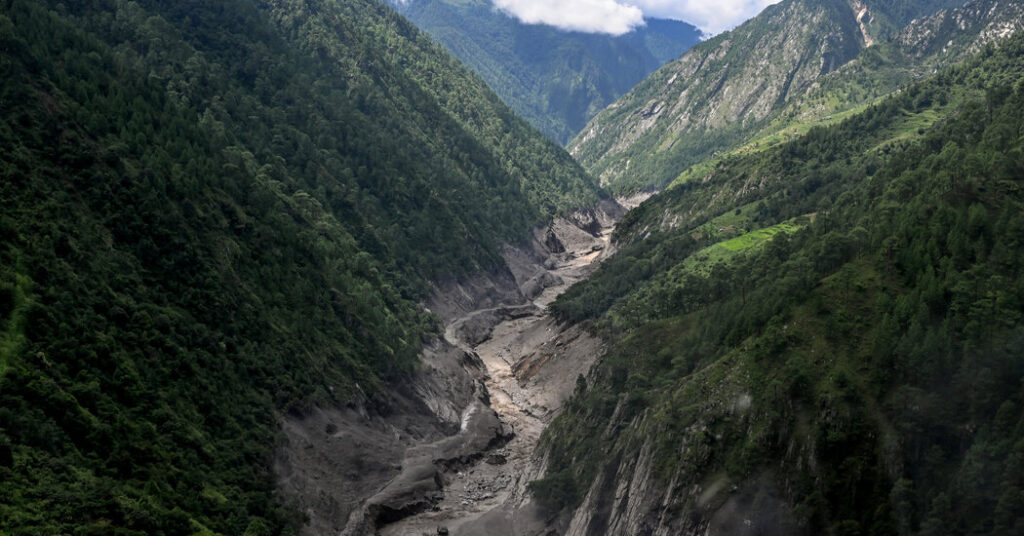
A group of glaciologists and geologists said on Thursday that the flooding was probably unleashed after an enormous chunk of bedrock collapsed underneath a glacier, triggering a landslide high in the mountains. At the same time, a chunk of ice snapped off the glacier itself and cascaded thousands of feet to the valley below, the scientists said.
As humans warm the planet by burning fossil fuels, the Himalayas are losing their permafrost, a mixture of soil, rocks and organic matter that has remained frozen for thousands of years. The thawing permafrost is destabilizing the foundation underneath glaciers, raising the risks of precisely these kinds of landslides and glacial collapses.
Data shows that glacial failures — the scientific term for a category of events that includes ice avalanches, glacier detachments and rock-ice avalanches — have happened dozens of times since 1900 in the China-Nepal border region that was the site of this week’s devastation.
“Permafrost has been the cryospheric glue that’s held the rock and the ice and the glaciers together for millennia, and now we’re getting increasing evidence that it’s being weakened by warming trends,” said Alton C. Byers, a senior research associate at the Institute of Arctic and Alpine Research at the University of Colorado at Boulder.
Dr. Byers, who plans to travel to Nepal next month to meet with communities confronting flood risks, suggested a new name for the phenomenon: “not-so-permanent permafrost.”
The landslide and glacial collapse took place on the north face of Langtang Lirung, a mountain in northern Nepal near the border with Tibet, at an elevation of around 17,000 feet. Millions of metric tons of rock and ice fell, pulverizing into mud and water as the torrent surged down the mountainside.
Ashim Sattar, an assistant professor at the Indian Institute of Technology Bhubaneswar who studies Himalayan glaciers, said that while it was too early to rule out other factors, warming temperatures caused by climate change may have destabilized the mountain slope.
“As the glaciers retreat and the permafrost melts, we see that these slopes become more susceptible to failure,” Dr. Sattar said, adding, “There’s a very straight link between climate change and these types of disasters.”
Still, scientists cautioned that climate change was not the sole, immediate factor behind the flooding, which has killed hundreds of people and left more than 1,400 missing. They noted that teams of researchers were still studying a wide set of data from satellite imagery and other sources, which could take months.
“I don’t think we can simply say this is as a result of climate change,” said Stuart Dunning, a professor of applied geomorphology at Newcastle University in England. “It’s likely a whole variety of factors that are long-term, along with possible short-term things like a strong snow melt component in the last few days.”
Dr. Byers said that thawing permafrost was a relatively new concept for some residents of flood-prone communities in northern Nepal. He said residents and researchers alike have tended to focus on a related risk: Melting glaciers are creating unstable lakes all across the Himalayas.
When an avalanche or earthquake causes falling rocks or snow to land on these lakes, it can set off a flood that engulfs everything in its path, including entire villages, tourist lodges and hydropower plants. The phenomenon is known as a glacial lake outburst flood, or GLOF, and the result can be similar to this week’s tragedy.
At the outset of the flooding on Wednesday, some scientists speculated that such an outburst had caused the destruction. But initial satellite data appears to show that an overflowing glacial lake was not involved, said Umesh K. Haritashya, the director of the sustainability program at the University of Dayton.
“There is common confusion about glacial lakes whenever something like this happens in this area,” Dr. Haritashya said. “But there are other hazards in these mountains that, going forward, scientists and policymakers need to be looking at carefully after these recent events.”
Nepal’s Department of Hydrology and Meteorology operates a network of sensors and gauges that monitor the water levels of some glacial lakes and connected rivers. When the network detects a potential outburst, officials alert downstream communities.
But Austin Lord, a senior fellow in the Energy, Water and Sustainability program at the Stimson Center, a nonprofit research organization, said that this early warning system was not designed to detect this week’s flash flooding.
“This type of flash flooding, because of the speed at which it moves, means that kind of conventional system is ill-equipped,” he said.
The post Climate Change Raises Risk of Disasters Like Nepal Floods appeared first on New York Times.