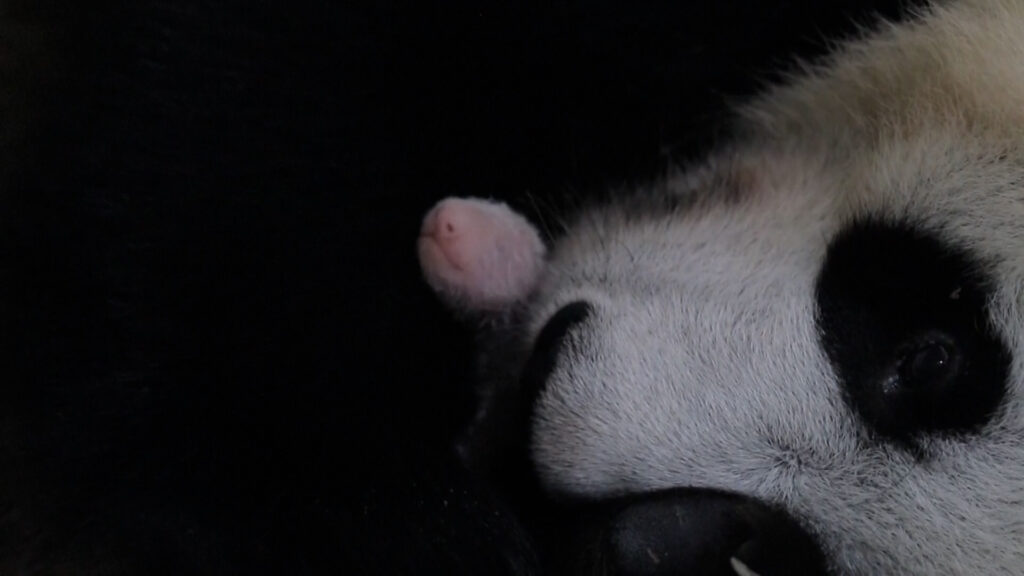
He’s a dinky fuzz ball with sparse hair and pink and white skin. From underneath his mother, he squeals, paws poking up into the air. The new arrival is small but he is noisy. His birth was hailed as a conservation success story, his name personally selected by Indonesia’s president.
Late last month, Indonesia welcomed its first locally born giant panda club, whom President Prabowo Subianto named “Satrio Wiratama” — which means “a brave, noble little fighter with a kind heart,” said the park where he was born, Taman Safari in Cisarua, West Java province. At less than 2 weeks old, he already has a nickname: Rio.
Rio was born Nov. 27, the park said, describing his name as “beautiful” and his birth as a “historic milestone.” The park shared images of the cub, standing on all fours on top of a blue blanket, his eyes still shut.
“This birth is the culmination of a meticulous, science-driven effort by our Life Sciences team, conducted in close partnership with the China Conservation and Research Centre for the Giant Panda,” the park said.
The cub is not yet accessible to the public, the Associated Press reported, citing the park. “Taman Safari Indonesia will continue to prioritise the health and welfare of the mother and her baby, and invites the public to join in praying for the baby panda’s development so that it remains healthy and safe in the early stages of its life,” it said in a statement.
Giant pandas, which all originate from China, are deemed a “vulnerable” species, meaning they are still at risk but a step back from the brink of extinction. In 2016, the International Union for the Conservation of Nature, the nongovernmental organization that maintains the authoritative list of the world’s rarest species, downgraded the threat level from “endangered,” though Chinese officials did not agree with the decision until July 2021.
According to the World Wildlife Fund, the species are “on the road to recovery” after decades of conservation efforts; 1,864 giant pandas were still living in the wild as of 2014, the most recent survey.
Mother pandas keep contact with their babies almost all of the time during their first month of life, the WWF notes. The cubs are typically tucked away, shielded by their mother’s paw, arm or head.
The giant panda is a Chinese national symbol. For more than 50 years, the animals — which can spend up to 16 hours a day eating — have been used as a diplomatic tool, shoring up alliances, wooing new partners and building goodwill worldwide, frequently loaned or gifted to other countries.
The post He’s tiny, fuzzy and pink. Indonesia hails its first local panda cub. appeared first on Washington Post.