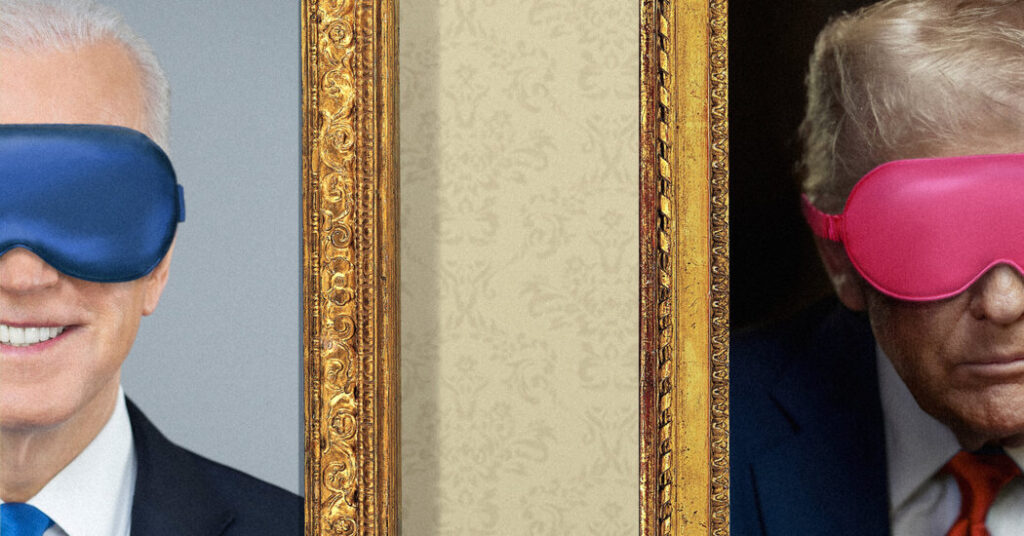
Just how run-down must a raging narcissist be to snooze through tributes to his own greatness?
At a cabinet meeting last Tuesday, President Trump didn’t merely close his eyes and achieve a droopy stillness universally recognized as a vertical nap. He did so during a gathering convened at least in part so he could bathe in his acolytes’ flattery. They batted their eyes at him; his eyelids fluttered shut. He might want to think twice about letting the television cameras in next time around.
And the rest of us might want to brace ourselves for some presidential déjà vu. He’s starting to give President Joe Biden vibes.
I’m in no way suggesting any equivalence or near equivalence in their characters. Biden meant well, regarded governing as serious business and radiated decency. Trump means to be either feared or worshiped, regards governing as show business and revels in cruelty and mockery, which are flexes of his power.
But there are echoes of what bedeviled Biden in what’s bedeviling Trump. And I’m talking about more than Trump’s arguably diminished energy and the inarguably intensifying public attention to it. I’m also talking about the economy — and Trump’s spectacular failure to allay voters’ anxieties.
The rap on Biden during the second half of his term was that he didn’t fully understand how financially stressed many Americans were and that he clung to a tone-deaf insistence that conditions were better than people’s perceptions of them. Trump, in the first year of his current term, has attained an aloofness that Biden could only dream of.
At that cabinet meeting, Trump challenged the very idea that the cost of living was on voters’ minds and waged war on a perfectly good noun, dismissing “affordability” as a Democratic hoax and hex.
“They just say the word,” Trump groused. “It doesn’t mean anything to anybody. They just say it — affordability.”
What made his gripe doubly bizarre is that he himself has talked about affordability time and again, in his indictments of the economy under Biden and his boasts about his own economic plans and progress.
He talked about it when he and Zohran Mamdani, the mayor-elect of New York City, made nice in the Oval Office just two and a half weeks ago, beaming at each other as the journalists in attendance picked their jaws up off the floor. “Some of his ideas really are the same ideas that I have,” the president told them. “A big thing on cost. The new word is ‘affordability.’ Another word, it’s just ‘groceries.’ It’s sort of an old-fashioned word, but it’s very accurate. They are coming down.”
The “coming down” part presumably refers to food prices, but with Trump’s fugitive grammar, you never know. That phrasing was uncharacteristically understated. Trump tends toward the kind of hyperbole he spewed at Laura Ingraham on Fox News last month, when he claimed that “we have the greatest economy we’ve ever had.” During that interview, he also said polls showing that Americans were worried about it are fake, a deflection so similar to one that Biden made a year and a half earlier that on CNN, the anchor Abby Phillip did a side-by-side comparison of the two presidents’ remarks. She introduced it with a question: “When it comes to the economy, is Donald Trump taking messaging advice from Joe Biden?”
He’s certainly not learning lessons from Biden’s troubles. In a recent column in The Economist with the clever print headline “Say It Ain’t Joe,” James Bennet recalled the audacious flurry of executive orders Biden signed in his first 100 days, the sweep of his legislative ambition, how fervently he believed that voters had demanded nothing less and how much all of that came back to haunt him later on. Bring to mind any other president you know?
Whether Trump gets his comeuppance remains to be seen, but his approval ratings have declined in recent months, and so, by the looks of things, has his vigor. Of course, his indefatigably adoring press secretary, Karoline Leavitt, disputes that; she said that Trump was “listening attentively” rather than dozing furtively as cabinet members extolled his and his administration’s wonders. She directed those who doubt his vim to the “epic moment” during the meeting when he attacked Representative Ilhan Omar, Democrat of Minnesota, and other Somali immigrants to America. You know, the one in which he called them “garbage.” I guess xenophobia is now a proxy for stamina.
Biden was 82 at the end of his presidency. Trump is 79 now, and he undeniably moves more fluidly, speaks more loudly and mixes it up with journalists more frequently than his predecessor did. But there are suggestions aplenty that he’s slowing down, as Katie Rogers and Dylan Freedman detailed in a recent article in The Times. And Americans are once again on a kind of presidential fitness watch, reading the tea leaves of bruises, blotches, gaffes.
Are Trump’s baffling non sequiturs, herky-jerky syntax and fantastical misrepresentations of fact just a wholly unleashed, fully emboldened version of who he has always been, or is his focus blurring? What was up with his swollen ankles and the discoloration, partly concealed by makeup, on the back of one of his hands?
And how to solve the mystery of the M.R.I. that he had at Walter Reed National Military Medical Center in October? Trump’s comments about it are the stuff of a “Saturday Night Live” skit. He has said that he gave the news media the full results of the test, a claim contradicted by the fact that we don’t even know what part of his body physicians were looking at, and when reporters asked him that, he professed ignorance.
“I have no idea what they analyzed,” he told a group of them on Air Force One recently. “But whatever they analyzed, they analyzed it well, and they said that I had as good a result as they’ve ever seen.”
This from a man who still routinely rants about the evasions and deceptions of “Sleepy Joe” Biden? Wake up, Mr. President. You’re not fooling anyone.
What I’m Watching
-
If you typed out all the words spoken by Robert Grainier, the introverted, reticent protagonist of the new Netflix movie “Train Dreams,” would they fill even a page? Based on an acclaimed novella of the same title by Denis Johnson, “Train Dreams” can be that muted. If you want a movie of boldly underscored emotions and briskly paced scenes, it will probably leave you cold. But if offers something subtler, richer: a tone poem about the puzzle of an individual life. Played with exquisite restraint by Joel Edgerton, Robert may say little, but he observes lots, his work building railroads and felling trees in the Pacific Northwest giving him a special vantage point on a rapidly industrializing, diversifying land. Watch “Train Dreams” in a distracted state of mind, and you might notice little more than the majestic landscape in which it’s set. Watch it more closely and patiently, and you’ll see that it’s a parable of how the twists of history touch an outwardly simple man — and vice versa.
-
As someone who teaches at an elite university and acknowledges how far to the left the culture on many campuses traveled over recent years, I was primed to be riveted by “After the Hunt,” the director Luca Guadagnino’s imagining of the fallout from a Yale student’s vague accusation of sexual abuse against a philosophy professor who denies it. But the movie, currently streaming on Prime Video, veers from dawdling to hyperventilating, and its plot is rife with all sorts of ancillary business that does nothing to sharpen its perspective. If you’re a big fan of any of its three stars — Julia Roberts, Andrew Garfield and Ayo Edebiri — then sure, check it out; each of them has a terrifically acted scene or three. Otherwise, you can skip this muddled lecture.
For the Love of Sentences
My way of saying “Happy holidays”: This week is one of the occasional ones when I keep politics out of our prose celebration.
In The Atlantic, Helen Lewis mapped our country’s quirks. “One of the many delights of America is that its geography is also a vocabulary. If I say ‘Portland, Ore.,’ or ‘the Hamptons’ or ‘Appalachia,’ the reader knows instantly which stereotypes are being invoked: the middle-class Maoist, the summering WASP, the hick,” she wrote. She further noted: “In the American imagination, Florida is where you go when you’ve done something wrong. California is where you go when you’ve done something wrong and want to be pretentious about it.” (Thanks to Ron Stack of Mendham, N.J., and Minty Smyth of Tiverton, R.I., among others, for spotlighting Lewis’s article.)
In The Washington Post, Monica Hesse provided context for her analysis of Meghan Markle’s holiday special on Netflix: “I did not review the first two seasons of ‘With Love, Meghan,’ and to start now seems unsporting, like showing up to a deer hunt after the animal is already dead and butchered just so you can point to the plates of venison and say, LOL, Bambi, sucks to be you.” (Karen J Andrade, Merchantville, N.J., and Virginia Matish, Chesapeake, Va.)
In The San Jose Mercury News, Dieter Kurtenbach defined the special shame of the three interceptions that the San Francisco 49ers quarterback Brock Purdy threw in a game against the Carolina Panthers: “These weren’t tipped balls or receiver errors or passes that were caught in the wind. They were floating, wobbling invitations to the Panthers’ secondary. He threw with the velocity of a heavy sigh.” (Gary Brauch, Los Altos Hills, Calif.)
On ESPN.com, David Hale appraised a recent University of Alabama football game in terms of a common phobia among the state’s drivers: “The first half was a slog for Alabama’s offense, but its defense was virtually impenetrable, like a quarter-inch of snow on Interstate 20 through Talladega.” (Fred Roecker, Columbus, Ohio)
In Harper’s Magazine’s “Weekly Review,” Amelia Anthony summarized some late-November developments: “The head coach of the University of Illinois Urbana, Champaign, basketball team decried his team’s defense as ‘doo-doo’; Italian couture brand Miu Miu successfully blocked a Polish beauty company from registering a business named Fiu Fiu; and the Macy’s Thanksgiving Day Parade showcased a 16-foot-tall Labubu.” (Nan Tecotzky, Manhattan)
In The New Yorker, Kyle Chayka appreciated an aural element of the Taylor Sheridan television hit “Landman,” starring Billy Bob Thornton: “The soundtrack intersperses recognizable country hits with sweeping ambient guitar compositions by Andrew Lockington that are reminiscent of the postrock band Explosions in the Sky. These artsy flourishes are the drizzle of artisanal jus on the plotline’s chicken-fried steak, mingling their flavors to the benefit of both.” (Janet Mills, Raleigh, N.C.)
In The Times, Matt Hongoltz-Hetling considered the importance of an annual communal feast to a Vermont town’s special fellowship: “Whether a vibrant community created the potluck or the potluck created a vibrant community is like asking which came first, the fried chicken or the deviled egg.” (Stacey Somppi, Cottonwood, Ariz., and Hillary Ellner, Durham, N.C., among others)
Also in The Times, Julia Moskin explored the upset when the folks behind the Michelin restaurant guide trained their discernment on a Philadelphia delicacy: “In a Venn diagram of people deeply concerned about Michelin ratings and people deeply concerned about cheesesteaks, the overlap is not large.” (Susan Cole, Escondido, Calif., and Ron Rosen, Conshohocken, Pa.)
Mark Harris cataloged and classified the kinds of payback meted out in the world of arts and entertainment, including Patti LuPone’s complaints about Audra McDonald and Kendrick Lamar’s torment of Drake: “There is the LuPone, where you hold on to particular thoughts about people who have irritated, crossed or disappointed you — for more years than some sequoias live, if necessary — and then, one day, decide to let them fall like a hail of arrows in an Akira Kurosawa film. There is the Kendrick, where you lay your opponent flat on the mat, then put another mat on top of him, then sit on it while you change into new shoes, then use those shoes to jump up and down on the mat, then sell tickets.” (Nicole Baril, Irvine, Calif., and Natalie Fernandez, Manhattan)
And Lizzy Goodman savored the honesty of Lily Allen’s most recent album, which performs an autopsy on her marriage to and breakup with the actor David Harbour: “You first listen to ‘West End Girl’ for the gory details, like reading a romance novel for the hot sex. But a few spins in, you start to hear the sadness underneath it all, and then suddenly, you find yourself just wanting to be her — this emotionally wrecked badass with the guts to say she feels old and heartbroken and destroyed.” (Pamela Saffire, Los Angeles)
To nominate favorite bits of recent writing from The Times or other publications to be mentioned in “For the Love of Sentences,” please email me here and include your name and place of residence.
The post Is Sleepy Donald the New ‘Sleepy Joe’? appeared first on New York Times.