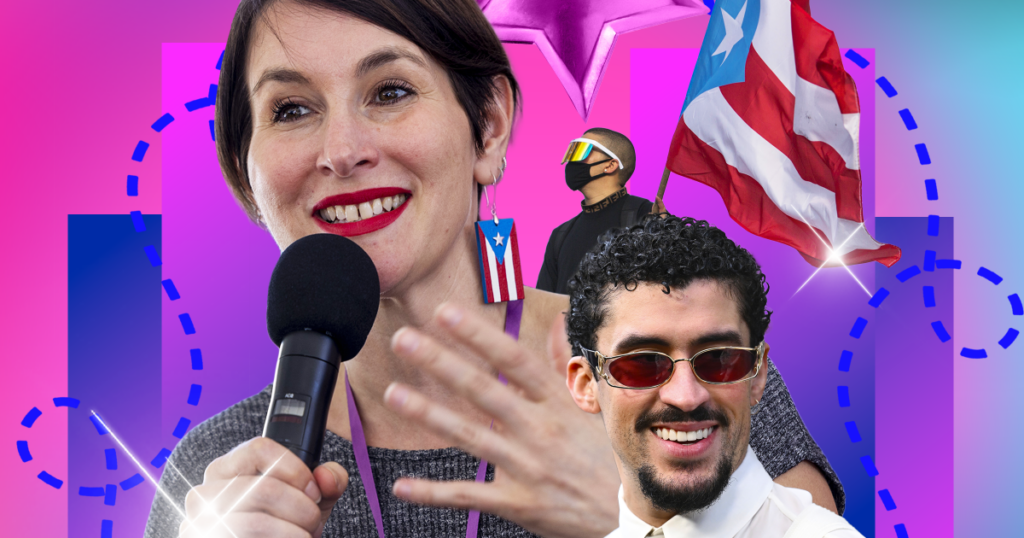
The first song that really turned Vanessa Díaz on to Bad Bunny was the 2019 single “Caro.” Featuring a vocal assist from Ricky Martin, the track highlighted the Puerto Rican singer’s songwriting abilities and emotional center, according to Díaz. The gender-bending music video released with the track showcased Bad Bunny’s willingness to challenge the rigid norms present in reggaeton, she added.
In the years since that single’s release, the artist has become a global icon, a highly politicized figure, a Grammy winner and a Super Bowl halftime show headliner. As his star power continued to expand, Díaz’s relationship with the singer’s music and her appreciation of its impact has grown so deep that she recently co-authored the book “P FKN R: How Bad Bunny Became the Global Voice of Puerto Rican Resistance.”
On this week’s episode of “The De Los Podcast,” hosts Fidel Martinez and Suzy Exposito speak with Díaz — a professor of Chicano and Latino studies at Loyola Marymount University — about the academic value of evaluating Bad Bunny’s career, how he came to dominate the global music charts and what that’s meant for fellow Puerto Ricans, Latinos in the U.S. and the rise of Latin music.
In 2023, Díaz began teaching a course titled “Bad Bunny and Resistance in Puerto Rico,” which was inspired by the “Eoo” artist’s decision to abandon his 2019 European tour to join mass protests in Puerto Rico against then-Gov. Ricardo Rosselló after a series of the leader’s controversial text messages were leaked. Rosselló eventually resigned.
That inflection point served as a launching pad for Díaz’s recent book.
“I think it really showed how seriously he takes representing for Puerto Rico and that’s part of the reason he’s so huge because everyone resonates, especially Latinos, with that profound love for a homeland,” Díaz said.
She pointed out that Bad Bunny’s allegiance to his homeland and its history has been highlighted in his constant use of the sky-blue version of the Puerto Rican flag — a symbol of resistance against U.S. rule — as well as how he has incorporated history lessons into his live shows and the journalism he has helped spotlight about the issues going on within the island.
He most recently repped Puerto Rico on a global stage during his Super Bowl halftime performance in February. Diaz argued that it signified a repositioning of Latin music from an outside force in the industry to a major force in the mainstream, which was nicely encapsulated by the presence of Ricky Martin, who was once advised to only sing in English.
“It was a historic moment of cultural pride for an entire people who are being dehumanized — being told that their language is criminal, that their culture is criminal, that they are not human, that they are not worthy,” Díaz said.
Díaz said she and co-author Petra R. Rivera-Rideau felt that right now was the best time for such a book to be released.
“When we think about how significant Latin music is to Latino culture, Latin American and Caribbean culture, to American culture and to global culture, it’s so huge and yet when we actually look at the study of it, there’s not a lot written about it,” Díaz said.
“When we think about our most important Latin musicians in history, there’s so much that needs to be written, there’s so much that needs to be documented. … It’s on us as people people who write and document culture to uphold it and also it’s [important] that this material is available to other people to go, ‘I know my history, I understand this music, I understand how we got here and I’m going to keep helping to amplify it.’”
The post ‘The De Los Podcast’: Vanessa Díaz on why it’s time for academics to take Bad Bunny seriously appeared first on Los Angeles Times.