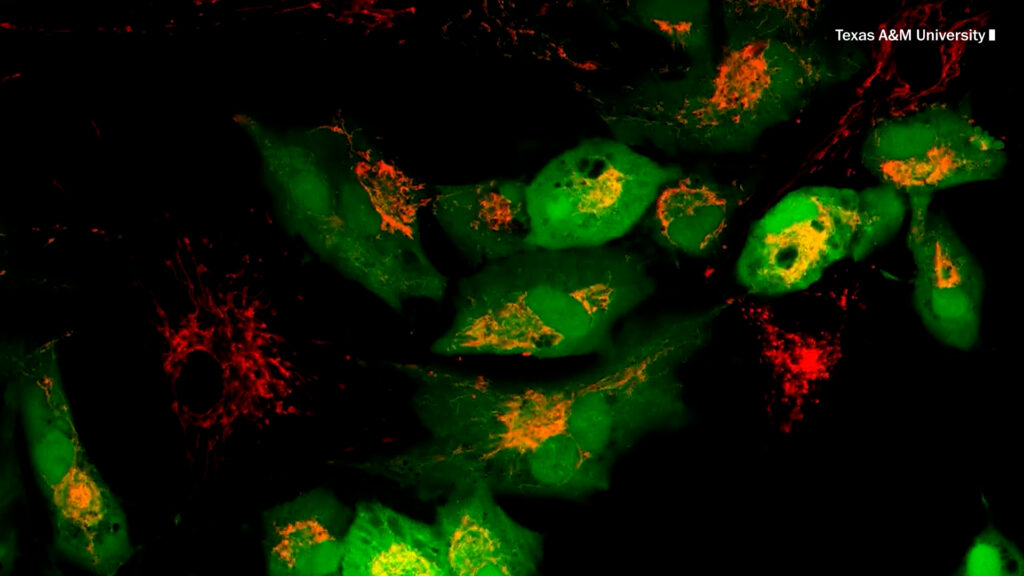
Aging taps us on the shoulder in many ways: wrinkles, thinning hair, loss of flexibility, slowing of the brain. But the process also unfolds at a more fundamental, microscopic level, as the energy source inside most cells deteriorates.
Scientists at Texas A&M University have discovered a way to recharge aging and damaged cells, an innovation that could lead to better treatment for a variety of conditions, including Alzheimer’s disease, muscular dystrophy and fatty liver disease.
All cells, except those in red blood, get their energy from the mitochondria found in the fluid that surrounds the nucleus. Sometimes called the powerhouse of cells, the mitochondria play an important role in fighting viruses, starving parasites, and synthesizing amino acids, sex hormones and other important chemicals in the body.
As people age, their mitochondria diminishes, “a primary or secondary contributor to multiple aging-associated disorders, neurodegenerative diseases and metabolic conditions such as diabetes,” according to Akhilesh K. Gaharwar, a professor of biomedical engineering at Texas A&M and one of the authors of a study recently published in Proceedings of the National Academy of Sciences.
Gaharwar and his colleagues created mini mitochondria factories by adding microscopic flower-shaped particles called nanoflowers to a lab dish containing stem cells. The nanoflowers, which are 600 to 1,000 times smaller than the width of a human hair, get taken into the stem cells through a natural process similar to the way cells absorb nutrients.
The nanoflowers are made from an inorganic compound called molybdenum disulfide, which is able to trigger the process cells use to make more mitochondria. However, nanoflowers enable the stem cells to produce double the normal amount of mitochondria, which they then transfer to ordinary aging or damaged cells.
Mitochondria experts said the study represents an important advance.
“The fact that you can increase the number of mitochondria per cell is huge,” said Daria Mochly-Rosen, a professor in Stanford University’s department of chemical and systems biology who was not involved in the study.
Mochly-Rosen, who co-wrote a book on mitochondria called “The Life Machines: How Taking Care of Your Mitochondria Can Transform Your Health,” said her own research led her to conclude that “knowing what mitochondria can do for us can change the future of medicine, and I think [the new study] is an example of that.”
The process described by the Texas A&M team exploits the natural ability of battery-like mitochondria to transfer from one cell to another.
“We are supercharging stem cells so that they can donate these batteries to damaged cells at a much higher rate,” Gaharwar said.
The stem cells, he said, “have a homing ability. Whenever they see damage, they go and settle down over there and they basically try to regenerate the damaged area.”
Scientists carried out the procedure using different cell types in a lab dish. Gaharwar said he and his colleagues hope to begin testing the technique in rats in January or February.
The method would need to show safety and effectiveness in clinical trials before it could be used to treat people.
Existing medications can increase a patient’s mitochondria, but most don’t change how the cell produces or maintains mitochondria. As a result, the treatments must be taken multiple times.
If the new method receives clinical approval, doctors could use it to supercharge a patient’s own cells, Gaharwar said. The patient’s skin cells, for example, could be removed and reprogrammed into stem cells, the raw building materials that develop into skin, bone, cartilage and blood.
The stem cells could then be supplied with mitochondria-boosting nanoflowers in a lab dish and given back to the patient. The newly energized stem cells would circulate through the body providing mitochondria to stressed or damaged cells.
Having new mitochondria could help aging nervous system cells communicate better. In a person with diabetes, the addition of fresh mitochondria could help cells process glucose faster, Gaharwar said.
His lab is collaborating with three other labs that specialize in muscular dystrophy, fatty liver disease and nervous system disorders.
Mochly-Rosen said she wondered whether the nanoflowers themselves could trigger mitochondria growth without having to be used in stem cells. “Provided that the nanoflowers are safe,” she said, perhaps they could be injected in a specific area to help injured or stressed cells achieve faster wound healing. She said it will be important to pinpoint how long-lasting the benefit is from this method of boosting mitochondria.
Keshav K. Singh, founding editor in chief of the journal Mitochondrion and director of the Cancer Genetics Program at the University of Alabama at Birmingham, called the study promising but cautioned that it is still in the early stages. Singh, who was not involved in the paper, said the long-term safety of molybdenum disulfide in humans is unknown.
Singh established the nonprofit Mitochondria Research and Medicine Society and founded a Birmingham-based company called Yuva Biosciences. The company has developed products that restore the function of mitochondria to fight hair loss and wrinkles, but Singh dreams of starting what he calls a human energy project.
“Improving mitochondrial function can really extend life and health,” he said. The goal would be to protect, sustain and generate new mitochondria, he said, “and do it for every organ.”
The post The quest to slow aging leads scientists into the powerhouse of cells appeared first on Washington Post.