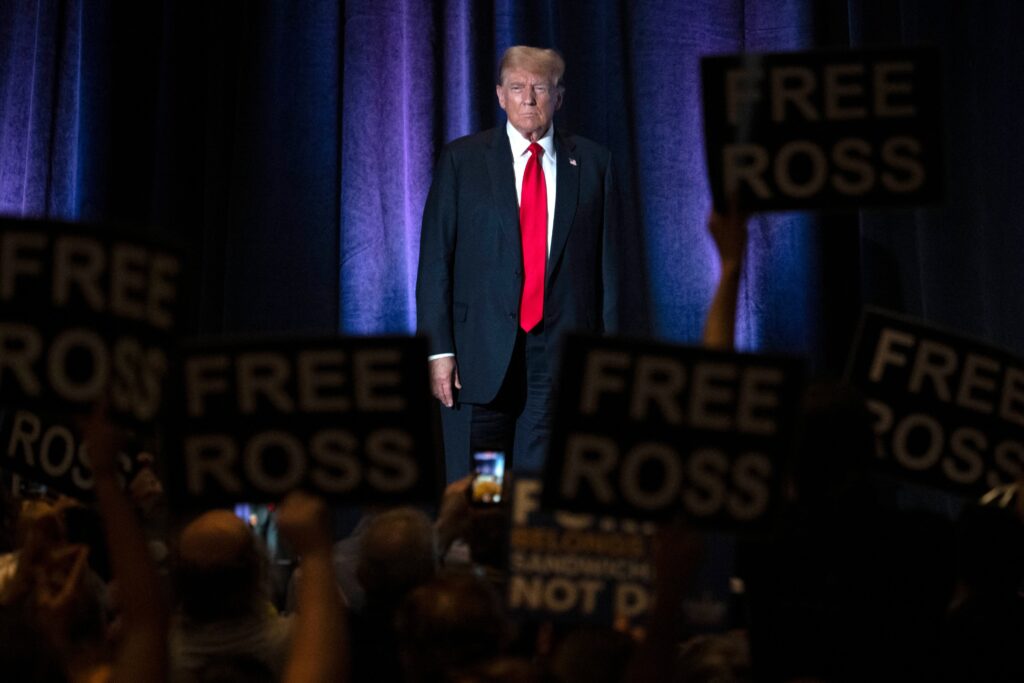
On President Donald Trump’s first full day in office this year, he pardoned Silk Road founder Ross Ulbricht, who was convicted of creating the largest online black market for illegal drugs and other illicit goods of its time.
In the months since, he has granted clemency to others, including Chicago gang leader Larry Hoover and Baltimore drug kingpin Garnett Gilbert Smith. And last week, he pardoned former Honduran president Juan Orlando Hernández, who had been sentenced to 45 years in prison for running his country as a vast “narco-state” that helped to move at least 400 tons of cocaine into the United States
Overall, Trump — who campaigned against America’s worsening drug crisis and promised to crack down on the illegal flow of deadly drugs coming across the border — has pardoned or granted clemency to at least 10 people for drug-related crimes since the beginning of his second term, according to a Washington Post analysis. He also granted pardons or commutations to almost 90 others for drug-related crimes during the four years of his first term, the analysis showed.
At the same time, Trump has threatened military action against Venezuela over accusations that the country’s government is supporting the drug trade and has pushed the Pentagon to conduct targeted strikes on boatssuspected of smuggling drugs in the Caribbean. The contrasting actions have come under fire from Democrats and other critics, who say Trump’s broad use of clemency contradicts promises to get tough on drugs.
“President Trump is claiming to be taking action to stop the flow of narcotics into the United States,” Sen. Tim Kaine (D-Virginia) said on the Senate floor Tuesday, describing the crimes of Ulbricht and Hernández. “… How does this protect Americans from the flow of narcotics entering our country?”
Asked about the contrast, White House press secretary Karoline Leavitt said the pardon of the Honduran president doesn’t make it difficult to defend the administration’s lethal strikes on suspected drug traffickers.
“I think that President Trump has been quite clear, in his defense of the United States homeland, to stop these illegal narcotics from coming to our borders, whether that’s by land or by sea, and he’s also made it quite clear that he wants to correct the wrongs of the weaponized Justice Department under the previous administration,” she told reporters last Monday.
Asked about Trump’s spate of drug-related pardons and commutations, White House spokeswoman Abigail Jackson told The Post that Trump had exercised his constitutional authority, and she attacked former president Joe Biden.
“The only pardons anyone should be critical of are from President Autopen, who pardoned and commuted sentences of violent criminals including child killers and mass murderers — and that’s not to mention the proactive pardons he ‘signed’ for his family members like Hunter on his way out the door,” Jackson said.
Trump and his aides have baselessly claimedthat Biden’s staffers routinely used an autopen to sign pardons and other documents without his knowledge.
Trump has wielded one of the greatest powers of the presidency, clemency, far more this year than he did in his first term. He has pardoned almost all of the approximately 1,500 Jan. 6, 2021, U.S. Capitol attack defendants. He also has pardoned about a dozen members of Congress, mostly Republicans, including most recently Rep. Henry Cuellar (D-Texas), who was charged last year with bribery, money laundering and conspiracy.
By comparison, Trump granted clemency to more than 230 people in his first term, just two of those in his first year.
The pardon frenzy has given rise to a lucrative cottage industry, The Post previously reported. Public disclosures show that lobbyists have spent more than $2.1 million this year on firms that advocate for pardons, clemency and other forms of executive relief — more than double the total spent in 2024. The records also show that individuals seeking pardons have paid up to $1 million to hire people close to the president to plead their case.
Experts say the administration’s efforts to strike boats near Venezuela have not proved effective in limiting the flow of drugs entering the country because the passage is not ordinarily used to traffic drugs to the United States. Drugs containing fentanyl, which has contributed to most recent drug deaths, are typically manufactured in Mexico and smuggled into the U.S. across the land border. The administration has not provided detailed evidence that the boats they have sunk had drugs on board and were heading for the United States.
The administration has claimed that the strikes are an effective deterrent for other drug traffickers. Defense Secretary Pete Hegseth told reporters last week that they paused the strikes “because it’s hard to find boats to strike right now, which is the entire point, right? Deterrence has to matter.” However, experts say there is no available evidence to support the theory that trafficking is down.
“Drug trafficking is like water,” said Regina LaBelle, a Georgetown University drug policy professor and former deputy director of the Office of National Drug Control Policy. “It’s going to find a way to get in.”
Critics of the war on drugs have also long asserted that the government has insufficiently addressed the root cause of deaths in the U.S.: addiction. Advocates have urged the government to invest more in overdose prevention measures, such as naloxone and treatment options.
The rate of overdose deaths has been on the rise for decades, fueled by fentanyl since around 2015, until the end of Biden’s term, when the rate declined.
Advocates warn that cuts to Medicaid and government-supported treatment options could lead to an increase. The Drug Policy Alliance, a left-leaning group, has estimated that at least $345 million was cut this year from federal programs that fund addiction and overdose prevention services.
“At a time we’re escalating these military campaigns and divesting from this health infrastructure, it highlights the contradiction in claiming that these military actions are saving American lives from overdose,” said Theshia Naidoo, the Drug Policy Alliance’s managing director of foreign policy advocacy.
U.S. officials have long asserted that Venezuela President Nicolás Maduro conspired to traffic drugs into the U.S., formally indicting him in 2020. Secretary of State Marco Rubio cited the indictment in a Fox News interview on Tuesday, emphasizing that it was handed up in the Southern District of New York and arguing that “it was undisputed.”
“Until the president decided to do something about it, no one disputed that Maduro was in the drug trafficking business,” he said.
Hernández was also indicted in the Southern District of New York.
Jeffrey Singer, a drug policy expert at the Cato Institute, said Trump has been all over the map on drug policy, pointing to Trump signing a law last month that stiffened restrictions on hemp, a form of the cannabis plant, after saying he backed Florida’s ballot measure to legalize recreational marijuana when he was a candidate.
“There’s no consistency,” Singer said. “He pardons a drug trafficker, but orders the shooting on-site of drug traffickers who are not in this country. In fact, based on that logic, it makes you wonder, why are we wasting our time arresting people in this country for drug trafficking? Why don’t we just shoot them?”
Several Republican lawmakers also expressed skepticism about the Hernández pardon. Sen. Thom Tillis (R-North Carolina) told reporters Tuesday that he thought it was “a horrible message.”
“It’s confusing to say, on the one hand, we should potentially even consider invading Venezuela for a drug trafficker, and on the other hand let somebody go,” Tillis said.
Trump and the White House have attributed several of his recent pardon decisions to an assertion that criminals were treated unfairly, part of the framing of Trump’s view that the justice system has been weaponized against him and others. Trump posted on Truth Social Nov. 28 that he had been told by “many people that I greatly respect” that Hernández had been “treated very harshly and unfairly.”
Liz Oyer, who served as the Justice Department’s pardon attorney under Trump before he fired her, said presidents have long used their clemency powers to shorten the sentences of nonviolent drug offenders who have served substantial time and shown signs of rehabilitation.
But Hernández does not meet that standard, she said, noting his brief time behind bars and the lack of evidence that he has accepted responsibility for his crimes. “The pardoning of drug kingpins is virtually unheard of,” said Oyer, who was fired after she said she refused to restore gun ownership rights to actor Mel Gibson.
Hernández’s pardon — along with Trump’s decision to pardon Ulbricht — underscores what Oyer described as the erosion of the traditional clemency vetting system, replaced by a process increasingly shaped by money, access and political influence.
For decades, pardons and commutations were reviewed by career Justice Department officials charged with assessing whether applicants merited a second chance. While presidents of both parties have sidestepped that system to benefit allies, Oyer said the breadth and consistency of Trump’s interventions mark a departure from past practice, amounting to a parallel clemency pipeline that largely bypasses the safeguards meant to prevent abuse.
Longtime Trump ally Roger Stone — who also received a pardon from Trump after being convicted of lying to Congress about interference in the 2016 election — wrote in a blog post that he forwarded a “compelling letter from Hernández to President Trump because a review of the case led me to the clear conclusion that the charges against Hernández were both politically motivated and false.”
In a text message, he denied receiving any money for his advocacy.
Former Libertarian Party chair Angela McArdle advocated for Ulbricht’s pardon and is seeking pardons for others convicted of crypto-related crimes. She said she thought Trump granted Ulbricht’s release because it was an olive branch to the third party that he had campaigned to vote for him and “a big middle finger to the people who wanted Ross locked up.”
“I think he understood that Ross Ulbricht was a political prisoner,” she said. “It was the same Southern District of New York that locked Ross up that went after President Trump.”
Aaron Schaffer, Theodoric Meyer, Federica Cocco and Julian Mark contributed to this report.
The post Trump pardons major drug traffickers despite his anti-drug rhetoric appeared first on Washington Post.