THE WHITE HOT, by Quiara Alegría Hudes
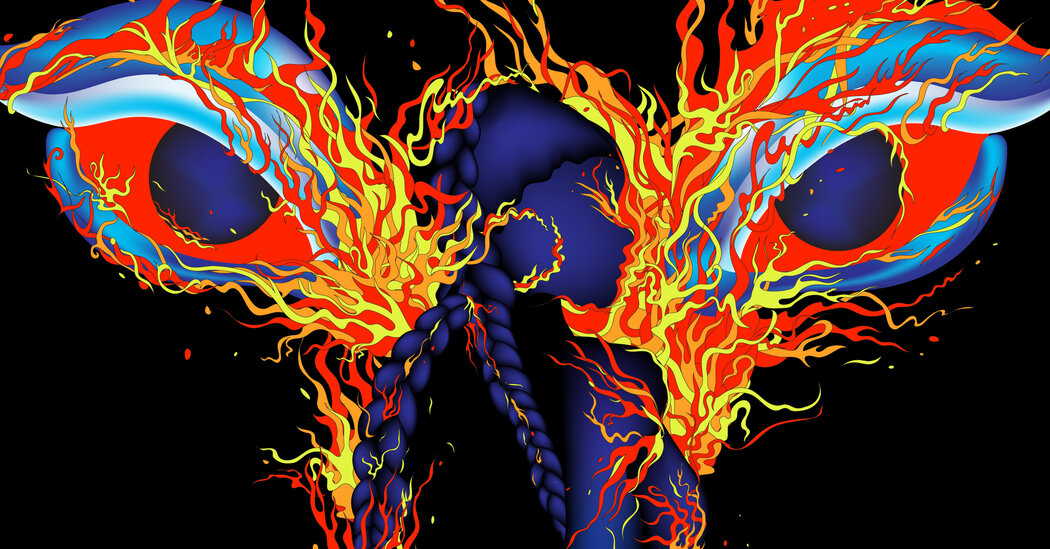
It starts with an electric flicker at the neck, which then blankets the body. A sheath of fury descends, a primal scream dances across the skin.
This is what it’s like to be April Soto at her worst — and her most incandescent.
“The White Hot,” the debut novel by the memoirist and Pulitzer Prize-winning playwright Quiara Alegría Hudes, takes its name from these waves of all-consuming rage. No matter how April, our narrator, tries to smother the feeling — clamping Beats headphones over her ears and blaring sounds of the sea, repeating the mantra “dead inside, dead inside” — she struggles to contain its spread.
And she’s seeing flashes of it in her young daughter, Noelle, who was born when April was 16. Noelle has an intelligence so fierce it is “borderline embarrassing,” and an honest streak that April knows can only bring trouble. April’s own “potential” (does it always sound so condescending, or only when describing fatherless girls?) metastasized into motherhood.
Mother and daughter live in a Section 8 rowhouse in North Philadelphia with Mamá Suset, April’s mother, and Abuela Omara, her grandmother. Four generations of Puerto Rican women have battened and rebuilt after men blew through their lives, and have even taken care to place a rhinestone-crusted baby Jesus in the hall and create a “Zen sanctuary” with plastic bamboo in the bathroom.
One evening, no decibel of ocean calm can quench April’s anger. “Got to go,” she thinks, and is drawn up and away from the dinner table mid-argument, finding herself at the bus station and relishing the minutes there “where being alive was no longer an emergency, or an anesthetic.”
She imagines she’ll be gone for 24 hours: enough time to let a Greyhound carry her to Pittsburgh, have a cup of coffee and come home. It would be the farthest she’s ever been from her family, or even Philly.
She couldn’t know that she’d be leaving for much longer.
“The White Hot” takes the form of a letter from April to Noelle, to be read on her 18th birthday. It’s not an apology but an explanation of her sudden departure and an extended response to the question, “How could love look like leaving?”
April’s journey takes her to astonishing places. A kind, grieving man named Kamal introduces her to Charles Mingus and Jimi Hendrix, and to a type of pleasure she had long thought was impossible; later, he pleads with her to summon all the violence she can and truly hurt him. After the act, as she writes to Noelle, “I blew on my knuckles, cooling them, as though they were your baby food.” Their safe word was “thank you.”
Appropriately for a woman in search of herself, April spends days alone and half-feral in nature, then confronting the people who represent her deepest wounds. Even as she relishes her parental truancy, April is racked with guilt. “I want a decade,” she declares at one point, clawing back the time that motherhood took from her, even as “saying it felt like dying.”
Mothers who leave their children are the third rail of splintered family narratives, and “The White Hot” has the effect of pressing your hand to a barbed live wire. April’s is one of the most memorable voices I’ve encountered in recent fiction: insouciant, observant, endlessly curious.
At one point, she receives whispered suggestions from a librarian regarding absentee mothers both real (Joni Mitchell, Annie Ernaux) and imagined (Medea, Sethe of “Beloved”). But really, she shares more with spiritual journeymen — they are almost always men — like Hermann Hesse’s Siddhartha. (High-school April’s review of that book: “You know what he was? A carefree baby daddy, doing what he felt.”) Hers is an emotional travelogue, a taunt and a dare — can Noelle, can we, handle the consequences of freedom, knowing they come at a devastating cost?
Hudes wrote the script for both the stage and film versions of “In the Heights,” and her play “Water by the Spoonful,” about a Puerto Rican Iraq War veteran confronting his demons, received a Pulitzer. In “The White Hot,” too, she’s unfailingly empathetic toward her characters — even those who, in the eyes of onlookers, need anger management, an exorcism, or both.
The buoyancy and cheer of “In the Heights” are replaced here by April’s sardonic, lacerating wit and Hudes’s brilliant depiction of a woman learning to transform her rage into something resembling transcendence. Siddhartha might call that enlightenment.
Readers know from the opening page that Noelle landed with her father and stepmother, both of whom were absent for the first part of her life. By the time Noelle reads the letter, it’s been years since she last saw her mother. But the return address is up-to-date, and if April decides to stop by, she’d see jars with plant cuttings in the window, a small act of hope for the future to come.
THE WHITE HOT | By Quiara Alegría Hudes | One World | 176 pp. | $26
Joumana Khatib is an editor at The Times Book Review.
The post Notes From a Young Mother, to the Daughter She Left Behind appeared first on New York Times.