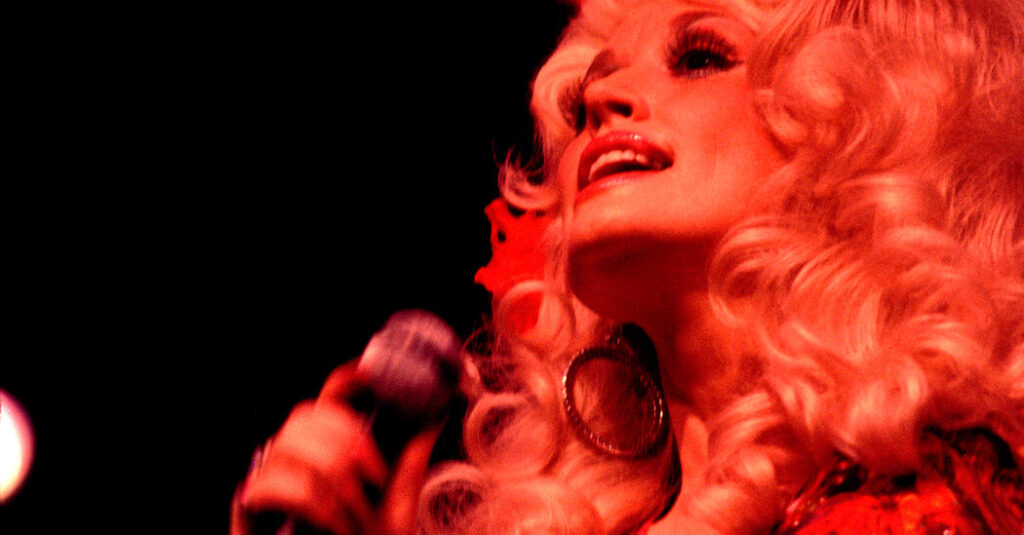
Listen to any recording by Dolly Parton — there are hundreds to choose from — and you’ll always hear one thing at the core. Underlying each tune she sings, and lyric she writes, is the irreducible character of Dolly, a person so palpably genuine she became a virtual synonym for sincerity without ever seeming tedious or naïve. While her fast-fluttering soprano will sound forever girlish, a key part of her gift came from her ability to use that instrument, and her writing skills, to convey every grown-up emotion in the human heart.
The certitude of Parton’s character allowed her to sing and write in styles far beyond the mainstream country category she’s most often associated with. Over a seven-decade career, Parton, who died on Tuesday at age 80, embraced pop, rock, gospel, bluegrass, dance music and more. “I don’t know if my style has a description,” she told the Songwriter Hall of Fame newsletter in 2023. “Except that it’s me.”
Parton’s vast catalog contains no fewer than 49 studio albums which, together, generated 22, No. 1 singles on Billboard’s Country chart. She has been credited with writing over 3,000 songs, some of which have been covered often enough to be considered standards, including the wise “Coat of Many Colors,” the worried “Jolene” and the stalwart “I Will Always Love You,” which became even better known through Whitney Houston’s batten-down-the-hatches blowout from 1992.
Parton’s tandem role as a vocalist and writer, dating back to 1967, made her a seldom acknowledged forerunner of the 1970s singer-songwriter movement that swept to fame stars like Joni Mitchell, Carole King and James Taylor. That role was especially rare for women at the time. In fact, Parton’s debut album appeared six months before Mitchell’s and three full years before King’s.
Here are 15 songs that capture the span and depth of Parton’s recorded work.
‘Something Fishy’ (1967)
On her sprightly debut, “Hello, I’m Dolly,” she wrote, or co-wrote, 10 of the 12 tracks. The first single, a cover of Curly Putman’s “Dumb Blonde,” may have proclaimed that she was far from it but it was another, self-penned song on the set, “Something Fishy,” that made the point undeniable. With a sassy wit, the main character calls out her husband for cheating when he’s supposed to be fishing. “I guess some largemouth bass left that lipstick on your shirt,” she sings. “I don’t think you’re a fisherman, honey, I think you’re a flirt.” Parton’s vocal in the song is as big as her hair, delivered in broad sarcastic arcs that delighted enough listeners to result in her first Top 20 Country score.
 Listen on Spotify, Apple Music or YouTube
‘Just Because I’m a Woman’ (1968)
A key motif in Parton’s lyrics was challenging the sexual double standards of women and men, a subject she approached with as much humor as resolve. In the first single from her second solo album, “Just Because I’m a Woman,” she highlighted the hypocrisy of a boyfriend who demands that she be pure even though his past is far from pristine. “Now I know that I’m no angel/if that’s what you thought you’d found,” Parton sings. “My mistakes are no worse than yours/just because I’m a woman.” For nuance, she delivered the lyric with a cry of hurt that never obscured the righteousness of her viewpoint.
Listen on Spotify, Apple Music or YouTube
‘Mommie, Ain’t That Daddy?’ (1968)
The same month that Parton’s debut album appeared, she became a regular cast member on singer Porter Wagoner’s popular TV show. Four months later, the pair released “Just Between You and Me,” the first of 13 joint albums. Several songs Parton wrote for the set showed her talent for creating opposing characters tailor-made for duets. In “Mommy, Ain’t That Daddy,” she voiced a mother who brings her children to a Goodwill store where they spot a dissolute man, later revealed to be their father, voiced by Wagoner. The result ably blurs the line between screenplay and song.
Listen on Spotify, Apple Music or YouTube
‘In the Good Old Days (When Times Were Bad)’ (1968)
Country music has often made a fetish of nostalgia, but Parton wasn’t having any of that on the title track of her third solo album. As the character reviews her life, she recalls nothing but backbreaking work, ruinous weather, hunger, and illness. The music Parton wrote for the lyric also breaks with tradition, melding country lilts with beauteous folk in the chorus.
Listen on Spotify, Apple Music or YouTube
‘Little Bird’ (1968)
Parton was just 22 when she wrote this aching ode to lost youth. “Beauty is a rare perfume/precious, yet doesn’t last long/Youth is but a playful breeze/that blows our way once then moves on.” To Parton, time flies like a bird, given lift by her fleet vocal.
Listen on Spotify, Apple Music or YouTube
‘Evening Shade’ (1969)
As a lyricist, Parton often acted like a short story writer, fashioning plots rich in detail. She set her song “Evening Shade” at a home for juvenile delinquents who suffer at the hands of a vicious head mistress. In a classic example of country justice, the kids end up burning the place to the ground, an act Parton’s vocal celebrates with relish.
Listen on Spotify, Apple Music or YouTube
‘Just the Way I Am’ (1970)
As both a lyricist, and a public figure, Parton always argued for acceptance of every soul no matter how quirky or hard. She articulated that most directly in “Just the Way I Am” with a character who asks her lover to accept that she might cry at any moment, run mad through the rain, or cut out in the middle of a workday. “My mind and spirit must be free,” she sings over an empathetic melody. The result isn’t just an early feminist anthem but a declaration of independence for everyone.
Listen on Spotify, Apple Music or YouTube
‘Down From Dover’ (1970)
One of Parton’s darkest songs also ranks with her most moving. “Dover” tells the tale of a pregnant teenager who, after being shunned by her family, pines for an absent father she foolishly believes will return. The story ends so tragically that her label wouldn’t release it as a single. That didn’t stop stars like Nancy Sinatra and Marianne Faithfull from covering it, no doubt drawn by the pained detail in the lyric and a rustic, Celtic melody that shudders with consequence.
Listen on Spotify, Apple Music or YouTube
‘Jolene’ (1973)
Every sound and sentiment in “Jolene” remains indelible, from the taut guitar riff that provides its spine to Parton’s escalating pleas to the title character not to take her man. Though inspired by jealousy, the song centers on empathy, with the narrator repeatedly asking Jolene to put herself in her shoes. As a single, it never rose above No. 60 on the pop charts, but it remains a lodestone of Parton’s legend.
Listen on Spotify, Apple Music or YouTube
‘I Will Always Love You’ (1974)
Inspiration ran so high for Parton at the time, she wrote this enduring gem on the same day as “Jolene.” It’s simultaneously a goodbye, and thank you, note to Porter Wagoner for giving her a platform she had, by then, far outgrown. While Whitney Houston’s stentorian delivery of the song treated steadfast love as a slogan, the delicacy of Parton’s take communicates a fathomless depth.
Listen on Spotify, Apple Music or YouTube
‘Here You Come Again’ (1977)
It’s hard to believe Parton didn’t score a major crossover pop hit until a decade into her recording career — or that she needed outside writers do it. But it fell to the Brill Building mainstays Barry Mann and Cynthia Weil to write the buoyant melody that soared the song to No. 3. Still, only Parton could deliver it with such pluck.
Listen on Spotify, Apple Music or YouTube
‘Two Doors Down’ (1978)
One year after her crossover, Parton wrote her own pop hit, focusing on a lonely woman who discovers that the best way to get over a broken heart is to crash a party down the hall and pick up the cutest guy in sight. The high-stepping beat, as well as Parton’s joyous vocal, nail the character’s reborn sexual brio.
Listen on Spotify, Apple Music or YouTube
‘Baby I’m Burnin’’ (1978)
Six years after Elvis Presley enjoyed the biggest hit of his late career with the hard charging “Burning Love,” Parton wrote a song that echoed its fervor and proved she could rock just as hard. Because of prevailing trends at the time, the production added disco flourishes that enhance the ecstatic lyric, mirrored by a firework of a vocal.
Listen on Spotify, Apple Music or YouTube
‘9 to 5’ (1980)
One of Dolly’s catchiest earworms doubles as one of the greatest workers’ rights anthems ever. Everything in it excites, from an opening piano hook as energizing as a morning cup of coffee, to a horn section that pumps like a factory’s pistons, to a vocal that’s stirringly defiant. Parton’s most damning lines — “It’s a rich man’s game no matter what they call it/and you spend your life putting money in his wallet” — could have just as easily have been written by Mother Jones, the firebrand who unionized workers in the coal country Parton knew well from her youth.
Listen on Spotify, Apple Music or YouTube
‘Little Sparrow’ (2001)
You won’t find a purer example of Parton’s vocal power, or deeper evidence of her rural roots, than “Little Sparrow.” To meet the new century, and to toast her father, who had just died, she recorded a stripped-down album in the Americana style. She delivers the first 29 seconds of the title song a cappella before bringing in fiddles, a pedal steel and a rich harmony assist from Alison Krauss. If it were possible to capture the glistening essence of Parton in just one song, this would be it.
Listen on Spotify, Apple Music or YouTube
The post Dolly Parton: Hear 15 Essential Songs appeared first on New York Times.