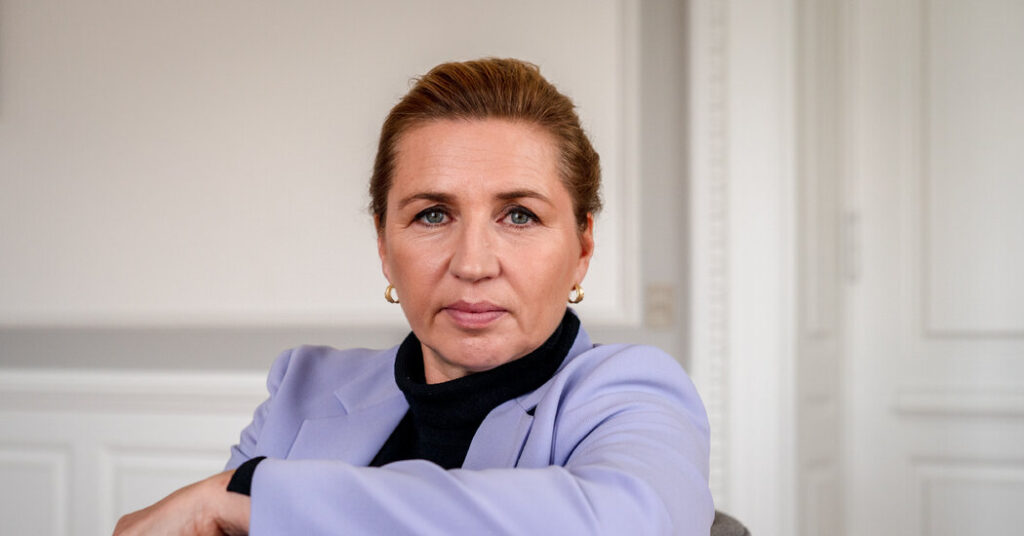
Prime Minister Mette Frederiksen of Denmark had just returned from Ukraine, where she celebrated its Flag Day and pledged continued support for its war against the Russian invasion, when she received a message.
“Do you want to get that little spot on your nose fixed?” it read.
The unsolicited message was sent to Ms. Frederiksen by a plastic surgeon. The prime minister shared it on her Instagram page, slamming the mismatched beauty standards that female leaders are subjected to.
“The last thing I heard as we left Kyiv yesterday was the air siren,” she wrote in the post on Monday, which included a screenshot of the text with the sender’s name obscured. “One of the first messages I got when I was back in Denmark was this one. Come on.”
Ms. Frederiksen, 48, has led Denmark since 2019 and its Social Democratic Party for more than a decade. Elected prime minister at 41, she is the youngest person in Danish history to hold the position. And she has played a forceful role on the international stage, standing up to President Trump’s repeated threats against Greenland, a Danish territory. None of that has insulated her from what is perhaps one of the most pernicious double standards in politics: a woman’s appearance.
“I can’t count how many messages I’ve received over time about my appearance,” she wrote in the post on Instagram, where she has nearly half a million followers. “Especially that I have ugly teeth and thin hair. The fact that I have an ugly ‘wart’ on my nose and good advice on getting Botox.”
She went on: “I’m fine with my body. Such as it is, when you are a woman approaching 50.”
Studies have long shown that female politicians face additional scrutiny over their appearance, and physical characteristics are regularly a subject of news coverage of female leaders around the world, from the United States to Britain and beyond.
“It is harder for women. There’s a double standard, and you can’t complain about it,” Secretary of State Hillary Clinton told Glamour magazine in 2016, during her presidential run. “You just have to accept it, and be smart enough to navigate it.”
In 2018, Prime Minister Jacinda Ardern of New Zealand said she was “unfazed” when an interviewer commented on her attractiveness, which set off a storm of controversy on social media.
In Washington, Representative Alexandria Ocasio-Cortez, Democrat of New York, has often been the subject of scrutiny over her wardrobe and beauty regimen. In 2022, Representative Katherine Clark of Massachusetts said her team debated whether letting her gray hair grow out could be bad for her political career.
“America has been led almost exclusively by gray-haired men for more than two and half centuries,” Ms. Clark said at the time. “But as a woman, my career seemed to be hanging in the balance because I was going natural.”
As for Ms. Frederiksen, she said that she would normally not wade into the subject of physical appearance, but that every now and then she felt “a little old-fashioned offended.”
“If you want to finally write to me (and you are very welcome to do so). Then I hope you will spend your speaking time on something more important,” she wrote in Danish. “Not about my nose.”
The post ‘I’m Fine With My Body’: Danish Leader Responds to Unsolicited Beauty Advice appeared first on New York Times.