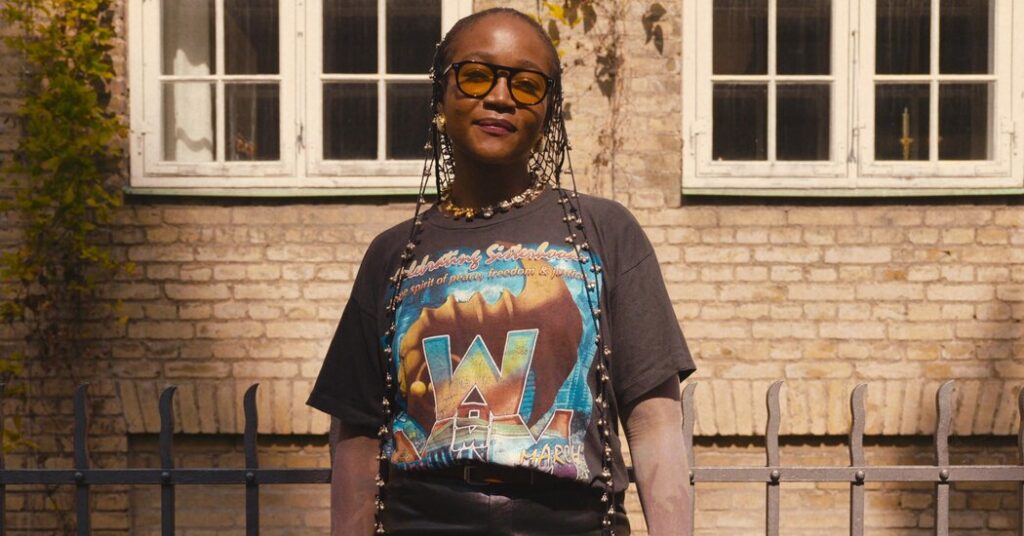
“The more thoughtful you are in your dress, the more conversations you might have,” Kimberly Drew said of using clothing as a social facilitator. She motioned to her black T-shirt from the Million Woman March of 1997 — a gift from her mother. “I just got this shirt and it’s like a badge of honor,” she said. “It’s an opportunity to strike up meaningful dialogue.”
I ran into Drew, a 35-year-old art curator and writer, early this month during a break between runway shows at Copenhagen Fashion Week. There was a mystically eclectic vibe about her look, highlighted by her fishnet durag that she said was “made by nuns” and a necklace that, in the tradition of an Afro-Brazilian religion called Candomblé, resembled popcorn.
She said that one of the things she preferred about fashion over art was its openness to curiosity. In the arts, she said, you’re expected to know everything all the time. “But in fashion,” she continued, “when you ask someone, What’s that shirt?, it’s such an opening gateway. It encourages, I think, a softer type of introductions and a softer type of conversation.”
As a Black woman working in both art and fashion, Drew said that it took her “a long time to learn” how to dress for her differing social and occupational expectations. “I feel sometimes like I push away from the responsibility of visibility,” she said. “But I also inherently understand how invaluable it is, even for myself — seeing other Black women in shows and stopping them to, like, gush over each other is such a poignant opportunity.”
The post A T-Shirt That’s Both a Conversation Piece and a ‘Badge of Honor’ appeared first on New York Times.