THE BLACK SHIELD: An American Memoir of Family and Power, by Wilbert L. Cooper
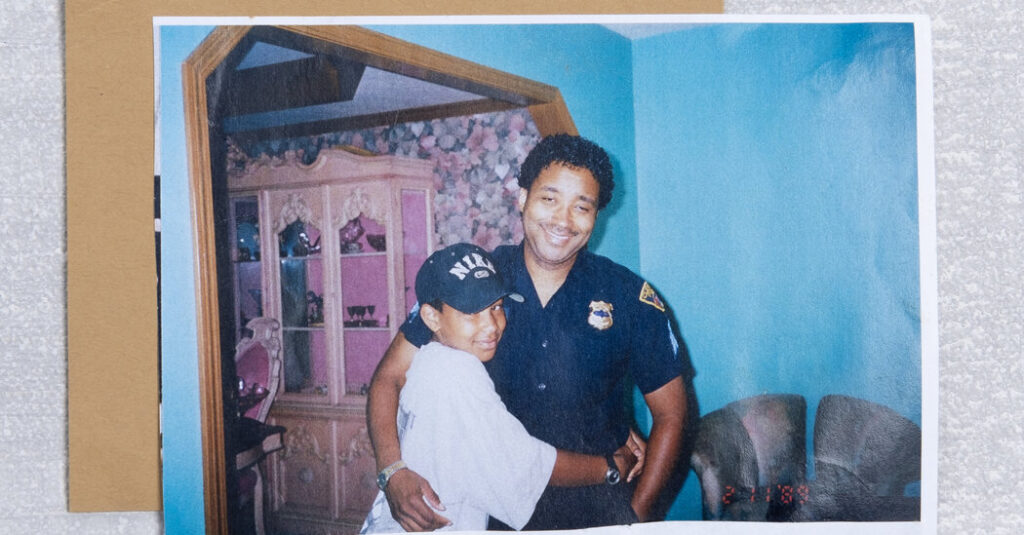
Wilbert Cooper was a teenager the first time he found the weapon. His parents both worked as police officers for the city of Cleveland in the early 2000s, and Cooper was borrowing his father’s unmarked car when he reached into the driver’s side pocket and felt a dense piece of metal about the size of a banana. It was as heavy as a bowling ball, camouflaged for darkness and wrapped in duct tape for easy gripping.
Cooper had grown up around his parents’ city-issued handguns, but the blackjack suggested a more clandestine style of violence. When he asked about it, his father took the weapon out of Cooper’s hands with a smile and showed him how he might use it to crack a suspect over the head.
Instead of following three generations of his own Black family into the Cleveland Police Department, Cooper became a journalist. His reporting over the last decade for Vice and the Marshall Project, among other outlets, has helped document the failures of America’s criminal justice system, including racially biased policing and excessive use of force. All of it eventually led Cooper back to the contradictions at the heart of his own childhood: “to all the questions I’ve been having about Mom and Dad’s profession and the life it has afforded me — and the life it has denied so many others.”
The result is Cooper’s evocative new memoir, “The Black Shield,” in which he tries to make sense of the parents who raised him and the system that made them both targets and enforcers. He embeds with the Black Shield, Cleveland’s fraternal organization for Black officers, and digs through court records to reveal a Police Department that spent decades deploying Black officers in order to change its look but without changing its outcomes.
Cooper is a vivid writer and an unsparing reporter, willing to turn the same scrutiny on his relatives, even when it means exposing them as complicit. His great-uncle Lloyd patrolled the city’s segregated East Side with both charisma and a penchant for violence. “By using it against his own community, he was granted the patina of freedom — money, clothes, impunity on the streets,” Cooper writes.
His most elusive reporting targets are the ones closest to home: his parents, to whom the book is dedicated. His mother, Gayle, grew up in Cleveland in the 1960s with a police force that saw her as “an enemy combatant,” Cooper writes. The city was about 30 percent Black, but its police force was nearly 93 percent white. When officers pulled up at Gayle’s elementary school playground on patrols, she was taught to run. “Everybody would jump fences,” she told her son. “We’d all break out in full sprints. You’d run and run and hide or run and get home.”
By the late 1970s, after a Black Shield lawsuit forced the city to begin diversifying its police force, Gayle was the one giving chase. She was a broke mother of three stuck in an abusive relationship when the Police Department offered her a badge; she worked her way up to vice detective and became an instructor at the police academy.
By the time Cooper was in his teens, Gayle had moved their family into a big house in the suburbs where she kept hundreds of pairs of red pumps in the bedroom closet. She had come to see police officers as the caretakers of a functional society. “I wouldn’t want to live in a world without them, because that world would be chaos,” she said.
But what Cooper is searching for, he writes, is “some kind of redemptive grace.” He hunts for evidence that his parents wrestled with their roles in an oppressive system. Instead, he eventually uncovers his father’s internal police record.
Will was a cocky street cop with shoulders built by hundreds of daily push-ups who often posed for photos with a hand cupped around his crotch. When he discovered his colleagues’ racist graffiti all over the police locker room, he responded with anti-white graffiti of his own. But for all his bravado and righteous anger, he couldn’t transcend the patterns of a racist system. He worked for the department’s Office of Professional Standards, a place Cooper describes as “the department’s incinerator” — where documents, even entire case files, would go missing or disappear. And then, in 2001, he shot another Black man.
The incident began as a routine drug raid, until the suspect drove off and Will spotted the dealer’s Ford Expedition idling at a stop sign. He and his partner were working undercover with no arrest warrant. They chose to open fire, hitting the driver’s side door and the rear window. The suspect fled as Will and his partner chased him through backyards, shooting him in the back and shoulder. Only later did the officers return to the car and discover the suspect’s 3-year-old son safely buckled into the back seat, amid bullet holes and broken glass.
When Cooper reads the incident report, he recognizes the same patterns he’s seen while reporting on a decade of police violence: contradictory statements, hollow justifications hidden behind police jargon, familiar phrases like “I feared for my life” or “he was reaching.” Ultimately, it’s part of another pro forma investigation without consequences.
“I feel as though I don’t know the man,” Cooper writes.
His parents armored themselves to survive a racist country and provide him with a safe, comfortable childhood, but that same armor is what holds “The Black Shield” at a distance. Despite Cooper’s beautiful excavation, the people at the heart of the book stay just beyond reach.
“After the contact high of the discoveries, I was overcome with a hollow, empty, feeling,” Cooper writes. “I wanted to close the distance. But despite all I’d already learned about their world, the space remained.”
THE BLACK SHIELD: An American Memoir of Family and Power | By Wilbert L. Cooper | Farrar, Straus & Giroux | 402 pp. | $32
The post A Son of Black Cops Asks What It Means to Be Both Target and Enforcer appeared first on New York Times.