Look closely at a painting, and you might be able to see where an artist changed their mind. Beneath the finished surface, there may be an abandoned line, a figure moved several inches to the left, a color that looked splendid in the morning and became unbearable by night. There may be a smudgy fingerprint at the edge of the canvas. The back may hold a date, a repair, uneven staples, a signature, or the name of a previous owner. These messy marks were once incidental to the artwork. Today they are considered evidence.
AI can produce an image in nano-seconds, then create hundreds of variations before a painter has mixed a color or cleaned a brush. Some of the results are technically bewildering and others inspire disbelief: How is this possible? Yet their abundance is changing our relationship to novelty. When nearly any visual idea can be summoned on demand, newness becomes easier to manufacture but harder to believe in. In an age of effortless images, the mess left behind by making something may become part of what makes it valuable.
So much recent visual culture can appear at once new and strangely familiar. Generative systems learn from immense archives of existing images, then assemble patterns according to statistical relationships. Their output can startle us, though the surprise often arrives cloaked in a recognizable visual fluency: the cinematic light, the dreamlike architecture, the glossy portrait or the eerily composed impossibility. After enough exposure, even the surreal can begin to feel conventional.
A study presented at the 2024 CHI Conference proffers one perspective about how this happens. Participants who used an AI image generator during a visual ideation exercise became more fixed on an initial example and produced fewer ideas, with less variety and originality, than those in the control group. The study involved only 60 people, so its findings should be treated cautiously, though they articulate something many artists and designers have begun to notice: a tool built to accelerate imagination can also narrow it by presenting a polished answer before a more difficult, original idea has had time to form.
Against this flood of frictionless imagery, fine art acquires another kind of presence. A physical artwork occupies time and holds emotion. An artist stood before it, considered it, changed it, ruined it, waited for it, and eventually decided to either finish or abandon it. All artwork contains a sequence of often messy choices that could have gone in any number of directions. The object becomes a record of attention, and attention is becoming one of the scarcest materials we have.
Researchers have already observed a version of this shift. Across six experiments involving 2,965 people, participants consistently valued art labeled “AI-made” less than work labeled “human-made,” even when the images themselves were identical. Awareness of the machine changed the perceived value of the human hand.
This preference extends beyond art. A 2015 study in the Journal of Marketing found that people considered handmade objects more attractive in part because they believed those objects symbolically contained the maker’s love. The participants were projecting on and responding to an imagined human presence embedded in the object, expressed through the perceived time and care required to make it.
Nostalgia is part of the current attraction to the handmade. We remember darkrooms, paste-up boards, paint-stained clothes, and the physical tools that digital technology has made unnecessary or irrelevant, and often forget the expense and tedium the processes demanded. Still, the renewed power of visible erasure or the pleasure of encountering an unrestrained line reaches beyond nostalgia. These marks allow us to envision the intent and the decisions behind them.
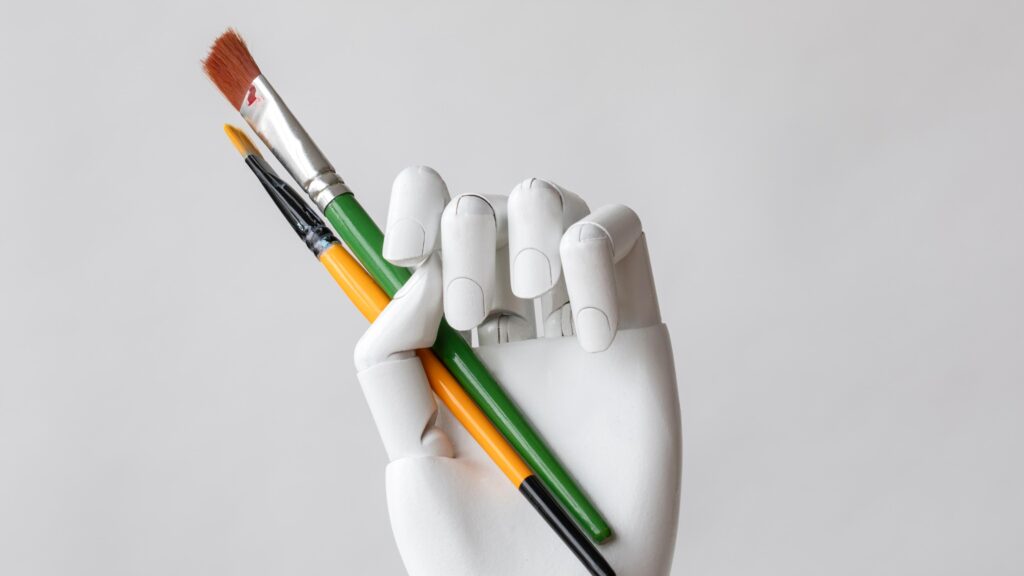
AI can attempt to imitate these marks. It can add a false thumbprint, invent pentimenti, reproduce a stray brush bristle, and generate an image that appears to have survived a century in an attic. But mess itself will soon prove very little. Provenance and an intelligible creative process will become more important as appearance ceases to represent authenticity.
In educated hands, AI can still become a profound artistic medium. Photography and digital tools have disrupted ideas about skill and authorship before becoming vehicles for extraordinary art. AI will be shaped by artists whose choices are specific enough to resist its defaults, and those artists may create work we cannot yet imagine. The presence of a tool has never settled the question of artistic value; the depth and consequence of the decisions made with it still matter.
We are entering a period in which polished images and endless variations are available on command. The works we retain or collect may be those that let us encounter another person’s limits: the place where control faltered or the artist had to surrender to something unresolved.
I think our nostalgia for mess is growing from a hunger for evidence that making something still requires time, effort, commitment, and—dare I say it—love.
The post The Art of Mess in the AI Era appeared first on TIME.