Of late, I’ve seen some arguments for why anyone who is even modestly to the left should quit Elon Musk’s X. Ned Resnikoff, the author of the forthcoming YIMBY manifesto “Build or Die,” offers one version of the case. Musk, he writes, is “deliberately building an immersive environment where far-right extremism is not only present but omnipresent.” To continue posting on X — even from the left, even as a critic of Musk — is to draw eyeballs and energy to a platform that Musk ultimately controls, and uses as he sees fit.
That Musk has turned X into a vehicle for tilting the world’s attention toward his personal politics is self-evidently true. In June, for instance, Musk became enamored of “Citizen Vigilante,” a film in which an American traveler in Europe, played by Armie Hammer, goes on a killing spree against Muslim immigrants and the woke government officials who coddle them. He posted the film free to his account for 48 hours and drove it to the top of various streaming charts and the front of the cultural conversation.
This came not long after Musk pushed the anti-immigrant Belfast riots (“Keir Starmer clearly hates white people,” read one of the messages he amplified), which in turn came amid Musk’s ongoing promotion of Germany’s far-right AfD party (“Only the AfD can save Germany”) and his heavy spending in support of President Trump and the Republican Party. We also know Musk has throttled links to publications he does not like (including this one) and at one point appended a “state-affiliated media” label to NPR.
To what extent are Musk’s views built into how X’s algorithm works? A study led by Germain Gauthier from Italy’s Bocconi University took almost 5,000 U.S.-based X users and assigned them to read either X’s algorithmic or chronological feeds for seven weeks. Users assigned to the algorithmic feed saw more right-wing content and shifted right in their own politics.
That study was conducted in 2023. Since then, Musk merged X’s algorithm with his Grok A.I. and posted much of the code for its algorithm. Opinions differ on whether this is sufficient transparency to be comforted. For me, it’s not. We know Grok has been repeatedly pushed toward right-wing views, including a period in which the A.I. responded to innocuous queries with rants about “white genocide.” Musk is entitled to his politics, but it is naïve to pretend that X under his ownership has been, or will be, a neutral platform. He can change the system however he wants, whenever he wants — and he will.
But the problem with X did not begin with Elon Musk. Appreciating that leads to something perhaps unintuitive: While Musk’s dominance of X poses a danger to the left, it is at least as dangerous to the right. X, like the One Ring in “The Lord of the Rings,” corrupts whoever controls it. Possessing it feels like power, but it ultimately deforms and isolates you.
“Woke 1 was crazy,” Representative Alexandria Ocasio-Cortez recently said, quoting New York City Council member Chi Ossé. Ocasio-Cortez’s explanation for that craziness was Covid and the shutdowns. But what were political elites — particularly progressive political elites — doing during Covid and the lockdowns? Tweeting obsessively. Relentlessly. Constantly.
Putting Twitter at the center of the story fits the timeline better than Ocasio-Cortez’s focus on Covid. The woke era predated Covid — Matt Yglesias’s essay describing “The Great Awokening” was published in 2019 — but its rise was inextricable from Twitter’s. In 2016, Jack Dorsey, then the chief executive of Twitter, wore a Twitter-branded shirt reading “#StayWoke” onstage at the Code Conference, setting off a rush of interest in the term.
At the time, Twitter was dominated by progressive ideas and trends. It was the online home of #BlackLivesMatter and then #MeToo. The platform appeared to be a friend to the organizer and the justice-seeker; a place where the voiceless could be heard and society could be wrenched toward decency.
It turned out otherwise. It’s true that Twitter allows new ideas to rip through society at a speed that would never have been possible before. But it mutates those ideas inside an ideological hothouse, where complex thoughts are compressed down to slogans, the coin of the realm is the cheers of your co-partisans and attention is a function of conflict.
The platform’s algorithmic preference for new and controversial ideas could temporarily lift voices that hadn’t been heard before, but it had no preference for the marginalized and no orientation toward justice. Twitter was, and X is, as happy to be a slingshot for the great replacement theory or anti-Semitism or Islamophobia as for calls to defund the police or abolish ICE. It favors ideas and voices that survive compression, unleash controversy and excite co-partisans. It discards ideas and voices that require nuance or balance competing values and positions.
This is the dynamic Ocasio-Cortez was obliquely describing in her comments. ABC’s Jonathan Karl had asked her about Francesca Hong, the Wisconsin gubernatorial candidate whose candidacy was partly sunk by old tweets that said things like, “Cancel Thanksgiving. Should have done this in 1621. If it takes a worldwide pandemic for us to realize we should stop celebrating colonialism and the original superspreader event that killed Indigenous folx and women so be it.”
But the stridency of that sentiment wasn’t a side effect of Covid-19. It was a side effect of excessive Twitter use. And while Hong’s case was extreme, she was far from alone.
In the 2024 election, Kamala Harris was hammered for positions that had no antecedent in her career as a “smart-on-crime” prosecutor in San Francisco. Today’s raft of democratic socialist candidates find themselves explaining away tweets from the past that imperil their prospects in the present. Zohran Mamdani spent a portion of his mayoral campaign apologizing for lines like “We don’t need an investigation to know that the NYPD is racist, anti-queer & a major threat to public safety.” A.O.C. is going to have to grapple with “Defunding police means defunding police. It does not mean budget tricks or funny math.”
Musk took ownership of Twitter in 2022. But the damage Twitter did to Democrats in 2024, and is still doing to them today, didn’t come from Musk’s tenure; it came from what they said when the platform’s politics were bluer and they confused retweets with persuasion.
In his 1922 book “Public Opinion,” Walter Lippmann argues that the central problem of democracy is that the image of the world inside our heads differs endlessly and unpredictably from the world as it actually exists.
“What each man does is based not on direct and certain knowledge, but on pictures made by himself or given to him,” Lippmann writes. “If his atlas tells him that the world is flat he will not sail near what he believes to be the edge of our planet for fear of falling off. If his maps include a fountain of eternal youth, a Ponce de Leon will go in quest of it. If someone digs up yellow dirt that looks like gold, he will for a time act exactly as if he had found gold. The way in which the world is imagined determines at any particular moment what men will do.”
There is no solution to this problem. The blazing otherness of reality will always defy the simplifications we impose upon it. But the representations we hold in our heads can be better or worse. The Mercator projection that recognizes a round earth is superior to a map that imagines oceans ending in an edge. The Mercator has its problems — Greenland appears as large as Africa, when it is 1/14th the size — but it is an improvement on its predecessors.
My contention about Twitter then, and X or BlueSky or TruthSocial now, is that they shape the pictures in our heads for the worse. The common concern here is disinformation, the lies that spread like wildfire across these platforms. And that is a real problem. But I agree with Henry Farrell, a political scientist at Johns Hopkins, when he writes, “The more important change is to our beliefs about what other people think, which we perpetually update based on social observation.”
What we consider reasonable to say, or even think, is built on what those around us say and think. We are all creatures of convention. These platforms surround us with unreasonable and antisocial voices, which are almost always more interesting than the reasonable and mannered ones. That can lead in useful directions, as every society preserves some injustice through convention and courtesy. But it can also lead in bizarre and destructive directions, as attention begins revolving around people ill-suited to leadership and political elites lose sight of how off-putting their ideas have become.
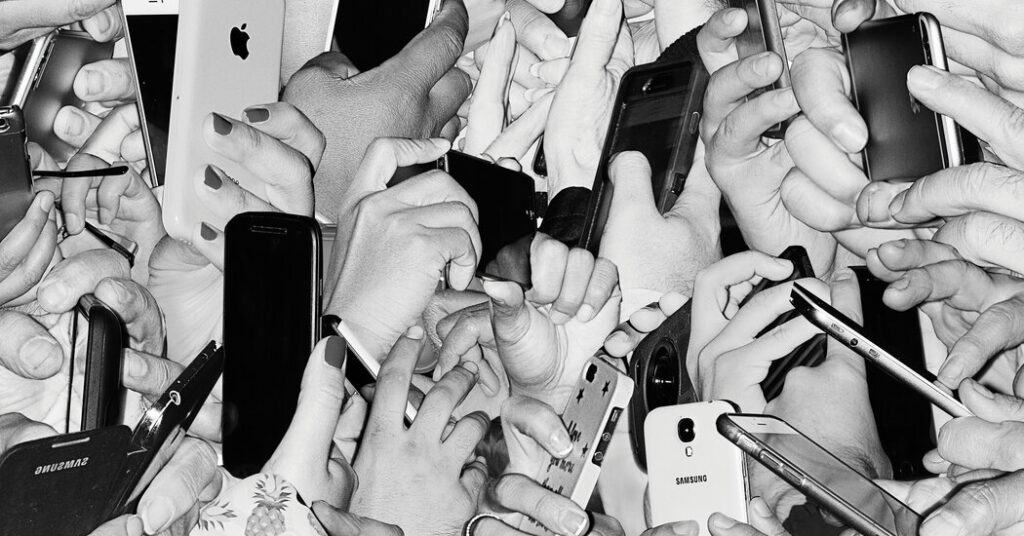
Politics, all over the Western world, has become wilder and worse since we began outsourcing our pictures of the world and each other to algorithms that care only for engagement and profit. Making the overall political communication environment more hysterical and outrageous does not produce more just societies or wiser leaders.
Deliberative habits are good for democracies, but bad for retweets; choosing your words thoughtfully is a virtue for a president, but not for an entertainer or influencer. There is a reason President Obama’s Twitter presence was staid while President Trump’s posts remain electric. There is a reason so many of Twitter’s most addicted users call it “the hellsite,” a reason we describe time spent on it, and on its competitor platforms, as “doomscrolling.”
We know these spaces are unhealthy. We know that we feel worse about our world and each other the more time we spend on them. We just don’t quite know what to do about it.
Which brings me back to Ocasio-Cortez’s comments and Elon Musk. Ocasio-Cortez is able to suggest an amnesty because the comments of the “Woke 1” era are aging. They are recognizably from a different era in politics — one Democrats have learned from.
“I think that during lockdown, of course, rhetoric in that time is not rhetoric that we would use today,” Ocasio-Cortez told Karl. Mamdani, asked by my colleague Lulu Garcia-Navarro to respond to D.S.A. criticisms of Jessica Tisch, responded, “In the many words that you were describing our police commissioner with, the two most important, I think, were ‘very successful.’ ”
The problem the right faces in 2026, and will face in 2028, is closer to the problem the left faced after 2020: Through Musk, it dominates X, and so it has fully exposed itself to the reality-warping, prudence-dissolving effects of the X hothouse. In dismantling Twitter’s guardrails against outright racism and anti-Semitism, Musk has filled the right with Groypers and white supremacists who will be a constant problem in Republican politics for years to come. Democrats paid a price for forming their politics on Twitter; the right will pay a price for forming theirs on X.
This is, I guess, the point in the column where I should call for everyone to abandon X. I have not posted regularly there in years, and I’d urge others to limit their use as well. Nor have I taken up BlueSky or Threads. I find that much time spent on any of these platforms shapes me in ways I don’t want to be shaped. All of these platforms create a feeling of being informed and connected that is fundamentally false. You learn too many of the wrong things and spend too much time in the company of the worst people. An hour spent with a newspaper, a magazine or a book, or in conversation with another human being or listening to people on a podcast, is far more valuable.
But I’ve never been comfortable calling for those kinds of all-or-nothing boycotts. If you think, for your reasons, you need to be on these platforms, or should be on them, or want to be on them, so be it. It’s not like Instagram or TikTok are spotless alternatives, and receding completely from the algorithmic sphere is often unrealistic. My approach to all these places is roughly Frodo’s approach to the Ring: I try to be there as little as possible, and recognize how badly I feel immediately afterward.
Lippmann, famously, never found a satisfying answer to the problems he posed in “Public Opinion.” There isn’t one. The best we can do is maintain a constant awareness that the world in our minds is not the world as it is, and we must be vigilant about how our representation of it is shaped.
The upside of Musk buying Twitter — one I predicted at the time — is that it has broken some of the hold Twitter had on political elites, particularly those on the left, and nothing has really taken its place. No one mistakes the Trumpist fortress of Truth Social, nor the progressive redoubt of BlueSky, for a representative public sphere, and that is for the good. Use these platforms if you must, but don’t mistake them for a map of the world, lest you fall off the edge.
It is not just Woke 1.0 that was crazy. This has been a crazy era, on all sides of politics, because much of it has taken place atop platforms that derange us for profit. Trying to stay as sane as possible requires constant effort. But the alternative is worse.
The Times is committed to publishing a diversity of letters to the editor. We’d like to hear what you think about this or any of our articles. Here are some tips. And here’s our email: [email protected].
Follow the New York Times Opinion section on Facebook, Instagram, TikTok, Bluesky, WhatsApp and Threads.
The post Republicans Are Making the Same Mistake Democrats Did appeared first on New York Times.