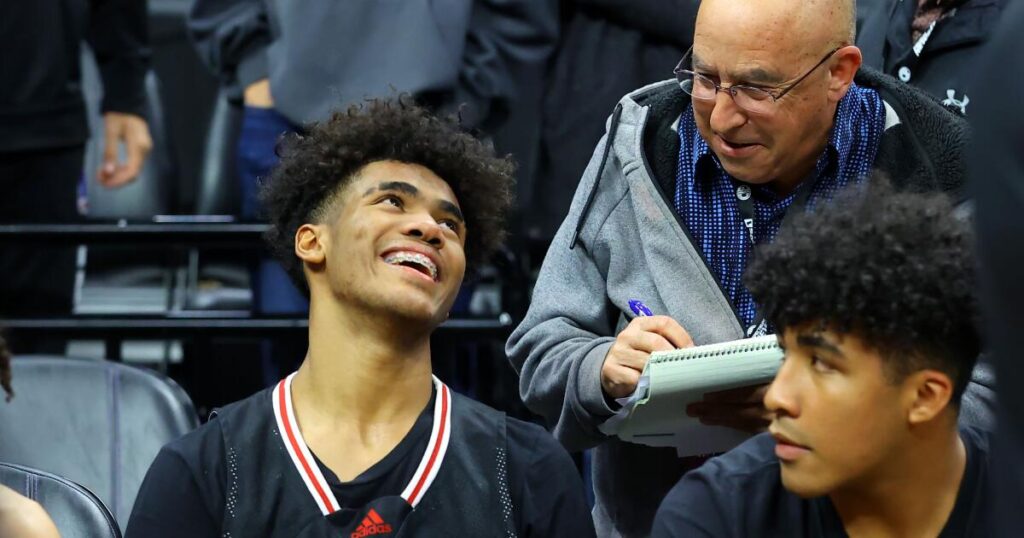
Fifty years in the shadows, gently nudging Southland kids into the light.
“It’s not my story,” said Eric Sondheimer. “It’s their story.”
Fifty years of covering more than 700 high schools like they were the only school, writing about thousands of athletes as if they stood alone.
“Los Angeles is so big, I try to treat it like a small town,” Sondheimer said. “And I love writing about that town.”
Fifty years on messy sidelines, in crowded bleachers, facing angry coaches, locked in ancient stadiums, juggling impossible deadlines, all for the sake of writing deeply buried stories that might be read by only family and friends.
“But when a parent comes up to me and thanks me for writing about their child, it’s the greatest feeling in the world,” Sondheimer said.
Fifty years of childhood tales about countless young athletes, stories about future Hall of Famers, he was their first interview, stories about anonymous benchwarmers, he was their only interview, stories filling dusty scrapbooks and crooked picture frames in parents’ houses all over the Southland, stories about teenage John Elway and whiz kid Tiger Woods and some anonymous sprinter from Taft.
And, now, finally, a story about him.
Let’s all join in a big pep squad cheer — gimme an E! — for Eric Sondheimer’s 50th anniversary covering high school sports in Southern California.
“I just love telling people’s stories, especially those that might not get told,” he said.
He celebrated this story as one might expect, driving all over creation last weekend to cover two league media days, then driving to Las Vegas this weekend to cover St. John Bosco’s opener against Bishop Gorman.
“My job is my life,” says Sondheimer, 67, who has been the chronicler of the sporting lives of three generations of athletes from San Clemente to Santa Barbara.
For the last 30 years, The Times has been the beneficiary of those efforts, as former Valley and Ventura edition sports editor Mike Hiserman smartly grabbed him from his long prep tenure at the Daily News in 1997 and eventually turned him loose on a region that is the greatest athletic factory in the country.
The results can be found today in professional locker rooms around the country, today’s stars never forgetting the 5-foot-4 bulldog who gave them their first headline.
This columnist first realized the scope of Sondheimer’s impact during the 2006 World Series, when a group of Hall of Fame baseball writers gathered around St. Louis’ Jeff Suppan, a former Crespi ace who once delivered newspapers and had a well-known appreciation of journalists.
“Who is the greatest sportswriter ever?” one of the legendary scribes asked him.
“Eric Sondheimer,” he quickly answered to a scrum full of quizzical looks.
He’s been that impactful. He’s been that enduring. Even today, a quick glance at The Times’ library reveals an almost supernatural ability to blanket a beat.
Since joining this news organization, he has averaged about 266 bylines per year. Considering the high school year lasts about 10 months, that’s nearly 27 bylines a month during those seasons, or nearly one story per day.
“Eric is a Los Angeles sports legend,” said Terry Barnum, Harvard-Westlake‘s athletic director. “He is the voice of high school sports in this city and has been for generations.”
Barnum, who has been covered by Sondheimer since he was a prep running back more than 30 years ago, added, “The history of high school sports in Los Angeles can’t be written without Eric Sondheimer. And that’s because he wrote it.”
To understand the depth of this history, one need only to read Sondheimer’s first story for the Times in 1997. It was about the possibility that West Hills brothers Jim and Randy Wolf, both in the minor leagues at the time, could one day be together in the big leagues as umpire and pitcher.
It was a typical Sondheimer scoop long before it happened. Both eventually made it big in the big leagues, Jim still umpiring after 27 years and Randy pitching for 16 years.
“He writes about all these athletes before they become great, he sees it all before anybody else sees it because he goes to so many games,” said Randy Thompson, the Bishop Alemany athletic director and baseball coach who has been covered by Sondheimer for more than 40 years. “His work ethic is incredible. I used to joke about his gas bill.”
There is no more gas bill, because Sondheimer drives a Tesla, but he does rack up a couple hundred miles in a weekend while covering all the bases in an area roughly bigger than at least two dozen states.
All of this, while working a beat that is considered an entry-level job at many larger news organizations. While prep sports is the lifeblood of smaller news organizations, the goal for many young sports journalists in bigger cities is to cover professional and college sports, and many consider prep coverage as the flimsy bottom rung on the ladder to success.
They’re wrong. Prep coverage is the most important stop on any upward path. This columnist’s three years in the trenches were the toughest yet most enlightening three years of my career.
And Sondheimer has done it for a half-century?
“If you can do high school sports, you can do anything,” said Sondheimer. “The first thing I look for when I see somebody hired for a big beat … have they covered preps?”
Although some larger high schools now run their athletics departments like college programs, the basic issues in covering a prep sports event remain unchanged.
You sit in the bleachers or walk the sidelines. You keep your own stats. You decipher your own roster. Afterward, you chase down the coach for a quote, then rush to file your story on a computer on your lap before the maintenance crew turns out the lights and locks you in for the night.
Sondheimer has bloodied his hands climbing over a fence to exit a bolted stadium. He has strained his eyes writing stories in the dark in a deserted gym.
An athletic director once threatened to call the police if he didn’t leave their sideline. His car has been vandalized while crammed in unsafe parking lots. An angry reader once came to his home.
He’s interviewed coaches in bathrooms. He’s filed countless stories from Starbucks. He’s sprinted through crowds and accidentally bumped fans to reach players for postgame quotes, only to discover that the player didn’t match the rostered number or the spelling or the position, all part of Friday night deadline frights.
Yet Sondheimer has endured all of this without fanfare, without a regular TV appearance, without a radio gig, without a regular podcast, without any of the trappings of today’s media stars.
He’s never been offered a chance to cover the Dodgers or the Lakers or even USC or UCLA, and yet it’s never bothered him.
In his dwindling spare time he can be found at the race track, where he’s been part-owner of six horses in nine years. He’s named only one of those horses:
”Dreaming of Hope”
Of course.
The kid who began writing prep stories for the Daily News while still in high school at Sun Valley Poly in 1976, and continued writing prep stories when he attended Cal State Northridge and beyond, says he’s still right where he’s wanted to be.
“I’m not trying to sell myself,” he says. “I like being local. I like staying local.”
Several years ago he became increasingly frustrated with the professionalism that has overtaken the larger Southland high schools — he has been outspoken against the constant stream of transfers — so he had an idea.
What if he cut through all the negativity and submitted a small positive story about high school sports each day? And so the immensely popular “Prep Talk” was born.
“He told me, ‘I have to do something to help and this is it,’” said Iliana Limón Romero, Times assistant managing editor for sports. “The daily dispatches shine a light on a wide range of often overlooked good news in our community.”
One recent Prep Talk was 11 paragraphs about Val Moreno, a man serving his 33rd season on the Servite football chain crew. One of his final Prep Talks last spring was about a Sylmar pitcher and Carson quarterback honoring their single mothers.
Every Prep Talk is accompanied by a photo … taken by Sondheimer, of course.
“Eric … has never wavered in his commitment to covering up-and-coming athletes, greeting each day with seemingly endless energy and curiosity,” said Limón Romero. “He is quick to push back against those he thinks are getting in the way of athletes having a fair opportunity to compete, but he is wary of putting too much negativity into the world at a fraught time.”
In other words … what Jeff Suppan once said.
In case you’re wondering, 20 years after his proclamation of Sondheimer as the GOAT, Suppan stands by his statement.
“Congratulations, Eric, on an incredible career and an incredible run,” Suppan said in a text message immediately after being contacted for this story. “I’m grateful I got to be a small part of it.”
Fifty years, small parts, one giant.
The post Fifty years on the prep beat and still going strong, Eric Sondheimer is a local legend appeared first on Los Angeles Times.