Across Ohio, a state that receded from the nation’s political battle zone as its voting patterns turned an ever deeper shade of red, signs of discontent this year are everywhere.
In packed public forums, residents rage about data center projects. In grocery store aisles, shoppers lament to cashiers how little they can get for $50. In the soybean and corn fields, farmers express anxiety and pessimism. The basics of life and business have gotten punishingly expensive, and many have come to doubt that relief is coming anytime soon.
“It’s all dumpy. Businesses are closing, the roads look like crap,” Kim Hall, 59, said as she shopped at a Dollar General in North Ridgeville, Ohio, on Wednesday. “Grocery prices are outrageous, and I can barely afford to live.”
Frustration like hers is evident in every region and demographic in the state, and it’s why Ohio may be up for grabs in the 2026 midterms. With the general election less than 75 days away, polls show dead heats for governor and a coveted Senate seat. Enough congressional seats are in play for either party to swing control of the House. Come November, the state that once bragged “So goes Ohio, so goes the nation” will find out if it is truly inching back toward purple.
But how voter frustrations will play out is anyone’s guess. Ms. Hall, who worked as a cook at McDonald’s until a kidney cancer diagnosis last year, was once an enthusiast for President Trump. In 2024, she voted for Kamala Harris. This fall, she said she is likely to give up on voting.
“I don’t like anybody,” she said. “I don’t agree with any of them.”
Nan Whaley, a former mayor of Dayton who ran for governor in 2022, said she believes that Ohio Democrats are landing with their message: “You hate everything and you can’t be mad at the Democrats. They haven’t been in control.”
She is reluctant to make predictions, having seen Democrats in Ohio get burned by false hope before, but the vibe is clear.
“People are just so — I’ve just not seen them this pissed,” she said.
On this, even the state’s Republicans agree. Jim Renacci, a former congressman who also ran for governor in 2022, has been flooding his Facebook page with dire warnings to his fellow conservatives. Ohio, he said in an interview, is at heart a state of independents who lean conservative, but those people must be won over at a time when they have a multitude of reasons to stay home from the polls.
“You can get mad at me for posting this. But I am just delivering the message,” he wrote to his followers this month, adding: “The biggest issues for Independents are: Iran War. Gas prices. Food prices. Utility bills. Rent.”
In rural Mercer County on the state’s western border, that list also includes the costs of fertilizer and farm machinery, which were increased by the Iran conflict and the global trade war. Few in the deeply conservative area are inclined to blame the president. But some of the farmers who were loading cattle at the Mercer County fair allowed that business conditions were getting scary, and that was before Mr. Trump announced on Friday that he planned to lower tariffs on foreign beef imports.
Diane Sheets, 77, who splits a 160-acre soybean farm with her sister and works at a travel plaza to make ends meet, said that politicians just don’t seem interested in people’s economic troubles.
“They might understand, but I don’t think they care,” she said. “Do you see them trying to help us any time?”
This same sense of powerlessness is fueling the fury over data centers.
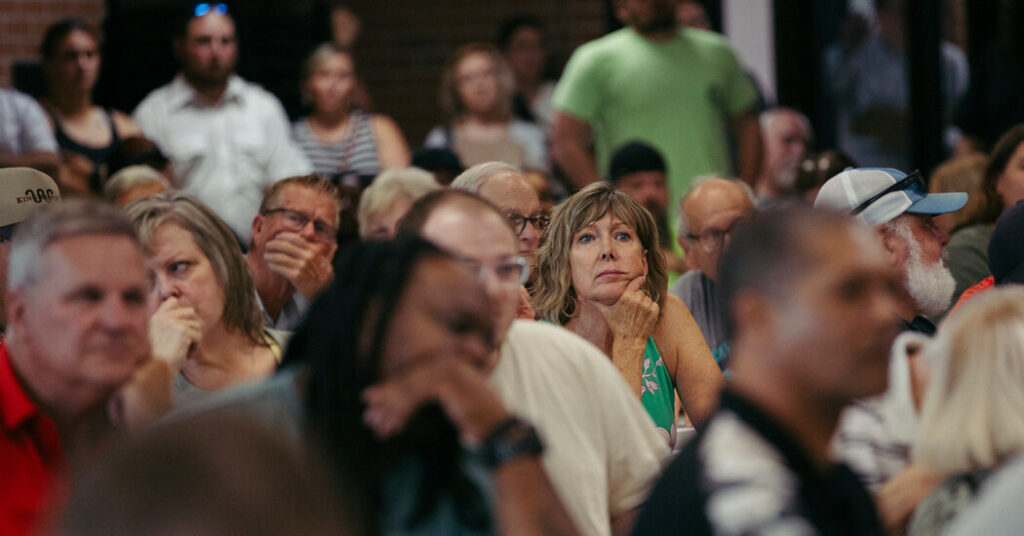
In Millersport, a village outside Columbus, a school cafeteria was packed for a hearing last week about a proposed power plant that would provide energy to a $2.1 billion data center project being built in nearby farmland. The residents in the cafeteria were virtually unanimous in opposition: A Democratic statehouse candidate wearing a Pride pin railed against the process, her criticisms later echoed by an Air Force veteran wearing a “Don’t Tread on Me” shirt with an Infowars logo.
It’s not just in Millersport. Those packing into meeting halls across the state express detailed objections about the ramifications for local waterways, the unfairness of tax breaks and the effects of pollution on children who live nearby. But their protests tap into a deeper conviction — that outsiders are making decisions about their communities without their consent.
“The way things look, it’s hard to have hope for anything, honestly,” said Wayne Harris, 68, whose anger was kindled by a planned 1,550-acre solar farm near Millersport, and burned hotter with the coming of the data center.
In both cases, he said, he learned about a major project in his community only after it was too late to do much about it. Both projects would “ruin” the quiet rural life the local residents had known, he said. He has written letters to the president on down, but he does not expect anyone to step in given the power of the corporations behind the projects.
“They have all the attorneys and all the money,” he said. “They just kind of laugh in your face at you, like, ‘We can do what we want.’”
Mr. Harris blamed the Biden administration for the solar farm and said he did not trust Amy Acton, the Democrat running for Ohio governor. But the backlash to data centers across the state has become so widespread that Republican campaign officials are nervous.
In a recent memo sent to tech companies, first reported by Axios, the National Republican Senatorial Committee warned that Democrats were harnessing the backlash to data centers in the Ohio Senate race, and that they were doing it “because it works.”
In campaign ads, former Senator Sherrod Brown, a Democrat angling for a comeback, has labeled the Republican incumbent, Senator Jon Husted, as “the face of data centers in Ohio.” Ads for Mr. Husted, meantime, have disparaged Mr. Brown’s previous long reign in the Senate, saying “Sherrod Brown is Washington.”
“More than any other thing in this race,” the Republican memo read, “data centers are the anchor hanging around Husted’s neck.”
If the Senate race has Washington’s attention, the governor’s race embodies many of Ohioans’ frustrations. The Republican nominee, Vivek Ramaswamy, captures one element of voter rage: He’s a billionaire who made his mint off pharmaceuticals, finance and technology. But the Democrat, Dr. Acton, carries her own baggage in an environment where trust is in short supply: She guided state Covid policy in the opening months of the pandemic.
While Dr. Acton is fighting the state’s rightward lean, Mr. Ramaswamy is facing a more acute problem: representing the party in power before a broadly unhappy electorate. In a June New York Times/Siena poll of likely voters in Ohio, nearly 30 percent of voters, and 40 percent of independents, said the economy or cost of living was the most important issue in deciding their vote for Congress. In that same poll, people disapproved of Mr. Trump’s handling of the cost of living by a nearly 2-to-1 margin.
Some Republicans say Democratic optimism is misplaced. Years of infrastructure building and G.O.P. control in the state, they say, has given their party a firewall.
“Those built-up grass roots advantages are hard to overcome in one outlier cycle,” said Mark R. Weaver, a Republican consultant and former Ohio deputy attorney general.
In reliably blue Summit County at the cafe of a locally owned health foods store, a group of liberal voters spent hours hand writing postcards to voters, all with the same message, designed to tap into the rage of the moment.
“Dear Eric, While working families struggle, billionaires and MAGA politicians are cashing in,” they wrote over and over, before advocating that Eric — or Heather or Barbara or all the other names on their precisely targeted list — come out and vote for Mr. Brown.
Bill Jordan, a suspenders-wearing retired law professor who has organized postcard-writing events since 2020, used to instruct his companions to write to people in states like Georgia or Virginia, where races felt more winnable. This year, Mr. Jordan, 76, has his hopes up for Ohio. His list was designed to drum up turnout from young people and voters who had cast their ballots for Democrats in the past but typically skipped the midterms.
Taylor Dupont, a 30-year-old software engineer, fell into both categories. Lorain County, where she lives, west of Cleveland, is the only Ohio county that went for both Mr. Trump and Mr. Brown in 2024. Her employer recently told her and around 200 of her co-workers that their jobs were being eliminated. Her child’s school district then cut busing, meaning she’d have to put more miles on her beat-up Kia at a time when gas prices felt outrageous.
Her grocery costs, utility bills and rent on her two-bedroom duplex were all rising, and she didn’t know what to do about it all. But she did know who she blamed: “The president,” she said, “and the billionaires.”
On Wednesday, she was combing through the half-off aisle at Goodwill. She said she planned to vote in the midterms for the first time, straight Democratic, but she hadn’t yet paid too much attention to any of the races. She needed to land another job, get her car fixed, and before any of that, find her daughter outfits for her first week of school.
“Remember,” she told her soon-to-be fifth grader, “we are looking for needs, not wants.”
The post Angry Ohio Voters Could Turn Their State Purple Again appeared first on New York Times.