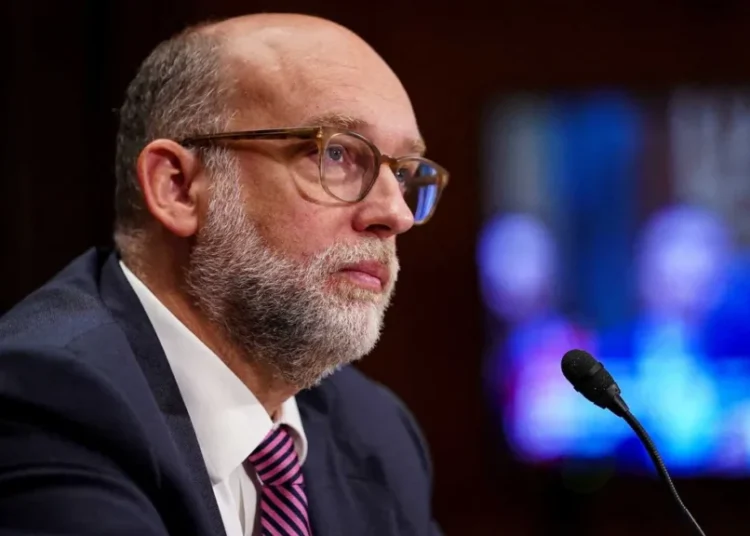
Sen. Jon Husted once promoted data centers as all upside for his state of Ohio. “Data centers are essential to our digital lives,” the Republican said in 2024, praising a planned Google project that he claimed would establish “central Ohio as an important tech hub in America.”
This spring, as he drew nearer to what is expected to be a tight November reelection race, Husted’s view of data centers appeared to change. He introduced a Senate bill that his website promises will “protect Americans from footing the bill for new data centers.”
Husted is far from the only Republican to shift from all-out data center booster to publicly speaking critically about the facilities in recent months, following growing signs that many voters are unhappy about the rapid spread of the computer-stuffed and power-guzzling facilities.
In the past six months, Republicans’ public statements about data centers have turned sharply negative, according to a Washington Post analysis of thousands of social media posts and newsletters from hundreds of politicians from both major parties since April 2024.
That shift follows a similar one made by Democrats, who have mostly focused on the negative effects of data centers since early last year, the Post analysis found.
Some Republican candidates are now trying to take the issue for themselves ahead of the midterm elections by attacking Democratic opponents with accusations they are too soft on data centers.
Last week, Rep. Tom Tiffany (R-Wisconsin), the GOP candidate for Wisconsin governor, made more than a dozen online posts that claimed his opponent, Democrat David Crowley, was too soft on data centers. Tiffany has promised to end tax breaks for the facilities; Crowley wants more regulation and for communities to get to choose whether to accept new data centers.
Stacy Garrity, the Republican nominee for Pennsylvania governor, has called Gov. Josh Shapiro, who is seeking reelection, “the biggest data center cheerleader in the nation.” On Tuesday, Shapiro announced new data center restrictions. Shapiro’s spokesperson said Garrity had a “long record of supporting completely unregulated data center development.” A spokesperson for Garrity said she had believed Shapiro’s prior statements on data centers but later discovered he hid their impact on local communities.
A spokesperson for Husted said in a statement that the senator’s position had not changed. “He has always believed that it should be up to the local communities whether or not they want new data centers,” the statement said.
The National Republican Senatorial Committee warned Tuesday in a memo obtained by The Post that “Data centers are the anchor hanging around Husted’s neck,” and could cause him to lose.
A poll conducted in June and July by the Annenberg Public Policy Center found that nearly half of Americans strongly opposed any construction of them in their area.
Honeymoon period
Two years ago, when only a third of Americans had used an AI chatbot, lawmakers rarely mentioned data centers online. When they did, it was generally to celebrate the arrival of one of the facilities in their district, talking of jobs, investment and the future.
“I was excited to celebrate the opening of the Meta Data Center in Cheyenne that will help Wyoming be on the ground floor of cutting-edge technology and boost our economy,” Sen Cynthia Lummis posted in July 2024.
“Illinois is fast retaking its place as the home of high-tech, high-growth industries of the future,” Gov. JB Pritzker (D) wrote of the groundbreaking of a new data center in October that year. “That means good-paying jobs and economic opportunity.”
After President Donald Trump returned to office with support from major AI investors last year and declared that he had “inaugurated a golden age for American manufacturing and technological dominance,” the number of Republican politicians posting about data centers more than doubled in the first half of the year. In that period, more than 90 percent of their posts and newsletter mentions were positive.
“It is a relatively new issue for most politicians,” said David Karol, a political scientist at the University of Maryland, who wrote a book about how parties shift their positions. “So the politicians are figuring it out, along with everyone else.”
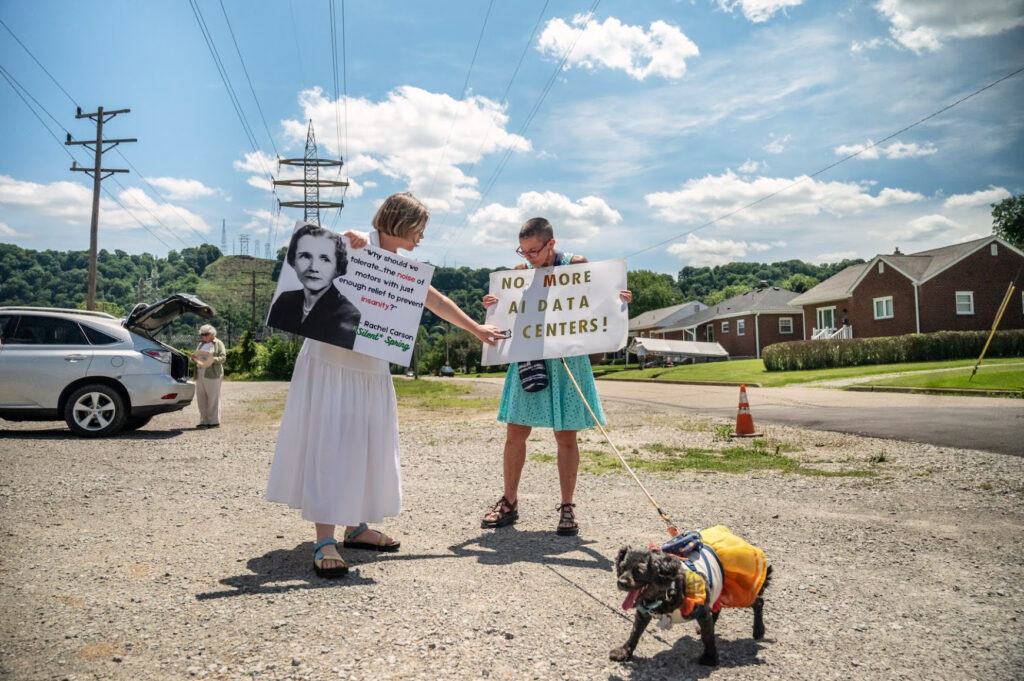
At the same time Republicans were embracing data centers, protest movements were already underway across the country as residents objected to their environmental impact and power usage and Trump embraced them as symbols of a resurgent United States.
Democratic politicians flipped to being mostly negative about the facilities in June 2025.
Five days after Trump’s executive order, Sen. Ed Markey (D-Massachusetts.) wrote “Data centers are eating up our electricity—and unless we do something about it, we’re going to keep paying the bill for their meal.”
By January of 2026, more than eighty Democratic politicians had already spoken up online about data centers and the vast majority of their 400 posts were negative. The most common criticism was their alleged role in hiking electric rates.
As pushback against data centers grew louder, they became a bogeyman for Republicans too. In February this year, twice as many comments were about data center’s costs than their benefits. More than half of Republican’s posts that month cited rising power bills. Others focused on subsidies and tax breaks for data centers or painting them as a threat to agriculture and the rural way of life.
Tiffany did both in March, writing “NO subsidizing data centers on Wisconsin farmland” in a post that listed them as threats alongside green energy and Communist China.
Many Republicans have also cited cases where data centers — or electrical infrastructure meant to serve them — led to people having homes or farmland taken via eminent domain.
“Eminent domain is government theft. I am NOT letting Big Tech steal our homes for their ugly data centers,” wrote Rep. Nancy Mace in June.
“I warned about these costs long before the media turned this into a national conversation,” she said in a statement to the Post.
Longtime supporters of data centers in both major parties are still updating their stances.
Texas governor Greg Abbott recently began calling for restrictions on data centers — after years of promoting them.
Illinois’ Democratic governor Pritzker did too. A spokesperson for Pritzker, said in a statement that “Responsible governance means reassessing incentives when circumstances change.”
Data centers still have some friends
Sen. Bill Cassidy (R-Louisiana) is still praising Meta’s data center in Richland Parish in northeast Louisiana: “Economic growth increases the tax base and sales tax revenue” and saying “Teacher bonuses there are up to $50,000 this year.”
Others focus on the need to compete with China. “Ask yourself who benefits when Americans turn against data centers. China does,” wrote Rep. Eric Burlison (R-Missouri) in June.
Several politicians tipped as likely to run for president in 2028, have mostly stayed silent on social media about data centers.
Sen. Jon Ossoff (D-Georgia) doesn’t appear to have posted about them, although he did write a letter to federal regulators about Georgians’ rising power bills. Neither has Secretary of State Marco Rubio. JD Vance’s only post on X about data centers is from 2021.
California Gov. Gavin Newsom has taken more of a middle road. He has mocked Trump’s stance on data centers, tweeting “Trump is burning more coal to run data centers. Welcome to the Golden Age!” But in a June episode of his podcast Newsom praised construction jobs building data centers as “legit.” He also noted concerns about their impact on power bills but added that rates they had already been growing.
Rep. Ro Khanna (D-California), whose district spans Silicon Valley and has said he is considering a 2028 run, in 2025 spoke in favor of building more American data centers. He criticized a Trump administration AI deal with the United Arab Emirates by asking: “Why are we putting data centers and research hubs in Dubai? We should have those high-paying new technology jobs in the United States.”
By June this year, Khanna had adopted a more critical and populist view, calling for “An end to data center extraction taking a community’s water and jacking up their bills, sucking all the money in the hands of a few tech billionaires.”
Khanna did not respond to a request for comment.
Karol, the political science professor, said this kind of shift is more common in politics than is commonly understood. “Politicians generally think it is in their interest to take the currently popular position. They react and they do update.”
Evan Halper and Scott Clement contributed reporting.
About this story
The Post analyzed 4,300 social media posts and newsletters matching the phrase “data center” from politicians from July 2024 through mid-August 2026. The posts, collected across a variety of social platforms, were provided by the National Conference on Citizenship; the newsletters were collected directly by The Post.
Posts and newsletters were classified as positive, negative, or neutral using an AI model (GPT 5.6 Luna). The AI model classified posts as negative if it focused on data centers’ downsides and positive if it focused on their benefits. The model got an accuracy rate of 90 percent on a hand-labeled set of 200 posts. Errors mostly occurred on posts that contained arguments both for and against data centers or that implicitly criticized other politicians’ stances on data centers. Posts classified as “neutral” were excluded from the visualizations.
The post See the moment when Republican politicians turned against data centers appeared first on Washington Post.