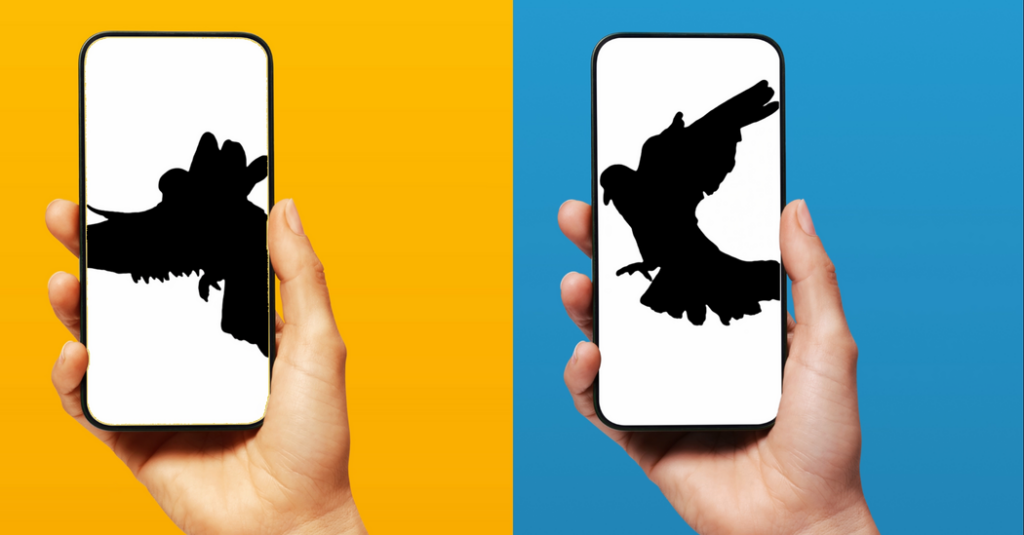
The carrier pigeon was halfway across the Atlantic Ocean, soaring toward Toronto. Its message, sent from London, would take more than a day to arrive.
But when the letter landed, it was not untied from a spindly leg but rather opened in an app, because this pigeon was digital, not physical.
A lot of time has gone into speeding up human communication, from the telegram to the Pony Express to shouting loudly from a rooftop. Lately, at least two apps have asked: Was a carrier pigeon the pinnacle?
One of the apps exploring this idea is Carrier Pidge, an app that allows users to send messages at the speed of pigeon. Users track their bird on a map as it whips toward its destination.
Like real birds, the digital pigeons have a chance of getting lost or dying — 0.2 percent. Buying a new one within the app will run you 99 cents.
As it turns out, this slower, riskier and costlier version of messaging has wide appeal.
“Some things are better when they’re worse,” said Olivia Macdonald, 27, who uses the app to send messages to her boyfriend. Her texts arrive in minutes — they both live in Manhattan — but the chances of the pigeon disappearing adds intrigue, she said.
“The uncertainty of that, compared to the numbness that we feel receiving so many texts and notifications a day, is something that I just find really attractive about it,” Ms. Macdonald said.
Carrier Pidge, which launched in April, exploded in popularity this month after a post about the app by its developer, Noah Iarrobino, was shared by thousands. After several months with only a couple hundred users, he said, the app now has more than 75,000.
Another app released in April, Roost, which lets users send texts via such animals as including pigeons, snails and penguins, reported that it has reached 650,000 downloads this month.
Both apps have connected with users who are tired of the daily digital grind.
“I was probably inspired by a trend going on in tech — people want to get away from their phones and get outside,” Mr. Iarrobino, 29, said of how the idea came to him. “I thought carrier pigeons were a funny concept, and it would be funny if some of them didn’t make it back.”
Mr. Iarrobino, a software engineer in New York, had developed other apps: One that charges users 99 cents every time they hit snooze on an alarm, another that keeps a leaderboard among users of who touches their phone screen the most in a day.
The first message he sent on Carrier Pidge was to a friend in Chicago — an image of a leotard-clad Danny DeVito from the TV show “It’s Always Sunny in Philadelphia.” Delivery time: 8 hours and 49 minutes.
The speed of each message varies, with a maximum speed of 110 m.p.h. (Mr. Iarrobino said he researched racing pigeons and found one named Bolt that had been recorded at that pace.)
Roost was designed by Logan Mendelsohn, a 31-year-old product manager. Unlike Carrier Pidge, the app offers over 1,000 animals to choose from, with the speeds to match. (A white Italian snail crawls at a little over one mile an hour, while a barn owl flies at about 20 m.p.h.) It has a “pen pal” feature that lets users meet and message new people.
“My focus is leaning in toward the slow-tech movement, leaning into areas that help people around the world connect,” said Mr. Mendelsohn, whose career has been focused on trust and safety in tech. He said Roost has gotten so big that he is planning to hire employees.
There has been some flag-planting in online comments sections from fans of Roost, who accuse Carrier Pidge of copying the concept. But Mr. Mendelsohn and Mr. Iarrobino said in interviews that neither took ideas from the other and that they have discussed their apps with each other.
Their apps appear to have tapped into a palpable discomfort with screen time and constant communication, and a yearning for an antiquated era.
A 2023 survey conducted by the Harris Poll, in partnership with the Human Flourishing Lab at the Archbridge Institute, found that 80 percent of Gen Z adults — those born after 1997 — were worried that their age group relied too heavily on technology. Fifty-eight percent said that new technologies were more likely to drive people apart than unite them.
“A lot of the digital tools that saturate our attention at the moment were built on the idea that friction is bad,” Cal Newport, a professor of computer science at Georgetown University and the author of “Deep Work,” said in an email.
“The human brain cannot function well in a friction-free world,” he said. “Too much information coming at us too fast overwhelms our ability to switch our attention.”
By reintroducing friction through apps like Carrier Pidge and Roost, Mr. Newport said, messages can be thoughtful and given the attention they deserve.
Ema Siddique, 28, deleted most of her social media accounts about five years ago after wondering if constant availability meant that her most important connections were not being tended to enough. When she learned of Carrier Pidge, she saw it as a natural extension of that mind-set.
Her pigeon was the one careening from London, where she lives, to a friend in Toronto (she messages another friend with the app who lives in Kuwait). Ms. Siddique and her friends don’t take the texts too seriously, but quickly began to use old-timey, “Bridgerton”-esque language, referring to one other as “my dearest lady.”
“It’s similar to a letter in the sense that you spend a lot of effort, and it does feel like every word that goes into it is intentional,” Ms. Siddique said.
She added: “You can track it, which adds to the excitement. I have one Carrier Pidge on the way from Kuwait, and you think, ‘What is she going to say in the next one?’”
The post Sick of Constant Pings, They’re Sending Texts at the Speed of Carrier Pigeon appeared first on New York Times.