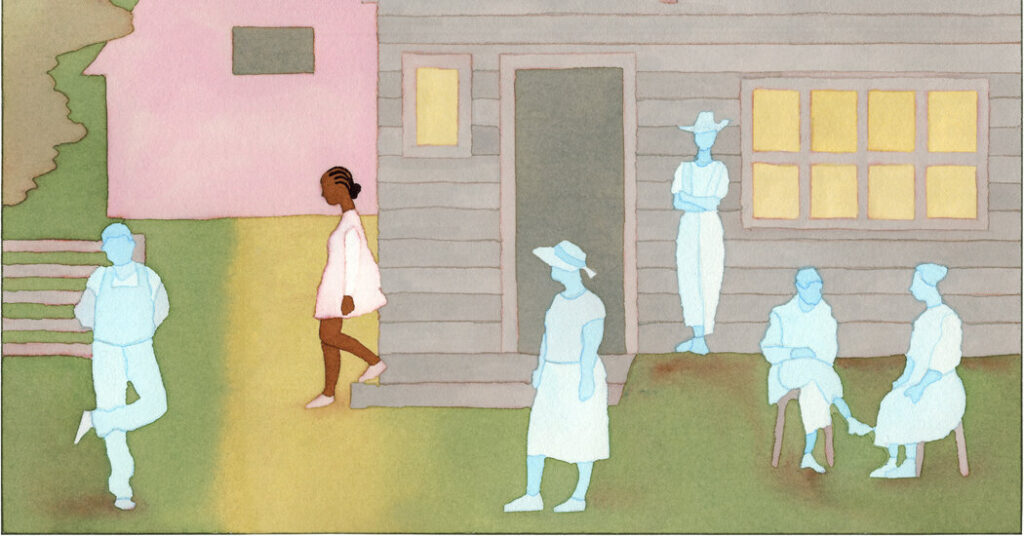
THE GREAT WHEREVER, by Shannon Sanders
Shannon Sanders’s debut novel, “The Great Wherever,” opens with a surprise. A ghost in a Lycra dress is spilling everything she knows about her pretty but hapless 32-year-old cousin, Aubrey, newly fatherless, who went to dinner on a rainy night in an itchy “strappy teddy” expecting a marriage proposal from her rich white boyfriend but got dumped instead. That’s the early voyeuristic premise of the story, and it’s delicious, right?
But gradually the book transcends this fizzy surface. This ghost cousin isn’t only dishing about Aubrey — her tale spans centuries, covering eight generations of their family, and her yarn is made majestic by her intimate renderings of the inner workings of their kin’s minds and hearts.
The narrator is one of four Lamb family ghosts, united by their “insatiable love of gossip.” Stripping the ghost conceit of any unnecessary mystery, she explains up front: “At the heart of all of this is a family farm, a share of which was supposed to pass to each of us but didn’t because we all died cruelly and too soon.” Now the ghosts are bound to the land and to those who have inherited it — four living cousins, including Aubrey — who are converging on the farm to hear a purchase offer from a development group.
While the living weigh the preservation of their family legacy against the temptations of a sizable payday, the ghosts uniformly object to the sale, fearing an eternity spent inhabiting a Costco. The trick is: With few exceptions, the ghosts can’t contact the living, try as they might. They can only watch as their fate hangs in the balance.
Several tensions animate “The Great Wherever.” We read on to find out whether or not the living will sell the land, but also hoping that the little multigenerational club of Lamb heirs will be a balm for what Aubrey’s grieving: her dead father; her ex-boyfriend and the comfortable life he would have provided; her personal debts; her underwhelming work life. Our ghost-narrator hashes out the tale with an endearing mix of tenderness and resentment — her own promising life was cut short at 27, and now she’s stuck watching her train wreck of a cousin make bad choices.
Woven through this story are enough characters and plotlines to fill several more novels, but Sanders handles the abundance of material with restraint. Our ghost deftly ushers us through the narrative, bouncing from a thriving Black community at the turn of the 20th century to a present-day DoubleTree Inn to the deathbed of an enslaver to the ghost realm. Sometimes she dips quickly in and out of a time and place; other times she lingers, immersing us so fully in a setting or dynamic that I’d forget there were other eras and characters waiting for the spotlight.
The effect is that each return to the will-they-or-won’t-they-sell dilemma becomes layered with new questions: What would the living make of Zena, the Lamb family matriarch, and all that she’d witnessed, first as an enslaved woman and then as the land’s first ghost? If the heirs knew the details of their ancestors’ desires and toils and mistakes, would they still consider selling? Sanders’s plot invites us to ask: What aspects of our lives would come into focus if only we could know the triumphs and losses and patterns of those who preceded us?
Indulge me, in the spirit of our ghost-narrator, in sharing my own aside. Last April my father and brother and I traveled more than 2,000 miles to an archive where we hoped to find records of my enslaved great-great-great-grandparents. We pored over the plantation overseer’s daily journals, scoured sales records, studied correspondence for any scrap of a clue, but we left with nothing. How I wish a cousin-ghost could appear and tell me about my family. (Dress her in a ’90s BCBG dress? Even better.)
While most descendants of enslaved people will never know the names, let alone the stories, of our ancestors, Sanders’s narrative shifts gorgeously through time and place to reveal all that’s been passed down through generations of Lambs. We see their lineage carried on by rituals, like cooking chicken and dumplings; by deliberate remembrance, like hanging the family symbols on a condo wall; by biology, like the erratic and painful menstrual cycles the women in this family share; and by behavior, like the clan’s penchant for placing their trust in the wrong people’s deceptive generosity.
By attaching this wealth of history to Aubrey and the unromantic details of her life, Sanders seems to be saying that every one of us deserves to know from where, and from whom, we came.
THE GREAT WHEREVER | By Shannon Sanders | Henry Holt and Co. | 400 pp. | $29.99
The post These Ghosts Absolutely Love Gossip appeared first on New York Times.