On a sweltering night in late July, a team of scientists gathered onboard the R.V. Pelican in Houma, La., a 116-foot blue-and-white vessel resting in a bed of water hyacinths under a stormy sunset.
As the clock ticked toward their midnight castoff, the scientists raced to set up the last of their equipment in the ship’s small laboratories. For the next week, they would be working 24-hour days in tight quarters to measure what little oxygen was left in the Gulf of Mexico’s infamous dead zone.
The dead zone results from excess nutrients, mostly from fertilizers, running off farmland into the Mississippi River and finally into the Gulf. The size of the oxygen-starved zone changes every year, growing as more nutrients make their way into the Gulf and shrinking when tropical storms or strong currents mix the water.
Nearly every year since 1985, teams from Louisiana State University and the Louisiana Universities Marine Consortium have spent a week at sea mapping the zone. At each of the dozens of sites dotting the coastal Gulf, these teams don hard hats and steel-toe boots and then cast into the sea the box cores, sensors and water sampling bottles that make their work possible.
The route the team takes is the same every year, allowing each crew to contribute to a decades-long catalog of changes in these waters. It’s an invaluable way to see how policies and industry changes have altered biodiversity in the Gulf and nutrient flow through the Mississippi.
This year’s crew of 12 — all students, staff members and friends of Cassandra Glaspie, the principal investigator and an L.S.U. marine ecologist — were eager to join the storied tradition of the cruise and worked frenetically in the hours before castoff.
“The first day is always so exciting,” said Dr. Glaspie, by far the calmest presence onboard. Waiting next to a plastic kiddie pool, where a large metal apparatus lined with seawater sampling bottles was partly submerged for a final test of its sensors, she correctly predicted that they would find a smaller-than-forecasted dead zone this year.
Unfortunately, that smaller size was not the result of improved conditions in the Gulf. Rather, it happened that the cruise set sail just after the tumultuous passing of Tropical Storm Bertha, which churned oxygen into the waters. So this year’s cruise focused not just on generating a map of the dead zone, but also on determining how quickly the process of deoxygenation happens.
“It was re-forming basically as we moved through,” Dr. Glaspie said. “We were surprised that it happened in a matter of minutes.”
Discovering the Dead Zone
The mapping project started with Nancy Rabalais, a marine ecologist at L.S.U., and her quest to understand what was happening in the ocean alongside her native Texas.
A love of crabs led to her early work in ecology, studying fiddler crabs in South Texas, but she soon started thinking about the larger problems plaguing local marine life, including one issue whose effects loomed large but were still unmeasured in the early 1980s: the dead zone.
“Hypoxia was right in my backyard,” she said.
Relics from the early years of the hypoxia cruise filled her office: small comics shakily drawn while onboard the ship, a portrait of her sitting in the deck hammock that research crews used to fight over, a bejeweled gold crown with colorful letters reading “Hypoxia Queen.”
“I wonder who’s going to want all this junk when I clear out the lab,” said Dr. Rabalais, now in her 70s.
Pulling a faded collection of papers from a binder, she unfurled the hypoxia cruise’s original handwritten data tables — hundreds of pale-green rows long since digitized by students. She had a record of every organism found in the early water samples, most identified down to the species.
Soon after joining the marine consortium in 1983, Dr. Rabalais received funding from National Oceanic and Atmospheric Administration to measure the hypoxic area off the coast of Louisiana. It was unexpectedly large — now known to be one of the largest in the world. And the effects on marine life, and the industries these animals support, were striking.
Nutrients running from farms into the Mississippi River are carried to the Gulf, where they encourage the growth of algae. It blooms and then dies, feeding bacteria that gobble up the water’s oxygen.
The long-running crisis endangers marine life and the livelihoods of thousands of shrimpers and fishers. The search for oxygen drives fish accustomed to life near the seafloor to venture higher into the water column, and bottom-dwelling creatures — like shrimp — to migrate to the dead zone’s edges.
This exodus of sea creatures leaves the top layers of the water vibrant and full of life, but the seafloor a practically barren muck.
The larger the dead zone, the farther shrimpers have to venture to escape that desolation at the bottom of the Gulf, increasing fuel use and the costs of other operations. And those added costs are a big problem for Louisiana’s $2.4 billion seafood industry, which is already struggling to compete with the cheap imports flooding U.S. markets.
“Everything we do is expensive, so when fishing and shrimping are challenging, it just drives up the cost,” said Lance Nacio, a shrimping boat captain and the owner of Anna Marie Shrimp in Montegut, La.
The discovery of the dead zone and its effects cemented the need for an annual expedition to keep track of changes over time and led the Environmental Protection Agency to establish a federal Hypoxia Task Force in 1997. The research also pushed Dr. Rabalais into the role of unofficial spokesperson for the Gulf’s crisis.
But the more researchers learned about the dead zone, the more complicated it became to address.
Nutrients have always washed into the Mississippi, but the advent of chemical fertilizers in the early 20th century jump-started a new era in agriculture.
Instead of replenishing the soil’s stores of nitrogen and phosphorus by rotating nutrient-demanding crops with those that require less, suddenly farmers could grow profitable plants — like the field corn used for ethanol, animal feed and corn syrup — year after year.
“It’s really corn’s fault, as far as the dead zone is concerned,” said Matt Rota, who directs policy efforts at the conservation nonprofit Healthy Gulf.
“Corn is a very nitrogen-intensive crop, and it’s also very leaky in that it doesn’t uptake a lot of that nitrogen.”
Courtney Briggs, president of the Agricultural Nutrient Policy Council, which represents farmers, acknowledged room for improvement but said that “farmers and the agriculture industry have been working — voluntarily — for decades” to reduce runoff.
Leaked nitrogen eventually ends up hundreds of miles away in the Gulf. That distance makes it difficult to identify the specific sources of pollution, which in turn complicates efforts by state and federal agencies to address consequences like the dead zone.
So far, there hasn’t been much action to limit pollution across the watershed as a whole, said Christopher Dalbom, director of Tulane University Law School’s Institute on Water Resources Law and Policy.
Without that broad collaboration, the southernmost states along the Mississippi are left to address the damage even as the pollution persists upstream.
“There is limited federal authority to work on it, and even less federal interest or motivation, and so then you’ve got individual states trying to deal with an interstate issue,” Mr. Dalbom said.
Reconstructing wetlands that soak up nitrogen before it reaches open waters can help, said Dr. James Pahl, a coastal resources scientist at Louisiana’s Coastal Protection and Restoration Authority.
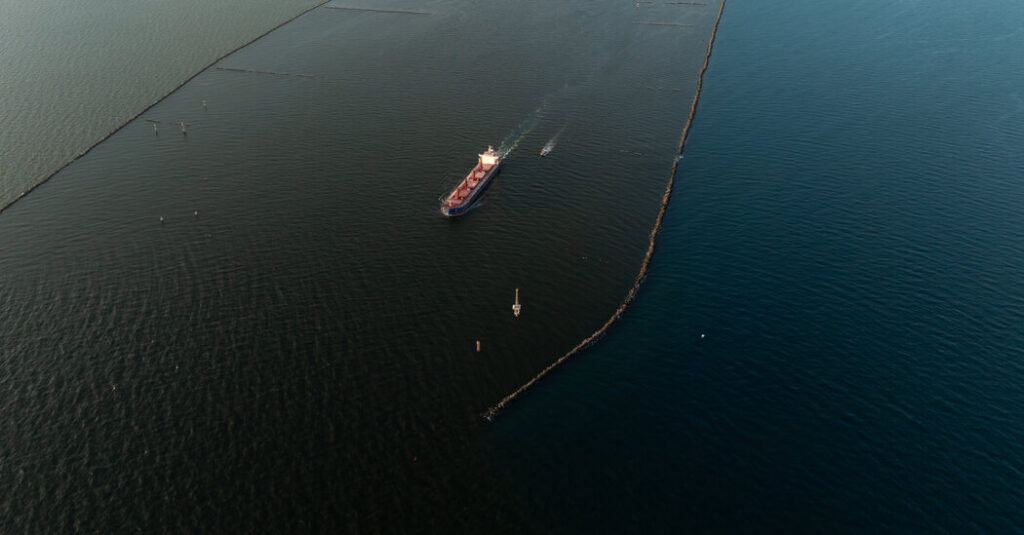
What can also help is making sure the dredged channels in and near the Gulf have gradual sides rather than steep ones, which can block currents that bring in oxygen from elsewhere.
But projects like these can be expensive and logistically difficult, as well as less urgent than other state priorities like shoring up Louisiana’s subsiding coastline, which loses about a football field of square footage to the sea each year.
Bringing attention to the dead zone and its impact is easier now than it was in 1985, said Doug Daigle, coordinator of Louisiana’s state-level hypoxia working group. But finding funding to support mitigation efforts and researchers — including those organizing the annual hypoxia expedition — is still difficult.
Continuing a Scientific Tradition
Connected to an old greenhouse along a quiet road at the edge of L.S.U.’s campus, Dr. Glaspie’s lab is not what one might expect of the research space for a project that so many government and educational institutions rely on.
The building’s facade is similar to that of a strip mall, a nondescript brick building lined with doors. “I had to bootstrap together a lot of our lab equipment,” Dr. Glaspie said. “The lab itself I had to eke into existence.”
Inside, it was much more lively.
In one room, shelves of sediment samples dyed hot pink line the walls around a table where students and staff members gathered, peering through a microscope at creatures found in the estuaries of the Mississippi River.
The lab’s second room, often flooded, was filled with bubbling plastic tanks housing crabs, clams, fish and other creatures plucked from the Gulf’s waters to measure the effects of various levels of hypoxia.
Dr. Glaspie is famously scrappy in the lab and at sea. This year, when a winch for lowering equipment into the water broke, she strung a pulley system for the students manning the deck. And in years past, she has been able to extend the length of the cruise on short notice, determined to reach the edges of the dead zone even when it’s at its largest.
“She’s a metaphorical octopus,” said Froggi VanRiper, a longtime friend of Dr. Glaspie’s and an environmental systems researcher who joined the hypoxia cruise this year.
But funding even this bare-bones enterprise has grown more difficult in recent years. Because the mapping expedition itself does not have designated funding within NOAA’s budget, it must compete against other programs. And the competition is becoming more fierce as NOAA’s budget declines year over year.
In 2024, NOAA’s budget was approximately $7.1 billion. This year, it was $6.2 billion, and proposed funding for next year is even lower, at $4.4 billion.
“I think about the fact that it might eventually be cut, and what really bothers me is that the people of Louisiana are experiencing and inheriting and facing this problem that is not theirs,” Dr. Glaspie said.
“The people who live near the Gulf of Mexico really deserve to have their finger on the pulse of the problem,” she added. “They deserve to know, so those data need to exist.”
The post Mapping America’s Largest ‘Dead Zone’ appeared first on New York Times.