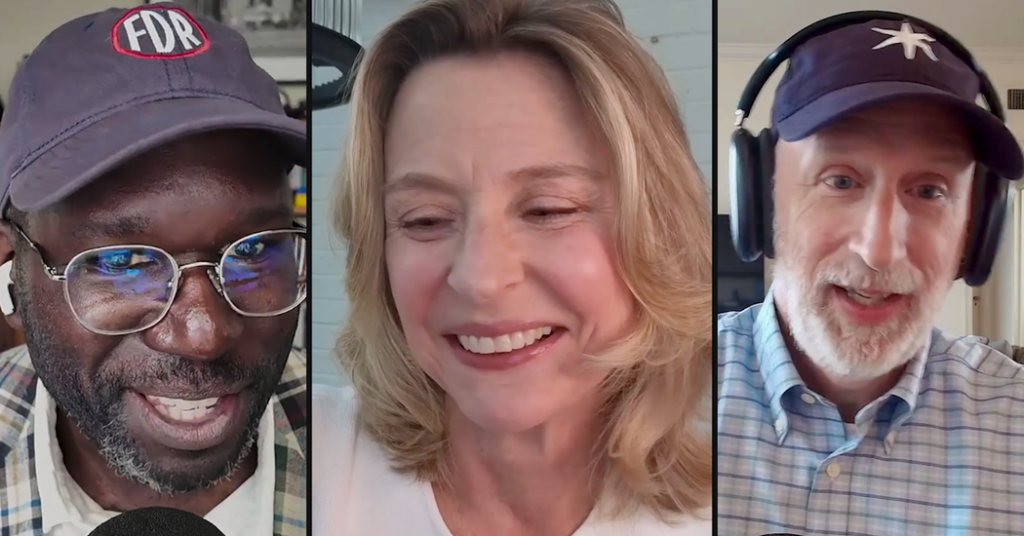
What will the Republican Party become after President Trump? And how can the Democrats rehabilitate their toxic brand? On this episode of “The Opinions,” the Opinion political writer Michelle Cottle teams up with the columnists David French and Jamelle Bouie to dissect party strategy ahead of — and beyond — the midterm elections. Plus, Jamelle divulges the book that fills him with dread.
Below is a transcript of an episode of “The Opinions.” We recommend listening to it in its original form for the full effect. You can do so using the player above or on the NYTimes app, Apple, Spotify, Amazon Music, YouTube, iHeartRadio or wherever you get your podcasts.
The transcript has been lightly edited for length and clarity.
Michelle Cottle: I am Michelle Cottle. I cover national politics for The New York Times Opinion. This week, I’m here with my co-conspirators, David French and Jamelle Bouie, and we are all — as the rest of America — coming up on the end of the midterm primary season in just a few weeks, and what a ride it has been. And what we’ve seen so far is that both parties are wrestling with who represents their future.
So before we figure out who inherits the conservative mantle from Donald Trump, the G.O.P. is going to have to decide what conservatism is going forward, while the Dems need to decide who they are and what they stand for. So I want to dive in first — because they are in charge — with the Republican Party. David, there’s going to be a new president-elect in 2028. JD Vance really wants to be that guy, and he is considered a top contender. So start us off by talking about what the vice president’s vision would be for a post-Donald Trump G.O.P., but then also how that compares to some of the other top contenders. I want to get a sense of the competing factions we’re looking at.
David French: Before we can talk about the factions, we’ve got to set the stage with what the Republican Party is now. So for example, in the JD Vance faction, a lot of people want to say that the Republican Party has just changed fundamentally, ideologically — almost down to its DNA level — to a much more authoritarian, statist project that JD Vance represents.
And then a lot of other people, such as, say, a Brian Kemp out of Georgia, would say: No, the G.O.P. is still a party, and has millions and millions and millions of voters who are still old-school, normie Republicans. They are more interested in limited government. They’re more interested in the classic three legs of the Reagan stool: limited government, strong national defense with international alliances, social conservatism. And the status authoritarianism of JD Vance — that’s not who we really are.
And the problem is, what Trump did is not really replace one G.O.P. ideology with another. It’s like he took the G.O.P. ideology that existed around 2015, nuked it from orbit, and then turned the glowing ruins into nothing but his impulses and desires. So conservatism, over time, became, well, whatever Donald Trump wants to do.
And so, what that’s done is, it’s punted the argument over the identity of the G.O.P. until that time in which Donald Trump’s desires will not be front and center. And JD Vance really is the only one stepping forward with a truly coherent ideological project.
And if you’ve been tracking him over the years, he very much has a friend-enemy distinction about how politics are done: My friends are to be rewarded, my enemies are to be punished. But it’s always framed in the sense of: The friends of America are to be rewarded, the enemies of America are to be punished. And it’s very statist, it’s very authoritarian, and it very much rejects the traditional G.O.P. push toward more economic freedom.
And what he essentially says is that economic freedom is personified by, like, a Milton Friedman. And I wrote about this for my newsletter — that this is for a more Christian country. That is for a country where the citizens are more Christian, more self-disciplined, like they were in — don’t laugh, guys — the 1980s.
Cottle: OK.
French: So Friedmanism might have worked — now, Jamelle, you’re a little younger than us, but Michelle, I know you remember the 1980s, that festival of Christianity.
Cottle: That’s what I think of it as, a time of —
French: Nothing but revival sweeping the land, wild stuff. But there is an actual philosophical argument here, and the actual philosophical argument is, in essence, for lack of a better term, that we had freedom. There was an argument when freedom might have made sense, when we had strong institutional, Christian barriers to libertine behavior. But now, we’re kind of going to hell; and so, we need a firmer hand. There has to be a firmer economic hand. And —
Cottle: And he’s volunteering to be that economic hand?
French: He has volunteered as tribute, Michelle. He has volunteered as tribute. And, that firm economic hand has a very powerful cultural component to it. It’s sort of designed to order and shape an economy with far less emphasis on, for example, both parents working.
And, I think, if anyone is stepping forward early on to take that on, it would be a Brian Kemp of Georgia, who has a little bit of that Trumpian swagger to him in some ways, but he’s ideologically a pre-Trump conservative — a unicorn in the Republican Party. He has confronted Donald Trump and survived.
He confronted Trump after the 2020 election. He faced a primary after the 2020 election, where he upheld the Georgia election results. He won convincingly. So he’s one of the few that actually has an independent voice.
He’s already starting to raise it to object to some of this move toward more statism, more authoritarianism, and that’s going to be the lay of the land. You’re going to see an attempted comeback by people who are more in my line of the ideological conservative world.
That’s never coming all the way back. But the battle lines are drawn, and a lot is going to depend on how popular Trump is after the midterms, whom he tries to anoint as his successor. But I think we can see where this is headed.
Jamelle Bouie: I think that’s a pretty good lay of the land by David. I’ll just comment real quick on Vance. Vance presents himself as someone who is a deep thinker and has this coherent vision of what he wants the American nation to be. And David’s right: It is statist and authoritarian. It seems to have explicit contempt for longstanding and traditional American values. See how he talks about the Declaration of Independence, see how he talks about notions of creedal nationalism.
But the point I want to make — and our colleague, Tom Edsall, made this point several weeks ago — is that not 10 years ago, JD Vance was a Trump critic, right? Like, not five years ago, JD Vance was a conservative Republican, who was Trump-curious, but not entirely on board, right?
This is a guy who will transform and contort himself into whatever form he thinks is necessary to advance himself politically. I think the record shows that the only thing JD Vance actually believes in is what can get JD Vance closer to the presidency. And so, I would just say that whatever form he takes in 2028 is going to be highly responsive to the particulars of what’s going on in the Republican Party in 2028, and this, to me, is actually his weakness.
One of the interesting things about Vance, as a figure in public opinion, is that the more people get to know him, the more they don’t like him very much. And obviously, obviously, I don’t like the guy. But if I put on my objective, little F.D.R. hat, and talk about it and think about it, what I think is, that sense that this is someone who can’t even feign belief in anything other than his own will to power. It turns people off. People notice it. People know when someone is just saying whatever they need to say to you to win.
And in a heavily favorable partisan environment, that’s fine. But in what are likely to be the 2028 conditions — which are maybe a sluggish economy, maybe even an economy in downturn, potentially international chaos — then JD Vance is not favored to win a general election. And I’m not sure his bag of tricks is going to be all that useful.
And the last thing I’ll say is, if conditions do look that bad, I agree with David that Brian Kemp is probably the single best in terms of like just, can this guy win a general election, candidate on the board — like, unquestionably.
If I were Brian Kemp and I thought 2028 was going to look anything like this year, I’d sit it out. Let Vance and Marco Rubio get the poison chalice and go down in fire, and then I come back in four years, as this emissary from the pre-Trump G.O.P.
Cottle: Vance, I have always thought, lacks the charisma or fundamental likability to take over the Trump mantle, which is a cult of personality. He strikes me a little bit like Ron DeSantis, who everybody was so fired up about because, oh my God, he’s the smarter, non-crazy Trump. Yeah, but that smile and that just general creepiness on the trail was never going to go, you know?
Bouie: I mean, not to interrupt, but there is that famous picture from 2022, I think, of DeSantis and Joe Biden in the same frame, and Biden’s like chatting it up with this guy, looking really kind of Biden-y, and DeSantis looks like Charlie Brown. And it’s like, “Yeah, that guy can’t win a primary.”
Cottle: He’d need like a serious glow-up; just some basic lessons on how to look human. But everybody’s going to pile in. Who do you see, maybe as having the potential to pick up the Trump mantle, but not have JD Vance’s crippling charisma problems?
French: That’s a great question. I mean, look, before we just write off JD Vance as having a crippling charisma problem, I think he has more charisma than Ron DeSantis. Low bar, low bar. But I also think that JD Vance ——
Bouie: I can run faster than a baby, you know?
French: Yeah. I think JD Vance is more shrewd in some ways, in that he’s also like Ron DeSantis, too online. But unlike Ron DeSantis, I think he speaks the language of faith more fluently. And critically, I think he’s better at whipping up religious fervor against his enemies.
And if you’ve carefully looked at the numbers from 2024, I mean, a couple of numbers stand out. One is white evangelical votes in favor of Trump. If you’ve got up to 30 percent of the country, that’s going to go for you by this more than 80 percent rate, you have to fight, scratch, and claw to get 40, only 40 percent of the rest.
So JD Vance has a very, very intentional message to this community. He is very much wrapping it around faith. And I think — to answer the actual question, Michelle — look, you’re seeing battle lines being drawn internally, within the conservative, sort of the MAGA movement between Rubio and Vance. And it’s entirely possible that this could be the contest. But to Jamelle’s point, I’m also seeing a lot of people telling Rubio, “Run in 2032. Run in 2032,” because they’re thinking of this more like the John McCain-Barack Obama election; that this is the election where the Republicans are essentially — whether they like it or not, want to or not, or believe it or not — going to be offering up a sacrificial lamb to a Democratic nominee.
I think that’s way premature to say, but if the fundamentals continue where they are, there’s some real validity to the idea that JD Vance may end up taking on the B team rather than the A team in 2028.
Bouie: It’s funny, if I were Kemp — precisely because of my relationship to Trump — I’d stay out of it. If I were Rubio, I would go for it. I think this is probably Rubio’s last chance. So if I were Rubio, I’d be like ——
Cottle: Interesting.
Bouie: The iron’s hot now. Rubio was hottest, so to speak, in the 2016 cycle, and that was a disaster for him. And now, he might walk away from the Trump administration to be the least compromised of the people involved. And you can’t predict who’s going to rise in four years. And so, I think for him specifically, 2028’s probably the best year for him. I think we could expect some people like Ted Cruz to run.
Cottle: Oh, of course, absolutely.
Bouie: Maybe Josh Hawley to run, you know. But the people I feel like would be serious national contenders — again, Kemp, Spencer Cox in Utah, I think will probably sit it out. Nikki Haley will probably sit it out, right? Like, anyone who has always been on the Trump-skeptical side of things, I think, is going to sit it out.
French: So there’s a name not mentioned: the Dauphin, the Prince of Wales — Donald Trump Jr.
Cottle: Oh, dear.
Bouie: Oh, Trump Jr., yeah.
French: I have heard no real rumblings in this direction, but it would not surprise me at all for this reason: The Trump family has been doing very, very, very well financially being in the Oval Office.
Cottle: They are buckraking, oh my God.
French: And so, you know, if a Trump is not in the White House, the gravy train is almost certainly going to end, at least to the degree that exists right now. So, you know, I would not be shocked if he enters the fray.
Cottle: So obviously, until we even see what happens in the midterms, we don’t have a real sense of how tired people are or how much they’re looking to punish the president’s party. From the primary results so far, are you getting any sense of where the Republican electorate is, David? I mean, whether they’re feeling still very MAGA-y or ——
French: Well, look, it’s a mixed bag, which is actually — from my standpoint of somebody who’s long wanted Trump’s influence to diminish in the G.O.P. — progress. So he has had some very notable successes. But many of his endorsed candidates have lost, especially of late.
So he’s about to hit a point where he’s had more losses of endorsed candidates than — I believe he’s already passed any cycle or perhaps approaching any cycle, and might be approaching like the previous couple of cycles combined. So something is happening here, where the grip is in some places, and at some points it is slipping.
But it’s still the case that it’s extraordinarily dangerous to confront him, politically, on the right. Which is why a lot of those post-Trump answers keep circling back to Brian Kemp — somebody who has confronted Trump and has proven popular with Republican primary voters still.
Cottle: Jamelle, is there anything giving you optimism from the primary results on the R side?
Bouie: I mean, not really.
Cottle: OK, moving right along.
Bouie: Even though the Trump endorsees lost, there’s still plenty of people who represent the same kind of, you know, fundamental politics of grievance, disinterest in governing.
If I could get Republicans who just cared about managing the government in a competent way, that would fill me with optimism. But like, there’s no indication that that’s ——
Cottle: Such modest goals. Such modest goals.
Bouie: —— a priority for Republican voters. So, you know, yeah.
French: Well, let me stick up a little bit for some Republican voters here. I think, at the state level, you still will see something that our colleague Nick Kristof has written about multiple times, and rightfully so — the Mississippi miracle in reading, for example, has been a product of state-level Republican innovation.
You know, Brian Kemp governs like a serious person. He has done a lot of things in Georgia that are serious governing things. The national party is a joke at this point. I mean, it’s absurd. It’s like watching WrestleMania sometimes. It’s just absurd. But I will say, at state after state across the country, there are still serious people doing serious things, and I look forward to the day, hopefully, when those serious people, who have been doing serious things, actually become part of the national conversation.
Cottle: This is why I’m always biased toward governor candidates running for president, in part because I think team sports in politics in Washington has just made it such that it’s not about governing or about competence so much. And I’m always like, if you’re a governor, you’ve got a better story. You tend to have a better record of getting stuff done. You actually have to deliver for your constituents. But that’s on both teams, so you know. But that’s just my personal bias.
This Tuesday in Florida, the left wing of the party scored another win, when State Representative Angie Nixon, a democratic socialist, defeated her moderate opponent, Alexander Vindman, in the Senate primary. He had a lot more money than she did, the backing of the establishment. But while the party’s left wing is surging in some places, like New York and Michigan, it’s also struggled in others.
And now, there’s also this kerfuffle, among progressives, with this new reassessment of wokeism, which has sprung up, in part, because there’s this viral clip making the rounds, of Alexandria Ocasio-Cortez distancing herself from what has been dubbed “Woke 1.0.”
So, Jamelle, for people less tragically online than we are, you want to just give us a quick explanation of this Woke 1.0 controversy?
Bouie: Sure. Before I do, I want to say two things, just to establish them right now and kind of to say where I stand on some of this stuff. The first thing is: “Woke” is a term that comes from African American vernacular. It has its origins in the 1930s, and it has traditionally meant something along the lines of: Be aware of the ways that this society is not built for you. Be aware of the ways that you may face disadvantage and oppression in this society. Again, this is a term that emerged in Black vernacular in the 1930s. And that is, as far as I’m concerned, what the term means. And the usage ——
Cottle: You are exactly one of about 20 people who think that’s what the term means.
Bouie: I know.
Cottle: I always love the historical reference, but that ain’t where it’s gone.
Bouie: I think a lot of Black Americans would agree with me on this point, I’ll say that. I think among commentators, sure, not very many people agree with me. Among the people for whom the term ——
Cottle: Oh, wait, wait, wait. No, no, no. You can’t pull that it’s a split between commentators. And like, half of America has decided what woke is, and it’s not that.
Bouie: Among Black Americans, it still means what I just said. So I just want to say ——
Cottle: But beyond the commentators, there’s plenty of folks who have decided something very different.
Bouie: I just want to put that out there. That’s the first thing I want to say. The second thing is that irrespective of what you think of all this, all of this stuff emerged in response to actual problems in the society. I want to make that clear, right? This emerges because people saw real injustice and had a strong reaction to it.
OK, so what is Alexandria Ocasio-Cortez talking about? I read her as talking about a response to the hyper-academic, jargony — in the case of Francesca Hong, maybe we shouldn’t have Thanksgiving — like that kind of stuff? I would say you saw, principally online, the kind of outbidding — people trying to outbid each other in their cultural radicalism in this 2020-2021 period. I think that’s what she’s referring to when she says “Woke 1.0.”
And to the extent that this is a thing, I think it’s entirely appropriate to say, “Yeah, that stuff is silly,” right? There’s a lot of litigation right now of what the 2020-2021 period was to begin with, and I would describe the two sides as well-meaning, but a lot of silly stuff happened versus there was like a mini cultural revolution that happened that harmed real people.
Cottle: Except the real people who got pushed out of jobs, of course.
Bouie: Right, right, right. That what I mean — that harmed real people. So you didn’t ask me to editorialize, but I will editorialize a little bit. Were there people who got unfairly pushed out of jobs? Yes. I still think, even with that, that we need to be careful about describing this — not even “need to be careful” — it is not accurate to describe this as anything like a cultural revolution. That even when you look at people who received unfair treatment, you have to ask yourself as well, were their lives irreparably harmed here? And as unfair as some of the treatment was, this wasn’t a HUAC. There wasn’t a HUAC. There wasn’t a blacklist.
Cottle: And by HUAC, you mean the House Un-American Activities Committee.
Bouie: Yes. And I have a real frustration with the way that no one can seem to talk about this with any kind of, not context, but perspective here. And I have a real frustration with this conversation in this moment, when the current government was literally sending people to foreign prisons. Americans were literally being deported from the country, legal permanent residents.
And so, from where I sit now, to observe this conversation about the excesses of wokeness, while there’s a government that has murdered people on the street and isn’t even investigating the deaths. There is no investigation of the death of Renee Good by the federal government. That’s a thing that’s happening, you know?
Cottle: My guess is that you then completely reject the idea that we wound up with this wretched administration in part because of the backlash to the excesses of woke, especially alienating young men, who were told they were the problem, just generally speaking.
Bouie: I completely reject that for simple reasons of linear time. This administration was elected in 2024. At peak woke, when Nancy Pelosi was wearing kente cloth, Democrats won a trifecta, right? At the ——
Cottle: So you reject the idea of a delay?
Bouie: I reject the idea of a delay, yeah. I think that, if you look at the 2024 election and you ask yourself, “Why did Trump win?” The very obvious answer is that he won because inflation was high and people didn’t like it. And people backfilled a lot of cultural reasons. They wanted to read the election as a big cultural backlash against woke.
But then, if that were the case, why is it that in March of 2025, when they’re polling on D.E.I., public support for D.E.I. still remains pretty high? Why is it that all of the public opinion indicators that you would expect to demonstrate a mass public backlash against woke aren’t there, but people are mad about inflation, and that directly tracks with the president’s declining approval, right?
Like, both timeline and what we’re witnessing suggests that no, 2024 wasn’t a big backlash against some woke cultural revolution. It was a narrow election because of inflation. It was 1980 more than anything else.
Cottle: David, I’m going to get you in here. The one thing I just wanted to say, the Democratic brand is toxic, in part ——
Bouie: Yes.
Cottle: —— because they’re seen as weak, woke, and whiny. Talking to voters, especially outside of urban enclaves, you get this like: “They don’t care about me. They care about their individual bespoke identities,” that sort of thing. So that’s a piece of it. But David, you’ve been sitting there patient long enough. Please.
French: Look, I date Woke 1.0 much earlier.
So, for example, if you look at what was happening on campus, there was actually a pretty clear sharp break by around 2014, 2015, when the nature of censorship on campus — which is something that I’d been working on for a very long time — switched from predominantly top-down, where it might be a dean of students or an administration silencing people. By around 2014, 2015, we began to see a huge wave of essentially what you might call “grassroots censorship” on campus, where there were attempts to hound people out of their jobs, to get people fired.
And one thing that I want to really emphasize about this is, look, we don’t have to go to something like the Cultural Revolution, where lots and lots and lots of people died, to talk about how horrific it was to be in the epicenter of some of these firestorms; where everything was taken in the worst possible faith. And then it began to radiate, and move from there into a position where lots of just regular folks felt like: “I may lose my public reputation. I may lose my job. I might be subject to public shame campaigns, when I’m just not going along with some things.”
Actually, part of woke was both a lot of intolerance and vicious intolerance tied to a lot of weirdness and strangeness, like weird language changes, very trendy things like putting your Instagram square all black. Weird things like this, that, you know, that didn’t do much of anything in the real world, but were supposedly quite symbolic of your in-group inclusion.
And I think the idea that this didn’t permeate America over time — because I hear what Jamelle says about 2020. I do hear that. I also think the outcome in 2020 may have been different. Remember, 2020 was a lot closer than people expected it, that it would be — the outcome may have been different had primary voters in the Democratic Party gone with one of the more woke candidates in 2020. They went with the least woke guy in the field, which was Joe Biden — the most normie Democrat in the field.
I agree with Jamelle, also, that inflation is the big thing. However, Donald Trump, I don’t think Donald Trump is back in office without this. And now, I say that specifically about Donald Trump. I think other Republicans could have probably won based on inflation alone. But I think Trump, with all of that history, all of that toxicity, one of the things that he rode was this wave.
And look, listeners know I am unsparing in my criticism of this administration. Unsparing, OK? Everything that I said does not excuse one millimeter of Trump injustice, not one bit of it. But I think we do a disservice when we try to minimize what happened in actual people’s lives. It’s horrific. It was horrific what was done to people again and again and again throughout that process. And at some point, I know that some folks were well-meaning, but some folks were just vicious and gleeful and vindictive. I mean, I was there. I experienced some of it. I knew exactly what it was like. And yeah, it wasn’t fatal, but it was horrible and something can be horrible without being fatal or incarcerating you.
Bouie: Can I make a point and ask a question? The point I make is that I agree: Internet pile-ons of that sort are terrible. I don’t want to diminish the real psychic and personal damage that does to people. I think where I disagree is to treat it as the particular product of an ideological formation that we can call “woke,” and more the function of social media.
And I say that because — and this is a question to you, David — you experienced a woke pile-on, but you also experienced, if I’m not wrong, a right-wing pile-on. An extraordinarily ugly and racist and quite dangerous right-wing pile-on.
French: Oh, yes.
Bouie: And I would just say that the fact that you experienced both of those things — and there was no wokeness happening amongst right-wingers — to me, that is not evidence, but potentially a data point in favor of the view that what we’re talking about here are the way that social media platforms, through the fact that they anonymize people and they can incentivize the kind of pile-on behavior that can happen from any particular set of ideological perspectives, right?
I’m just not certain that one can say that this thing that we call “woke” was responsible for all of this.
Cottle: Well, I want to jump in and say nobody’s suggesting that woke is uniquely pernicious. But A.O.C. is clearly telegraphing that the Democrats have decided that it is problematic. Because the reason she is doing this — it is widely acknowledged — is that the gal is looking at a presidential run.
Bouie: Right, right.
Cottle: And she knows she needs to do some damage control.
Bouie: I want to throw in at least just, like, the left-wing critique of wokeness as it developed, which is that — and I said, at the start that this was a response to real problems, and what ended up happening, and you mentioned the black squares, that’s a good example. What ended up happening is that there wasn’t really any attempt to make any material change to those problems, right? There wasn’t any attempt to deal with the underlying, the fundamental questions that are responsible for things like police violence; responsible for things like institutionalized sexual violence. Instead, it was, we can do some symbolic politics and get people off of our backs. And that, I think, from the left is the failure of that moment.
Cottle: Well, one of the things that happens in these situations is that the people who are looking for change, they attack the people who they think are the problem. Those people don’t care. Like, Trump doesn’t care. Trump’s not going to do anything. A lot of the Republicans are like, “Yeah, come at me.” And so, then the people who wind up getting caught up in this are the kind of wokesters’ allies, and they’re the ones who wind up too nervous to say anything or, like, everybody had to go out and buy “How to Be an Antiracist” so that it could be seen in their house and stuff like that. So you wind up attacking your allies.
Bouie: I mean, listen, you may have felt that way. You’ve got to understand, part of my skepticism here is that people use this language, “Well, everyone had to do this thing.” No, you didn’t. No one forced you to do anything. I didn’t put a black square on my Instagram. I didn’t go out and buy a bunch of books. I think I wrote a column in 2020 that was like, “’White Fragility’ is a bad book,” right? Part of my frustration is that there’s this language of compulsion, and it’s like, I don’t know, you know?
Cottle: Well no, but like, the compulsion was there. If you didn’t want to take a beat-down, if you didn’t want to get fired in certain places. It’s not like somebody was going to come shoot me if I didn’t do certain things, or certain politicians didn’t ——
French: In parts of the right, you worry about that.
Cottle: But it doesn’t have to come to that. So again, nobody’s suggesting that wokeism is pernicious in, like, some unheard-of way. But what we’re looking at here is a Democratic Party, and a corner of progressives in the Democratic Party even, thinking that it is time to push back and separate themselves from this. And my question is, like, can they do that? Just practically speaking.
Bouie: Sure. I mean, what’s interesting is that this was true in the 2020 cycle, this is true now. What’s interesting is that for the most part — Abdul El-Sayed wasn’t running a campaign about cultural sensitivity. He was running a campaign about, like, you can’t afford your groceries.
Cottle: But one, he hasn’t won anything yet in a general election. Two, he doesn’t have a huge record like, say, A.O.C. does, that they were going to throw at him.
Bouie: But the point I’m making, though, is that there may not necessarily be anything. Like, A.O.C. might have to say, “Some of that stuff was silly,” and move on. But when you look at the most left-wing candidates, then and now, they tend to run on very material issues. And this gets to the left-wing critique of wokeness, right? Like, part of the funny thing is that it’s the candidates closer to the center left who don’t want to offer big transformative material programs, who bend toward the cultural politics.
I think the people who are going to have a more difficult time maneuvering this are actually closer to the center, precisely because they use that cultural moment to try to make themselves palatable to the left, without actually having to give any concessions. That’s sort of the challenge.
Cottle: Well, one thing I’m interested in is calling Woke 1.0 “crazy” pretty much assumes there’s a Woke 2.0 on the horizon. So have we a sense of what this will be?
French: Nope. It’s here.
Cottle: Woke 2 is here?
French: Yeah, it’s here. It’s from the right.
Bouie: OK, this whole, like, “woke right” thing, which I know got some currency a couple months ago, I think is stupid. I’m not even going to be polite about it. I think it’s very stupid. I think we can just talk about that as right-wing ideology. It’s its own thing with its own dynamics.
But the other thing — Woke 2.0, I’ll just say real quickly, to the extent that that’s a thing — Woke 1.0 was a backlash to Trump; Woke 2.0 is going to be a backlash to Trump. The question is: What is the nature of that backlash going to be? I think, in this iteration, the nature of the backlash is going to be less about trying to create a cultural space of anti-Trumpism, and more about what a political, hard-nosed anti-Trumpism looks like.
And when you look at the kinds of candidates that Democrats are going for, it’s those candidates that have a very hard-nosed, “We want to extirpate whatever this is from this society.”
Cottle: You think more economic?
Bouie: I think more economic, I think more political reform. The fact that, you know, an easy applause line for a Democratic audience is, “We’re going to pack the Supreme Court,” should tell you, I think, where Democratic voters all are and what Woke 2.0 looks like in practice.
Cottle: OK. We’re going to switch to lighter fare. It’s time for recommendations. Jamelle, go first.
Bouie: I’ve been reading the book from our colleagues Maggie Haberman and Jonathan Swan, “Regime Change.” It’s quite good, I really recommend it. And I recommend it just because, even if we’re all involved in this — politics sickos, and if you’re watching this or listening to it, you’re a politics sicko too, hate to tell you — being people who follow this stuff for a living, it is quite shocking to read some of this inside reporting of what’s happening in the White House. It’s actually genuinely quite shocking. I’ll say the things that have shocked me the most reading this are just the total collapse of the information environment inside of the White House.
There’s a lot of stuff in there that’s even more troubling — and “troubling” is a very modest way to put it, a mild way to put it. But that book — I’m not one for hyperbole, but that book fills me with dread, knowing just how disorganized, how much that White House is operating in a cloud of delusion.
Cottle: Awesome. Cloud of delusion. There’s the phrase for the day. David, please give me something less grim and unsettling.
Bouie: Read the book, it’s good.
Cottle: Please.
French: OK. Michelle, your wish is my command. I have the most heartwarming, the most uplifting, the sweetest show on television to recommend, and it’s an absolute freaking hoot. It is hilarious, it is warm, it is joyful. I like it better than “Ted Lasso” in all of those regards.
It’s on Apple TV. It’s called “Trying,” and it’s about a young British couple. They can’t have kids, and so they start trying. The “trying” is to adopt. And we’re an adoptive family. It is a beautiful show for adoptive families to watch. It really does illustrate the difficulty of the process, and the ups and downs and the heartaches and the triumphs. And so, it’s a wonderful show, and if you really want something that is going to, quite frankly, show you what love looks like, watch “Trying.” It’s so wonderful.
Cottle: OK. That’s going to the top of my list.
So we talked a little about the McCarthy era, which is funny because I’m going to recommend “American Scoundrel,” which is the soon-to-be-released bio of Roy Cohn that Kai Bird has written. I think it’s out in early September. It is amazing. It is very upsetting, because as viewers and listeners probably know, Roy Cohn was this big political figure all through the ’50s through to the ’80s.
He was a prosecutor on the Julius and Ethel Rosenberg trial. But his influence on Donald Trump, as you read through, is just so upsetting. I mean, Cohn was this kind of monster who plowed through life just through sheer force of will, shamelessness, dishonesty. It was like watching the making of the proto-Trump, and so it is the most compelling read.
For those who will recall the Oppenheimer book, this is along the same lines — not quite as substantial. It is not going to serve as a doorstop in the house, but it is a compelling read. Absolutely put it on your list.
Bouie: Can I recommend two things to watch along with it, if you read it?
Cottle: Oh, please do.
Bouie: I haven’t read it, but they come to mind. There’s an HBO documentary, “Bully. Coward. Victim. The Story of Roy Cohn,” that’s pretty good. And then, “The Apprentice” from a couple years ago. It’s Sebastian Stan as a young Donald Trump and Jeremy Strong as Cohn. It is actually very good. So I would recommend.
Cottle: Multimedia experience. All right. With that, I think we’re going to land this plane. Guys, always fun. We’ve solved it all. Although I do think we’re going to have to, like, do a “Return to Woke: Part 2” something in the future, so just brace for that.
Bouie: I would say that we don’t have to do that.
Cottle: Jamelle is a hard no. OK!
Bouie: I would say that there are more important things for us to talk about.
Cottle: All right, guys. Have a great week. Thanks.
French: Thank you, Michelle.
Bouie: Bye.
Thoughts? Email us at [email protected].
This episode of “The Opinions” was produced by Derek Arthur. It was edited by Alison Bruzek. Mixing by Pat McCusker. Video editing by Kristen Williamson. The postproduction manager is Mike Puretz. Original music by Pat McCusker. Fact-checking by Mary Marge Locker and Kate Sinclair. Audience strategy by Kristina Samulewski and Ali Baluch. The director of Opinion Video is Jonah M. Kessel. The deputy director of Opinion Shows is Alison Bruzek. The director of Opinion Shows is Annie-Rose Strasser. Special thanks to Aaron Retica.
The Times is committed to publishing a diversity of letters to the editor. We’d like to hear what you think about this or any of our articles. Here are some tips. And here’s our email: [email protected].
Follow the New York Times Opinion section on Facebook, Instagram, TikTok, Bluesky, WhatsApp and Threads.
The post The Right Is Rethinking MAGA. The Left Is Rethinking ‘Woke.’ appeared first on New York Times.