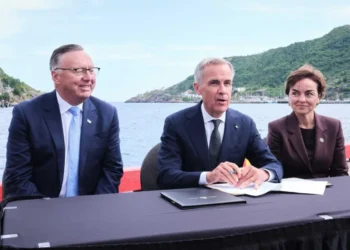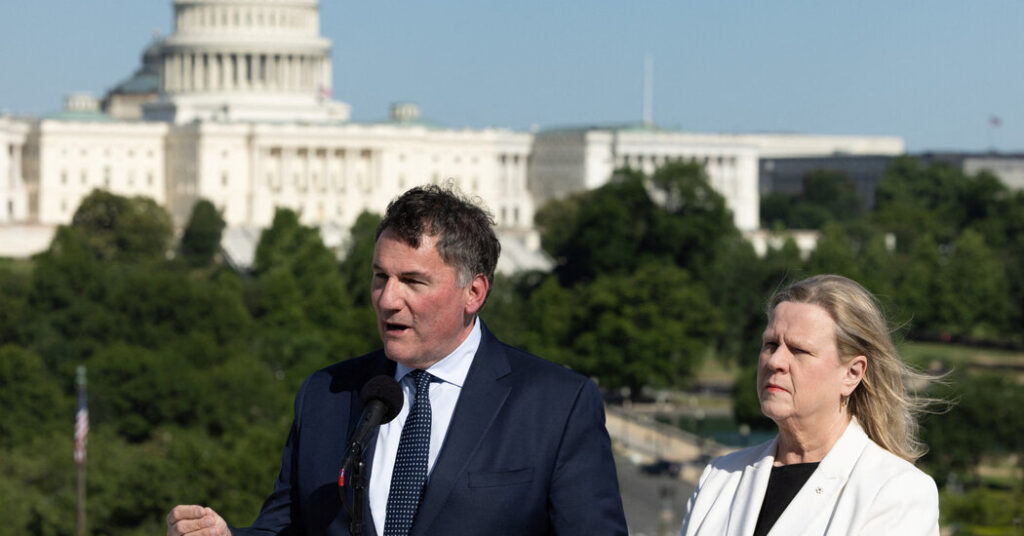
Even by the standards of the Trump administration it was an up and down week. On Tuesday President Trump declared that a trade deal with Canada had been reached. Late Friday night, Prime Minister Mark Carney blamed last minute American demands as he ordered his negotiators to walk away from the table and return to Ottawa.
Now Canada and the United States, two former partners in free trade, are locked in a high stakes trade war that escalated sharply last night. Washington has imposed 50 percent tariffs on what it estimates to be $20 billion in Canadian goods. Mr. Carney vowed to match them “dollar for dollar.”
[Read: Canada-U.S. Trade War Escalates as Talks Collapse]
[Read: The Topsy-Turvy World of Trump’s Canada Tariffs]
[Read: Trump Tariff Talks Leave Key Canadian Official Hopeful]
[Read: Tariffs on Hold as Trump Claims Deal With Canada Is Near]
This week’s tumult over trade in Washington, and the failed negotiations, echo the talks that brought free trade between Canada and the United States in 1989 that transformed Canada’s economy.
Early in my career I was sent by Maclean’s, which was then a weekly newsmagazine, to report on the negotiations in Washington, which began in 1986.
The circumstances then were dramatically different. The initiative came from Canada. And Prime Minister Brian Mulroney and President Ronald Reagan had a close rapport — matched only by Prime Minister Justin Trudeau’s with President Barack Obama decades later.
As Ontario’s recent television ads aired in the United States reminded viewers, Reagan was also a proponent of free trade.
Above all, there was no threat looming over the talks like the sweeping 50 percent tariffs Trump has now imposed after threatening them in July. If the talks failed, there were no potentially disastrous repercussions.
This time around, Janice Charette, a retired public servant who is Canada’s chief negotiator, never speaks when she goes in and out of the Office of the United States Trade Representative, its exterior remarkably unchanged since the 1980s.
That’s in stark contrast with Simon Reisman, Canada’s negotiator back then, also a former public servant who was pulled out of retirement. He was often combative with the reporters, including me, who clustered like pigeons outside the trade office. Most famously, he once called The Toronto Star — which was overtly campaigning against free trade — a “rag,” walked away and then turned around to jab his finger at its correspondent and say, “You are a hack!”
The issues that were difficult to negotiate back then are still with us: softwood lumber; automobiles; Canada’s closed supply management market for dairy; and provincial liquor stores discriminating against American products. There’s the media: Then, it was the United States complaining about Canadian cable systems’ use of American TV signals without compensation; now, it is Canada trying to get American tech giants to pay for Canadian media.
But the biggest sticking point of all was that Canada wanted some sort of independent and binding system that would settle trade disputes between the two countries. Even back then, softwood lumber tariffs — spurred by complaints from American producers that Canada’s forestry system was an unfair subsidy — were a major irritant in the negotiations.
The idea that the United States would suspend its domestic trade laws that led to the lumber tariffs remained a non-starter. But Canada continued to push for an additional system that would hold either country to account for breaking the trade agreement.
The American side argued that making the U.S. government accountable to an independent body was unconstitutional and was unlikely to be approved by Congress.
On Sept. 23, 1987, Reisman declared that the talks were over after 16 months because, he said, the Americans had failed to “belly up to the bar.”
But there was a deadline. The Reagan White House, unlike the Trump administration, respected Congress’s power over trade. And the White House’s authority from Congress to negotiate with Canada expired on Oct. 4.
On Oct. 1, Mulroney sent a delegation to meet with James Baker, the Treasury secretary, whom he described as Washington’s “go-to guy.” Joining Baker was Clayton Yeutter, the United States trade representative.
Suddenly there was the possibility of a deal again.
But late on the evening of Oct. 3, Mulroney wrote, the Canadian delegation phoned from the Treasury building in Washington to say that things had again fallen apart. Shortly after they hung up, the former prime minister wrote, Baker came into the delegation’s room, flung down a piece of paper and said: “All right, you can have your goddamn dispute settlement mechanism.” Michael Wilson, Canada’s finance minister, offered a thumbs-up from a window to journalists outside.
The next morning, a Sunday, rather than go to a bike race as planned, I joined other reporters in a gilded hall in the Treasury building for a more conventional announcement.
The end of negotiations, of course, was only a step toward free trade. A federal election in Canada the year after became a de facto referendum on free trade, with the legislation to implement it stuck in the Liberal-dominated Senate.
While the two countries failed to reach a deal on Friday, Mr. Carney said the talks have only been suspended, leaving open the prospect they may rekindle, as they did in 1987. But if not, we will most likely see another round of talks about the future of the trade pact Canadians call the Canada-United States-Mexico Agreement.
Ian Austen reports on Canada for The Times. A Windsor, Ontario, native now based in Ottawa, he has reported on the country for two decades. He can be reached at [email protected].
A network of guns-for-hire in Toronto
Shots rang out at the United States consulate in Toronto in March as two gunmen took turns firing the same weapon at the building and then sped off in a stolen car. Four months later, the consulate was targeted again by another pair of shooters.
The attacks, the police said, exposed an emerging criminal phenomenon: young guns for hire as gig workers in the underworld economy. Vjosa Isai, our reporter based in Toronto, traced some of the accused teenagers to an apartment block in the city. The neighborhood, beleaguered by gang violence, has been thrust into the spotlight after a policeman was killed in June while investigating the guns-for-hire network.
The network resembles a “violence-as-a-service” scheme under investigation in Europe. Young people are recruited into crime on social media, giving the financiers and criminal brokers hiring them more anonymity.
Read the full article.
Trans Canada
-
Night after night, through the defining events of Lloyd Robertson’s epoch — the first moon landing, the fall of the Berlin Wall, the Persian Gulf war, the Sept. 11 attacks and 14 Canadian federal election campaigns — his plain, matter-of-fact delivery rhymed with the national sensibility.
-
From Opinion: Matt Dinan, a professor at St. Thomas University in New Brunswick, got his students to love a Dostoyevsky classic by falling in love with it himself, he writes.
-
From Real Estate: Pick your favorite lakefront home in Ontario.
-
From The Athletic: The Edmonton Marathon finally admitted that it had miscalculated the length of its race. It was a half-mile longer than 26.2 miles.
How are we doing? We’re eager to have your thoughts about this newsletter and events in Canada in general. Please send them to [email protected].
Like this email? Forward it to your friends, and let them know they can sign up here.
The post Waking Up to an Escalating Canada-U.S. Trade War appeared first on New York Times.