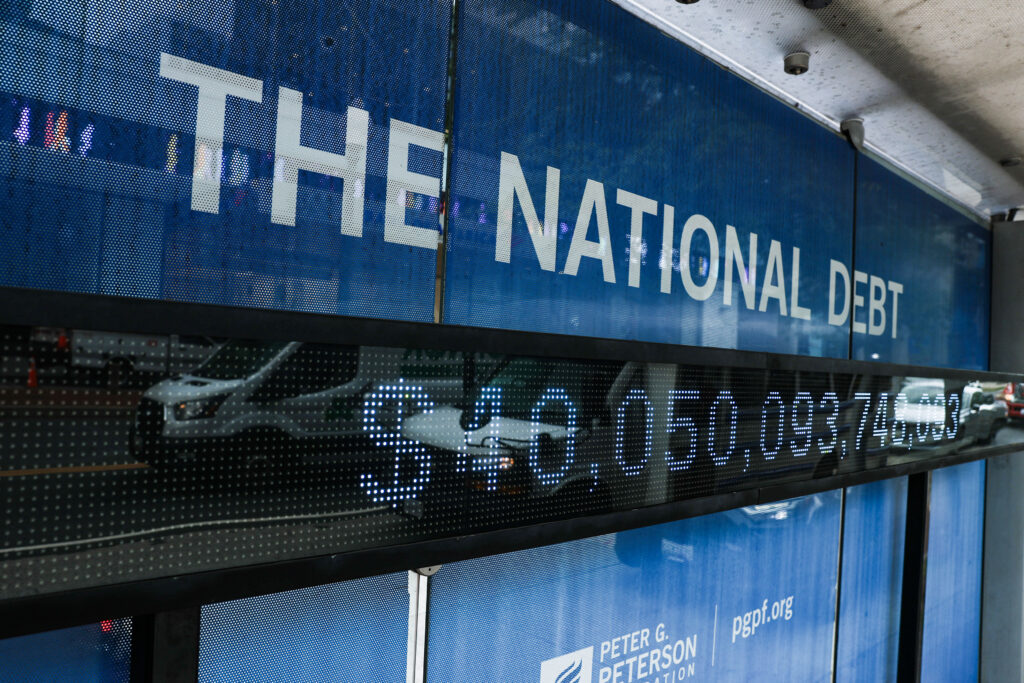
Year after year, the federal government has spent more than it collected in taxes. Each annual shortfall increased the national debt, slowly at first and then by leaps, defying warnings of an inevitable reckoning.
Now, the reckoning may be at hand.
This week’s bond market sell-off brought government borrowing costs to their highest level in almost two decades and prompted an extraordinary Treasury Department intervention.
On Friday, the yield on the 30-year Treasury bond topped 5.27 percent, up slightly from one day earlier, a sign that Treasury Secretary Scott Bessent’s plan to calm markets is not working. After decades of free spending, Washington may soon be compelled to make some long-deferred, and politically unpalatable, choices that will leave few Americans unscathed.
“This is what the bond market is trying to signal: We’re going to have to make choices that hurt growth,” said Adam Abbas, who manages $4 billion in bonds for the Oakmark Funds. “We have two levers to do that: raise taxes or cut spending. Either option is not politically popular, and it will never be popular, but at some point we have to address the problem.”
The problem is a $40 trillion national debt, along with crisis-level annual budget deficits that require significant new borrowing.
When the Treasury Department woos investors for its bonds, it competes with other governments and corporations — notably the hyperscalers building the nation’s artificial intelligence infrastructure. All that competition for capital means investors can demand higher returns, or yields, from those that want their money.
Fiscal watchdogs have warned for decades that rising U.S. debt will eventually trigger a crisis. As borrowing costs rise, debt becomes more expensive in what can become a vicious cycle, said Marc Goldwein, senior policy director for the nonpartisan Committee for a Responsible Federal Budget.
“What I worry about is we’re on the verge of sort of a real debt spiral, which happens when your interest [bill] is growing faster than your economy,” Goldwein said.
Fast-rising bond yields or interest rates often reverberate through the financial system in unexpected ways, exposing costly vulnerabilities. In 2023, for example, Silicon Valley Bank failed after rising bond yields blew a hole in its balance sheet.
Today, potential weak spots in the financial system include some of the nation’s largest hedge funds, where borrowed money used for investments, or leverage, is “near all-time highs,” according to the minutes of the Fed’s July 28-29 meeting. Likewise, traditionally staid life insurers are holding riskier assets that would be difficult to unload quickly if they needed to raise cash during a crisis.
Financial setbacks also could occur overseas in places like France or Japan, said Rebecca Patterson, former chief investment strategist for Bridgewater Associates and now a senior fellow at the Council on Foreign Relations
“When we’re thinking about what could cause a crisis in the U.S., don’t just think about what’s happening in the U.S. Think about other markets that could be vulnerable,” she said.
Today’s fiscal pressures began building a quarter century ago after former president Bill Clinton and a Republican-controlled Congress balanced the budget four years in a row. The federal government actually began paying off its debt.
That prompted Federal Reserve Chairman Alan Greenspan to give a speech in 2001 warning that eliminating the debt, and thus treasury securities themselves, could disrupt financial markets. Even so, he expected it to happen.
“Current forecasts suggest that under a reasonably wide variety of possible tax and spending policies, the resulting surpluses will allow the Treasury debt held by the public to be paid off,” Greenspan said.
Instead, a series of policy choices and unforeseen crises swamped the nation’s fiscal progress beneath a tide of red ink.
The problem has grown especially acute over the past decade. Between 1789 and 2016, the U.S. government borrowed a bit more than $19 trillion. Over the past 10 years, President Donald Trump and former president Joe Biden added an additional $20 trillion, doubling the national debt, and making debt service payments one of taxpayers’ largest annual burdens.
The U.S. now spends more than $1 trillion each year paying interest on the national credit card, more than it devotes to Medicare, according to the nonpartisan Congressional Budget Office. As recently as 2010, the interest bill was less than one-fifth that amount.
The rising U.S. debt load is part of a broader phenomenon. Global debt of all types hit a record $353 trillion earlier this year, more than three times the size of global output.
Unlike the risky mortgage borrowing that triggered the 2008 financial crisis, recent years have featured governments as the biggest borrowers. Here and abroad, governments borrowed to repair their economies after the 2008 meltdown and borrowed again to get through the 2020 pandemic. Poorer nations in Africa and Asia have gone deeper into debt to finance higher energy and food bills following the wars in Ukraine and Iran.
“The debt has transferred to governments. I don’t think this is only a U.S. story, by any means,” said Patterson.
This week’s bond market drama returned long-term yields to the level they occupied for most of the 1990s. But there are important differences between that period and today. Debt was lower and growth was faster.
In 1997, for example, when the yield on the 30-year bond was around 6 percent, the economy still managed to post growth that topped out at 6.8 percent, more than four times faster than the most recent quarter. Relative to the size of the economy, the national debt that year was less than half as big as today.
“Demographics. Labor force growth is down because of aging, the recent departure of older workers, and diminished immigration. And Trump keeps throwing in supply-side shocks — tariffs, Iran wars. The supply-side is completely different now,” Douglas Holtz-Eakin, president of the conservative American Action Forum and a former director of the CBO, said via email.
The only surefire way to restore order to bond markets would be credible action to reduce the nation’s yawning budget deficit, which the CBO estimates will hit a record $2.1 trillion this year.
In a Thursday interview with CNBC, Bessent promised the Trump administration would soon announce “an increased” focus on the government’s finances, including an examination of potential changes on “both the revenue and the cost side.”
But there is ample reason for skepticism. The administration’s initial attempt at overhauling government spending produced Elon Musk’s Department of Government Efficiency, which upended large swaths of the civil service while failing to back up exaggerated claims of savings.
Despite that experience, Bessent said he expected “several hundred billion dollars” in savings from an anti-fraud task force led by Vice President JD Vance.
The administration’s economic assumptions are also more optimistic than those of outside forecasters. Before the president’s signature tax legislation passed last year, the White House Council of Economic Advisors projected that this year’s deficit would be about $1.7 trillion.
The CEA also assumes that the U.S. economy will grow at an average annual rate of 2.8 percent, notably faster than the CBO’s 2-percent forecast.
Independent experts say some combination of higher taxes and cuts in popular entitlements such as Social Security and Medicare are unavoidable. But less then three months before November’s congressional elections, the administration’s promised fiscal consolidation “seems unlikely to be realized,” economists at Barclays told clients this week.
Indeed, on Capitol Hill the debt issue so far has spurred little more than dutiful public statements.
“Our reckless spending problem in Washington is immoral — it unfairly leaves our children and grandchildren to foot the bill — but it also is making our economic stability extremely fragile,” Sen. John Curtis (R-Utah) wrote Thursday on X. “The more we add to our debt, the greater the threat of disaster in the event of an economic shock.”
Curtis is lead sponsor of a bipartisan bill to create a commission to propose ways to shrink the national debt to less than 100 percent of GDP by 2039. He also voted last year for the president’s tax legislation, which the CBO estimates will add $4.7 trillion to deficits over the next decade.
Curtis’s office did not immediately respond to messages on Friday.
Other lawmakers have proposed creating a commission to rescue Social Security, which is expected to run short of money to pay full benefits in 2032. If that happens, benefits are legally mandated to be slashed by 22 percent.
Few expect early action. And Sen. Bill Cassidy (R-Louisiana), a lead sponsor of one of the commission bills, said no one should expect such a commission to tackle problems beyond Social Security.
“It’s easy to say, ‘fix everything at once,’ but we know that is not possible,” Cassidy said in an email. “Once we do this, it will prove that other areas of the debt can be addressed, but we should crawl before we walk.”
As Congress tries to crawl and the Social Security trust fund’s depletion approaches, the bond market’s anxiety will grow, said Jason Fichtner, executive director of the LIMRA Retirement Income Institute and a former chief economist of the Social Security Administration.
“I don’t see that meaning that the government defaults or goes bankrupt,” he said. “But I do think it means a higher costs of living for everybody.”
The post As debt surpasses $40 trillion, the bill for Washington spending comes due appeared first on Washington Post.