This article is part of Overlooked, a series of obituaries about remarkable people whose deaths, beginning in 1851, went unreported in The Times.
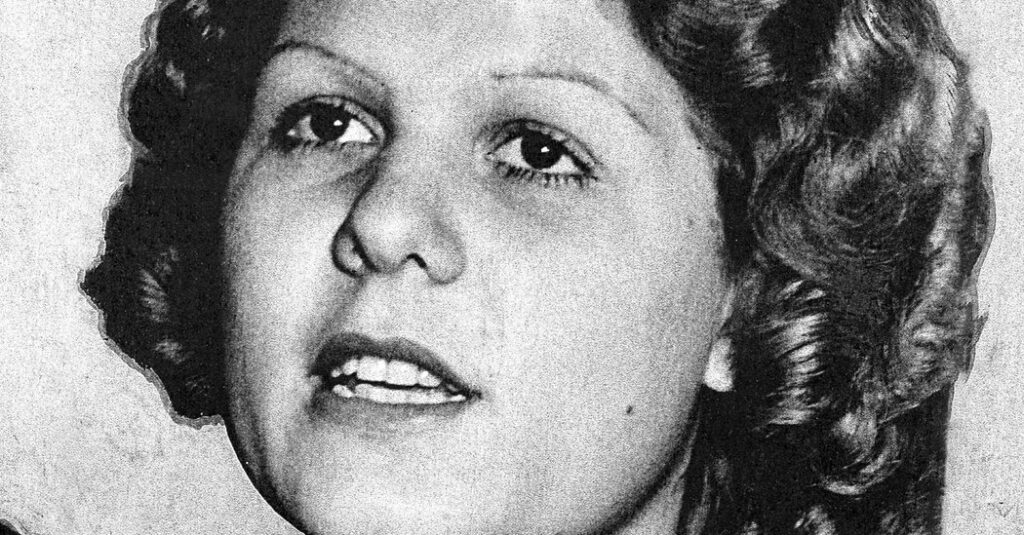
In May 1937, a 20-year-old extra and dancer named Patricia Douglas was invited to appear in a movie produced by Metro-Goldwyn-Mayer, the biggest movie studio in Hollywood.
When she showed up on location at the ranch of the producer Hal Roach in Culver City, Calif., she discovered that there was no film shoot. Instead, she later said, she and more than 100 other young women — many of whom were minors — had been summoned to entertain men attending MGM’s annual sales convention.
Douglas later testified in court that during the event, one MGM salesman harassed her, then two men held her down and forced her to drink liquor. Later, she said, the salesman assaulted and raped her in the parking lot.
She reported the attack to prosecutors, pursued a criminal case and sued the studio executives she believed were responsible. She later said MGM mounted a campaign to discredit her, and witnesses mysteriously recanted their earlier statements. A grand jury declined to indict the salesman, her civil suit was dismissed and her story fell out of public memory.
Douglas later said MGM had mounted a campaign to discredit her and had succeeded, and she was blackballed by Hollywood. Years before the #MeToo movement of the late 2010s transformed the way sexual abuse in Hollywood was discussed, Douglas’s story re-emerged because of a curious reporter who had happened upon the case in the course of other research.
“I see her as the Rosa Parks of rape culture,” David Stenn, the reporter, said in an interview. “She stood up against the culture of silence when no one else did.”
Stenn unearthed Douglas’s story in 2003 for a Vanity Fair article, “It Happened One Night at MGM,” and a 2007 film documentary, “Girl 27,” a title taken from the number assigned to Douglas in MGM’s call sheet for the supposed movie shoot — a document he discovered in the Hal Roach archives at the University of Southern California.
Stenn researched the Douglas case for years, digging up grand jury affidavits with sworn testimonies, along with black-and-white film footage of the salesmen arriving at the ranch, where they were welcomed by MGM’s studio chief, Louis B. Mayer. The event was billed as a Wild West show, and the women were given cowgirl costumes to wear.
Karen McNally, the editor of the 2026 book “Women in Hollywood’s Dream Factory: Tales of Inequality, Abuse, and Resistance,” said in an interview that the circumstances surrounding Douglas’s assault were hardly unusual in the 1930s studio system. Young women were routinely brought in to entertain men at industry events, leaving them vulnerable to abuse, she said.
“If you’re repeating the behavior in this manner, which is quite blatant and intentional — that’s a system,” she said.
Patricia Douglas was born Dorothy Shellenberger on March 24, 1917, in Kansas City, Mo., to William Shellenberger, a chauffeur, and Mildred Kritser, who Douglas later estimated had been “married eight times.”
The family moved to Los Angeles in 1920; her parents divorced in 1928. Kritser was a gown designer who “kind of disappeared,” Douglas said, moving into an apartment in Beverly Hills while Dorothy went to live with her grandparents.
At the time, young women from across the country were flocking to Los Angeles, lured by the promise of Hollywood and the opportunities it seemed to offer, especially amid the Great Depression.
“It’s kind of like, ‘Go west, young woman!’ because women have opportunities in Hollywood that they don’t have in other places,” said McNally, who is a professor of American film, television and cultural history at London Metropolitan University. “It’s advertised as something new and wonderful. These young women would have been running around auditioning everywhere.”
At around 14, Dorothy dropped out of school to work as a dancer and changed her name to Patricia Douglas. At 16, she appeared, uncredited, in the 1933 Bert Wheeler-Robert Woolsey comedy “So This Is Africa” and the musical “Gold Diggers of 1933.”
Douglas was in her mid-80s when Stenn tracked her down in Las Vegas, where she was living at the time. With her permission, he recorded their phone conversations for months. He eventually persuaded her to sit for an on-camera interview in 2002.
She told Stenn that the party hosted by MGM was on May 5, 1937, the final night of a four-day convention. A Chicago-based salesman named David Ross approached Douglas on the dance floor. “He kept pestering me to teach him how to truck,” she said. “That was the dance at the time.” He tried every way he could “to get his hands around me,” and eventually she left the dance floor and returned to her table.
There were cases of scotch and champagne, but when Douglas said she didn’t drink alcohol, two salesmen forced her to, by holding her nose and pouring the liquor into her mouth.
She ran to the washroom to vomit, then went out to the parking lot for air. That was when Ross knocked her down, dragged her to his car and raped her, she said.
“The only thing I can remember is this David Ross’s face. It was in my nightmares for many years,” she said in the film documentary. “I could not get him off my mind and what he had done to me. He took my innocence. You can never get that back.”
Her account of the incident became headline news almost immediately after it happened. The Daily Times, a Chicago tabloid paper, ran a full-page headline, “Wild Film Party,” and a sub-headline, “Assault Told by Girl, 17,” for a story that included her name and photo, incorrectly reporting her age as three years younger than she was.
Subsequent news about developments in the case appeared in papers across the country, including The Los Angeles Times, with stories resorting to euphemisms like “ravished” or “outraged” instead of “rape.”
“Rape was literally a four-letter word in the 1930s,” Stenn said. “They wouldn’t print it in the newspapers.”
Ross called Douglas’s claims “absurd, ridiculous” and Mayer’s personal attorney defended the salesman in the case, Stenn said.
When the grand jury declined to indict Ross, Douglas refused to let the matter end there. She sued Ross and other studio executives in Los Angeles Superior Court, accusing them of conspiring to “defile, debauch, and seduce” her for “the immoral and sensual gratification of male guests,” according to legal documents. She sought $500,000 in damages — more than $11 million in today’s dollars.
The suit was dismissed in February 1938. The next day, she filed an identical suit in federal court, arguing that the assault had violated her civil rights. It was, Stenn wrote in Vanity Fair, apparently the first time a woman had made rape the basis of a federal civil-rights case. That case, too, was ultimately dismissed because both lawyers failed to show up in court.
In “Girl 27,” Stenn described a cover-up campaign led by executives at MGM, which implicated the Los Angeles County District Attorney’s office and the doctor who had examined Douglas after the attack. Even an eyewitness who had helped her when she emerged from the bushes, crying and bleeding, later denied having seen anything.
“What she did had no real precedent, and she did it in a vacuum when there was no support on any level, no legal protections for women, and such a situation was considered unspeakable,” Stenn said in an interview.
A representative from Warner Bros. Discovery, which owns MGM’s film library from the 1930s, said the company did not have “anyone who can speak on the matter.” The Los Angeles County District Attorney’s office could not immediately respond to a request for comment.
Douglas married and divorced three times and had a daughter from her first marriage. Douglas died on Nov. 11, 2003, in Las Vegas. She was 86.
McNally said that very few cases of harassment and assault in the film industry came to light at the time, unless the woman involved was famous. Although there’s evidence that stars like Lana Turner, Judy Garland, and Shirley Temple faced sexual harassment or assault on the job, those stories often went public long after the incidents occurred.
The fact that Douglas’s case became so widely known was also unusual, McNally said. “Her case was in the press at the time,” she said. “It was headline news, and it was out there at the time, and then just forgotten.”
The post Overlooked No More: Patricia Douglas, Who Challenged Hollywood’s Culture of Abuse appeared first on New York Times.