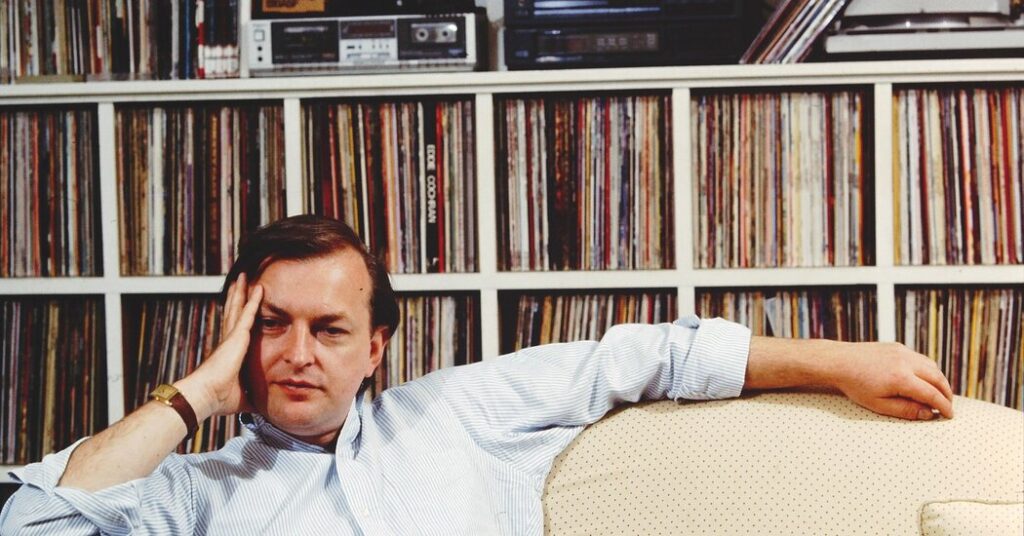
Dave Marsh, an influential and idiosyncratic rock critic who championed passion over polish, helped catapult Bruce Springsteen to fame and damned the Grateful Dead as “the worst band in creation,” died on Friday at his home in Norwalk, Conn. He was 76.
The cause was complications of posterior cortical atrophy, a form of dementia, his wife, Barbara Carr, said.
Mr. Marsh, a star writer and editor for Creem, the taste-shaping Detroit rock magazine, and Rolling Stone, was among a generation of pioneering critics, including Lester Bangs, Jon Landau and Greil Marcus, who shaped how the world saw the golden age of rock.
He could be quirky. In a list of the 30 greatest rock ’n’ roll guitarists included in “The Book of Rock Lists” (1981, written with Kevin Stein), he ranked Carl Wilson of the Beach Boys — a celestial voice, but no one’s idea of a shredder — above the fretboard leviathans Jimmy Page and Duane Allman.
“He was born with the DNA of a contrarian,” Mr. Landau, who went on to manage and produce Mr. Springsteen, said in an interview. “He loved to argue, sometimes just for the sake of arguing.”
But the opinions Mr. Marsh held, he held with conviction. Mr. Marcus once described his work as “heartfelt, heart on your sleeve, blood in your mouth.”
With tastes that ran from the Supremes to the Sex Pistols — with heavy helpings of garage rock, soul, R&B and heartland rock from Bob Seger along the way — Mr. Marsh, proud of his blue-collar origins, was a music populist as well as what Mr. Landau called a “classicist” who steered clear of ephemeral fashions.
The mission of rock, he once wrote, was to bring “a glorious possibility, a chance to communicate across all the gaps in our society — gaps of class, race, region, gender, generation, education.”
Given that Mr. Springsteen’s goal was similar, it was little wonder that, among the more than two dozen books that Mr. Marsh published, including appraisals of Elvis Presley, George Clinton and the Who, five were about the bard of the Jersey swamps, starting with the best-selling “Born to Run: The Bruce Springsteen Story” (1979), the first major biography of the artist.
“My great friend Dave, with his straight-out-of-Detroit attitude, was a true rock ’n’ roll lifer,” Mr. Springsteen wrote on social media after Mr. Marsh’s death.
“He deeply believed in what I was trying to accomplish,” Mr. Springsteen added, “and his lifetime of support meant the world to me.”
A connoisseur of raw minimalism, Mr. Marsh was one of the first journalists to use the term punk rock, in a 1971 Creem column about the Michigan garage rockers ? and the Mysterians (Question Mark and the Mysterians). In 1993, he published an entire book on a timeless three-chord frat-house raver, “Louie Louie: The History and Mythology of the World’s Most Famous Rock ’n’ Roll Song.”
To him, rock did not need filigreed solos or 24-track production to touch the heart. “Rock ’n’ roll is an attitude,” he once wrote. “It’s not a musical form of a strict sort. It’s a way of doing things, approaching things.”
What good music required, he believed, was emotional authenticity. In his 1989 book, “The Heart of Rock & Soul: The 1,001 Greatest Singles Ever Made,” considered a landmark of music criticism, he listed at No. 1 Marvin Gaye’s recording of “I Heard It Through the Grapevine.” That 1968 version of the song, he wrote, isn’t “a plea to save a love affair; it’s Marvin Gaye’s essay on salvaging the human spirit.”
In a Rolling Stone review of Patti Smith’s vulnerable and brutal 1978 album “Easter,” he called her “the most profoundly religious American popular performer since Jim Morrison.”
Conversely, he felt that the bombastic music of progressive rock bands like Emerson, Lake & Palmer and Yes, with their Carnegie Hall-worthy orchestral arrangements and virtuoso musicianship, was “truly arrogant,” as he wrote in Rolling Stone in 1977, “because it refuses to articulate just what moods its complex structures are meant to evoke.”
He reserved equal ire for what he considered slick, soulless corporate rock. In “The New Rolling Stone Record Guide” (1983), he gave every one of Journey’s nine albums up to that point — including the 1981 juggernaut “Escape,” which sold over 10 million copies — one out of five stars.
The band, he wrote, “made records perfectly calculated to be inserted into FM radio playlists: ‘Stepford Wives’ rock, dead on its feet without any awareness of the utter triviality.”
In the same record guide, Mr. Marsh called the Grateful Dead, with their interminable space jams and druggy aura, an “assertedly major oeuvre that’s virtually worthless except for documentary purposes.” In a Rolling Stone review of Queen’s 1978 album, “Jazz,” he said the group “may be the first truly fascist rock band.”
History did not always prove him right. A Dylan admirer, he nevertheless panned “Blood on the Tracks” (1975), now roundly hailed as a masterpiece, writing, “The long songs, particularly, suffer from flat, tangled imagery, and the music, with all its hints at the old glory, is often incompetently performed.”
As he said in a 1987 interview with The Washington Post, “I was always a hard-ass in terms of my opinions.”
David Rodney Marsh was born on March 1, 1950, in Pontiac, Mich., the eldest of three children of Oliver Marsh, a labor relations officer for the Grand Trunk Western Railroad, and Mary (Evon) Marsh, a teacher’s assistant.
He grew up listening to R&B records at the height of the Motown era, and the music helped him realize that “all the inequality and segregation and racism I had been brought up with had to be wrong,” he said in a 1989 radio interview with the author Studs Terkel.
He wrote for the newspapers at Waterford Kettering High School, outside Detroit, from which he graduated in 1968, and at Wayne State University, which he abandoned after a year.
At 19, he “talked my way into Creem,” he later recalled. He became the “spark plug” for the magazine, as Mr. Landau put it, helping define the publication’s hard-edge Detroit sensibility and giving an early stamp of approval to ferocious local bands like Iggy and the Stooges and the MC5, who created a blueprint for punk rock.
After rising to become the editor in chief of Creem, Mr. Marsh left in the early 1970s because of mounting tensions with Barry Kramer, the magazine’s publisher.
He moved to the Boston area and began writing for The Real Paper, a trailblazing alternative newspaper. In the spring of 1974, he and Mr. Landau headed to the Harvard Square Theater to check out a shaggy troubadour out of Asbury Park, N.J.
“I expected nothing,” Mr. Marsh later wrote. “I got everything.”
He became a close friend of Mr. Springsteen’s, as well as a leading interpreter of his work; his wife, Ms. Carr, helped Mr. Landau manage Mr. Springsteen. The cozy relationship drew scrutiny, which Mr. Marsh did not duck.
“Hidden conflicts of interest are not good,” he wrote in the introduction to his 1987 biography, “Glory Days: Bruce Springsteen in the 1980s.” “Open conflicts of interest are part of the story.”
In the early 1980s, Mr. Marsh was a founder of Rock & Roll Confidential, a left-wing monthly newsletter that billed itself as “the Voice of the Undesirable Element,” exploring music, censorship and corporate greed.
Later that decade, he collaborated with Mary Morello, who would become the chief opponent of Tipper Gore, the future second lady, in a widely publicized battle over labeling records for potentially offensive content.
“If you don’t think a label is a form of censorship,” he told The Miami Herald in 1988. “Ask anyone who had to wear a yellow star in Nazi Germany.”
In more recent years, he was a host, with Jim Rotolo, of “E Street Radio,” a weekly program for Springsteen fanatics, and presided over another music show, “Kick Out the Jams,” both on SiriusXM.
In addition to his wife, he is survived by a step-grandchild and a sister, Paula Seguna. Mr. Marsh’s stepdaughter Sasha Carr died in 2024. Another stepdaughter, Kristen Ann Carr, died of sarcoma in 1993 and inspired the creation of a fund in her name supporting cancer research and patient care, for which Mr. Marsh helped raise money.
While Mr. Marsh was known for his fierce advocacy for baby-boomer staples like the Beatles and Motown, his tastes evolved with the times, and he came to see hip-hop as a more earthshaking populist art form than punk. In 1992, the newsletter he edited changed its title to Rock & Rap Confidential.
“Do I think that the revolution in white rock ’n’ roll, or in part of white rock ’n’ roll, that happened in England and was stillborn in the United States with punk, approaches the significance of the rise of rap music?” he said in an interview with the writer Scott Woods. “That’s a silly idea.”
The post Dave Marsh, Rock Critic Who Loved Springsteen and Hated the Dead, Dies at 76 appeared first on New York Times.