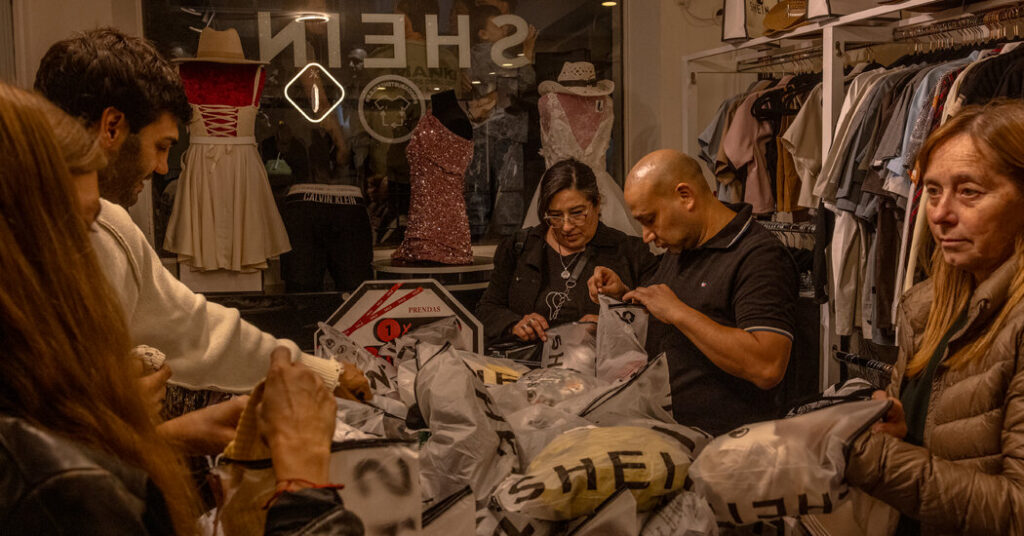
Shein was once one of the most talked-about companies in retail.
It could spot what Generation Z wanted and, within days, turn those trends into $10 mesh dresses and $5 crop tops. Its clothes were so cheap and its churn of new styles was so relentless that #Sheinhaul became a phenomenon on TikTok. Shein overtook bigger rivals like Zara and H&M, started planning an initial public offering and, at one point, was valued at nearly $100 billion.
Now the buzz has faded.
After years of delay, Shein is close to going public — this time at a fraction of its peak valuation. It is searching for new ways to grow after the United States and Europe dismantled tariff exemptions on cheap goods that had helped underpin its low-cost model. Sales have fallen sharply in the United States, its largest market. And the company has offered investors few specifics about where meaningful new growth will come from.
“For a company as hyped as it was for such a long time, the music has seemingly run out,” said Juozas Kaziukenas, an independent e-commerce analyst.
No Chinese fashion brand has been as successful as Shein at going global. And yet the company remains unusually reclusive.
Its founder and chief executive, Sky Xu Yangtian, is so private that until he appeared publicly in February, most of the photographs circulating online purporting to show him were false. Even a senior overseas Shein executive, who spoke on the condition of anonymity because he was not authorized to speak with the media, said he had never met or interacted with Mr. Xu.
Shein declined requests for an interview. The timing and pricing details of its market debut have not been announced, but the company filed a prospectus with the Hong Kong Stock Exchange last month.
Shein has taken pains to distance itself from its Chinese origins. In 2019, it established its headquarters in Singapore and de-registered its original Chinese corporate entity a few years later. The aim was, in part, to navigate Chinese rules governing companies seeking offshore listings and clear a path toward an I.P.O. in New York.
The strategy failed. In the United States, Shein encountered intense, bipartisan scrutiny from lawmakers over its supply chain and labor practices. After abandoning its New York listing effort in 2024, it turned to London, where it faced similar resistance from nongovernmental organizations and other protesters.
That left Hong Kong as the last major viable venue. But after years of delay, analysts say Shein may have missed its moment.
The turn toward Hong Kong has also put Shein in the awkward position of having to re-embrace the Chinese identity it once tried to play down. In China, the company has faced criticism for “blooming in China but bearing fruit abroad” — a phrase suggesting that Shein built its success in the country while redirecting profits overseas.
Then, in February, the famously elusive Mr. Xu suddenly appeared before officials in Guangdong Province.
“Guangdong is Shein’s root,” he declared, announcing that Shein would invest about $1.4 billion over the next three years to build a supply chain hub there.
Chinese media initially covered the speech. Then some articles began disappearing from the internet. Lu Minghe, a veteran journalist, posted a notice showing that Shein had demanded that his public WeChat account remove an article about Mr. Xu’s appearance, citing “infringement.”
Even as Shein recalibrates its relationship with China, a more fundamental problem hangs over any potential listing.
Jianggan Li, founder of Momentum Works, a consultancy that has followed Shein closely, said prospective investors had told him that they sensed little enthusiasm from its founders.
“There hasn’t been any effort to drum up interest,” Mr. Li said. “I don’t feel there’s a strong desire for the management to make the company public, aside from the fact that the investors want to exit.”
Investors are asking how Shein can keep growing.
President Trump’s decision last year to end a policy that had allowed billions of dollars of low-cost imports to enter the United States duty-free dealt a major blow in its single biggest market. In May 2025, Shein began raising prices in the United States. In the first quarter of 2026, U.S. net revenue fell 14.3 percent to $2 billion, the company said.
Europe could pose an even greater challenge. Last month, European authorities announced a 3-euro flat fee on e-commerce parcels that had previously entered duty-free.
Europe accounts for more than a third of Shein’s revenue. In its prospectus, Shein warned that although it was too early to assess the impact of the situation in Europe fully, it “could be generally in line with or exceed the impact observed in the U.S.”
Shein is now trying to convince investors that its future goes beyond ultracheap clothes by selling access to the system it built to design, produce, market and deliver products quickly.
So far, there is little evidence that the supply chain strategy is paying off. Since offering the service as a pilot in 2023, Shein has signed up only about 20 brands. The program generated less than 1 percent of its total net revenue in 2025, according to the company.
Shen Meng, a director at Chanson & Co., an investment banking firm in Beijing, said Shein succeeded in part because it was willing to squeeze its own costs and margins — trade-offs that other brands using its platform may be unwilling to accept.
“It’s hard to see any outstanding advantages in Shein’s transition,” Mr. Shen said.
Shein is also branching out into furniture, cosmetics, pet products and electronics. Nonapparel goods accounted for more than a third of its revenue in the first quarter.
Other analysts are similarly skeptical that Shein has found a second act.
“It’s not clear, other than really cheap, ultrafast fashion, what they’re going to be able to generate,” said Sucharita Kodali, an e-commerce expert at Forrester, a research agency.
Shein’s first act was remarkable.
It was founded in 2012 by Mr. Xu and three colleagues at a marketing firm that helped Chinese exporters sell products online. In 2015, it shortened its name from Sheinside to Shein.
During the Covid-19 pandemic, as online shopping exploded, Shein’s popularity surged. The company saturated the internet with advertisements aimed at young consumers, enticing them with extremely low prices and constantly changing designs.
By 2022, Shein became the world’s biggest online fashion retailer. That year, it was valued at $98.2 billion and backed by a roster of big-name venture capital investors.
The secret was a system built to compress the traditional fashion cycle. Shein used algorithms to track emerging trends, then placed initial orders of a few hundred units to test demand. The model allowed it to introduce approximately 4,700 new apparel styles a day. Zara, by comparison, produces 20,000 a year, according to analysts.
Shein paired that technology with an industrial ecosystem concentrated in Guangdong, where spinners, weavers, seamstresses and small factories could rapidly manufacture orders as small as 100 pieces.
But Shein has struggled to duplicate its Chinese supply chain model in countries such as Turkey and Vietnam, according to Mr. Li of Momentum Works. At the same time, competitors like Temu arrived with even broader product assortments and even lower prices.
Mr. Kaziukenas said he had scoured Shein’s prospectus to find the answer to a question that he’d had for years: “What is the future of Shein?” He added: “I don’t think we got that answer.”
Li You contributed research.
The post Shein Was Fast Fashion’s Next Big Thing. Now It’s Fighting for a Second Act. appeared first on New York Times.