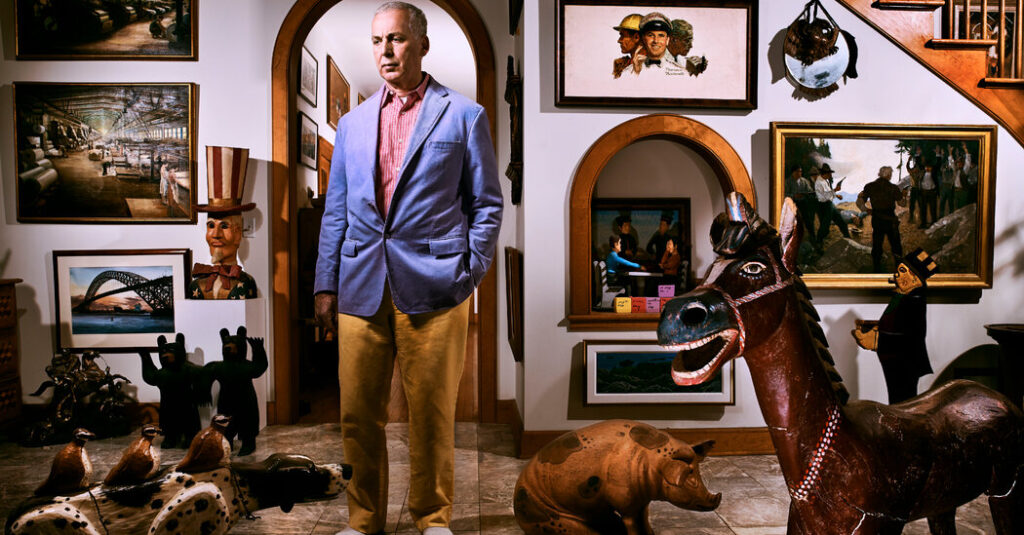
Victor Niederhoffer, a quirky polymath who pioneered using computers to predict short-term movements in stocks and commodities — a volatile, high-stakes trading technique that made him and his clients a fortune, which he subsequently lost, regained, then lost again, died on Aug. 4 at his home in Weston, Conn. He was 82.
The death was confirmed by his family.
In an industry of big personalities, Mr. Niederhoffer outperformed in eccentricity. He wore mismatched sneakers on the squash court, ordered dessert before dinner, browsed bookstores in his socks and read just one newspaper, The National Enquirer.
His 20,000-square-foot, Tudor-style mansion served as his trading post and personal museum, with sprawling collections of rare books, mechanical toy banks, paintings of shipwrecks, seashells from around the world and letters written by scientists, presidents and other illustrious people.
“His curiosity was insatiable, and he just fed it all day long,” Andrew W. Lo, a friend and professor of finance at M.I.T., said in an interview. “Talking to him was a real journey. You just never knew where his mind would go.”
The son of a police officer and a teacher, Mr. Niederhoffer developed an appetite for risk while growing up in the Brighton Beach neighborhood of Brooklyn, where he bet on paddle ball, checkers and card games against guys with nicknames like Nervous Phil, Bitter Irving, the Refugee and Bookie.
“Brighton was the Harvard of my education as a speculator,” he wrote in “The Education of a Speculator” (1997). “The games, bargains, music, sex and fauna taught me to appreciate the earthy and nitty-gritty. That’s the proper foundation for buying low and selling high, the trade of a speculator.”
As an economics major at the real Harvard, he became suspicious of the efficient market hypothesis — the theory that stock price movements weren’t predictable.
During late nights at the library, he examined the movement of stock prices dating back to 1890. He identified patterns in the way stocks went up and down during trading sessions — a kind of “ping-pong” effect that could be capitalized on with quick trades.
After graduating in 1964, he enrolled in the doctoral program in finance at the University of Chicago, where the efficient market theory was golden.
Combing through more records, he found evidence that stock prices had weekly rhythms, including spikes that were more likely on Fridays than on Mondays. When he argued his position in class, there was nearly a riot.
“Booing and hissing broke out,” he later wrote. “Some of the more revered professors stood up to demand that I retract. I expected an old vaudeville-style hook to yank me out by the neck.”
He earned his doctorate in 1969 and taught at the University of California, Berkeley, for several years before moving to New York to start his own business. Determined to find patterns in stock movements, he recorded stock prices in large ledgers and entered them into a computer program that he had written to track patterns.
In 1979, Mr. Niederhoffer began trading for himself with $50,000. Eighteen months later, after turning that sum into $20 million, he started his own hedge fund, leaning heavily — but not completely — on his computer program.
“You have to do a lot of counting, and you have to have a scientific mien,” he said in 2017 on the Bloomberg podcast “Masters in Business.” “But I don’t believe that algorithms and robot trading is the secret to success. I believe you have to have a higher framework.”
He did not mean God, but rather the patterns that he had identified in ecology, biology, physics and, especially, music.
“Right after lunch or before a holiday, the markets have a tendency to meander up and down in a five-point range above and below the opening,” he wrote. “The pattern is similar to the twinkling C-major fifths of Haydn’s symphony.”
To some Wall Street observers, Mr. Niederhoffer appeared harebrained and reckless. But as his yearly returns soared to 30 percent and higher, big-name investors, including George Soros, began sending him their cash.
Emboldened, Mr. Niederhoffer turned to foreign markets, particularly Thailand, where he sent a friend to investigate the economic conditions by looking into, among other things, the length of discarded cigarette butts. (Long butts meant discretionary income was high; smokers could afford to waste tobacco.)
In the spring of 1997, Mr. Niederhoffer invested several hundred million dollars in Thai securities, borrowing heavily against his holdings to increase his positions. The Thai currency soon crashed, starting a chain of events that wiped out Mr. Niederhoffer and his investors.
Nearly broke, he mortgaged his house and liquidated some of his collections. “I was destroyed,” he said in an interview with Slate in 2010. “I had lost money for my customers and that was very terrible. And I had lost my feeling of competence in my chosen field.”
Slowly, he began trading again — first for himself and then for clients. His tactics didn’t change, but the world around him did, with quantitative trading taking off on Wall Street.
By early 2007, he had recovered his fortune and his reputation. Later that year, the subprime mortgage crisis upended his heavily leveraged trades and wiped him out again.
“In both cases,” he told Slate, “I was in over my head.”
Victor Barry Niederhoffer was born on Dec. 10, 1943, in Brooklyn, to Arthur Niederhoffer, a New York City police lieutenant who later taught at the John Jay College of Criminal Justice, and Elaine (Eisenberg) Niederhoffer, an English teacher.
Gambling was woven into his childhood. When he was 7, he and an uncle slipped out of synagogue to bet on a playoff game between the Brooklyn Dodgers and the New York Giants, losing the bet when Bobby Thomson hit his famous “shot heard ’round the world” home run.
In school, Victor was a handful. “Although a little trying at times, you were the spark the class needed this year,” his sixth-grade teacher wrote to him, as recounted in a 2007 profile of Mr. Niederhoffer in The New Yorker. “You have a keen mind; learn to curb your inclinations to demonstrate superiority.”
His competitiveness made him a ruthless opponent in sports, especially handball, paddle ball and tennis.
In college, he stumbled on students playing a country-club sport that he had never seen in Brighton Beach: squash. He sought out Jack Barnaby, Harvard’s coach, and told him, “I’m going to be the best ever.”
Amused, Mr. Barnaby taught Victor to play. Within 14 months, he had won the national junior championships. In 1964, during his senior year, he captured the National Intercollegiate Individual title.
He continued playing in graduate school and during his early days as a trader, winning the U.S. National Singles championship five times. In 1975, he beat the squash legend Sharif Khan to win the prestigious North American Open.
But even as he dominated the game, Mr. Niederhoffer never quite fit in with the WASP-y squash crowd. He wore mismatched shoes and bedraggled attire, argued with referees and occasionally propped up his feet on fancy furniture.
“I finally reached the conclusion that he was one of the few people who deserved to be called a genius,” Mr. Barnaby told The Washington Post in 1997. “He could think under pressure better than any player I’ve ever seen.”
Off the court and trading floor, Mr. Niederhoffer’s life was “more complicated than Rupert Murdoch’s,” he joked in The New Yorker — an allusion to the media mogul’s multiple marriages and complicated relationships with his six children.
Mr. Niederhoffer had seven children with three women; remained close friends with his ex-wife, Gail Niederhoffer; and had a public falling out with his eldest daughter, Galt Niederhoffer, a writer and movie producer named after the Victorian polymath Sir Francis Galton. (Another daughter, Rand Niederhoffer, was named after Ayn Rand.)
He is survived by his wife, Susan Niederhoffer; their four daughters, Rand, Victoria, Artemis and Kira Niederhoffer; two daughters from his previous marriage, Galt and Katie Niederhoffer; a son, Aubrey Niederhoffer, from a relationship with Laurel Kenner, a former editor at Bloomberg; 15 grandchildren; and two siblings, Roy Niederhoffer and Diane Klein.
In 2009, before falling out with her father, Galt Niederhoffer wrote an essay in Vogue about his life after the second catastrophic collapse of his business.
“For anyone who has lived through boom and bust times, one thing is abundantly clear: Money is fleeting,” she wrote. “It is — we all know this intuitively — a hollow symbol.”
Still, Mr. Niederhoffer continued trading.
“He has only one employee,” she wrote. “But he trades with the same athletic discipline. He is still awake late into the night, alert for the morning bells of the European and Asian markets, studying every permutation, setting up for every angle.”
The post Victor Niederhoffer, Trader Who Went Boom and Bust (Twice), Dies at 82 appeared first on New York Times.