THE BREAKUP, by Kurt Andersen
Novels set in the future aren’t exclusively the province of science fiction; anxious times tend to generate anxious, cautionary literary dystopias, and when was the last time you can remember not feeling anxious? The 20th century in particular abounded in such visions, some of which — “The Handmaid’s Tale,” or “Brave New World,” published in 1932 and getting spookier every day — have proved more prophetic than others. They’re best understood, though, not as genuine bets on our future, but as dreamlike unleashings of present-day fear over the blind volatility of the moment.
Kurt Andersen, in his new novel “The Breakup,” does something few such books do (Jon Raymond’s excellent 2022 climate-disaster novel, “Denial,” comes to mind); he sets his stage not in some distant century when our own problems are the stuff of history, but a mere 19 years from now, when most of his readers are still likely to be around.
In an effort to game out the frightening liminality of American life in 2026, he depicts a 2045 in which — some years after a short, dirty, rather brilliantly imagined second American civil war — the country has fractured into two sloppily distinct but still official entities: the United States of America (now down to 39 states) and the Free American Republic, a largely white and Christian throwback to certain retrograde ideals with which we are all, here in the present, glumly familiar.
With peacetime established, the entirety of the former United States is allowed to vote on which of these two entities they want to join. Thus there is, this time around, nothing so geographically and imaginatively neat as a Mason-Dixon line; travelers through Southern states, for instance — where urban areas don’t want to be part of the F.A.R. any more than the F.A.R. wants them — are crossing and recrossing “national” boundaries all the time. Not secession, but “disunion”: As solutions, go, it’s a mess, but at least it’s halted the terrorist drone attacks and the Army’s responsive deployment of robots to kill rebellious American citizens in the streets. For now.
Our docents through this new American life are a family called the Zimbalists, whose own lines of fracture mirror the nation’s, as they are very much aware. In 2044, the family moved from Tennessee to San Francisco so that Asher Zimbalist could take a job running a hazily defined “Institute” on behalf of a person who may be that most elusive of species, the altruistic billionaire. But Asher’s wife, Natalie, couldn’t bear the culture shock. She’s a poet, of all things, though one who has earned some cultural infamy as a sort of plainspoken, Lionel Shriver-coded abuser of liberal pieties; six months ago, she moved back to Tennessee.
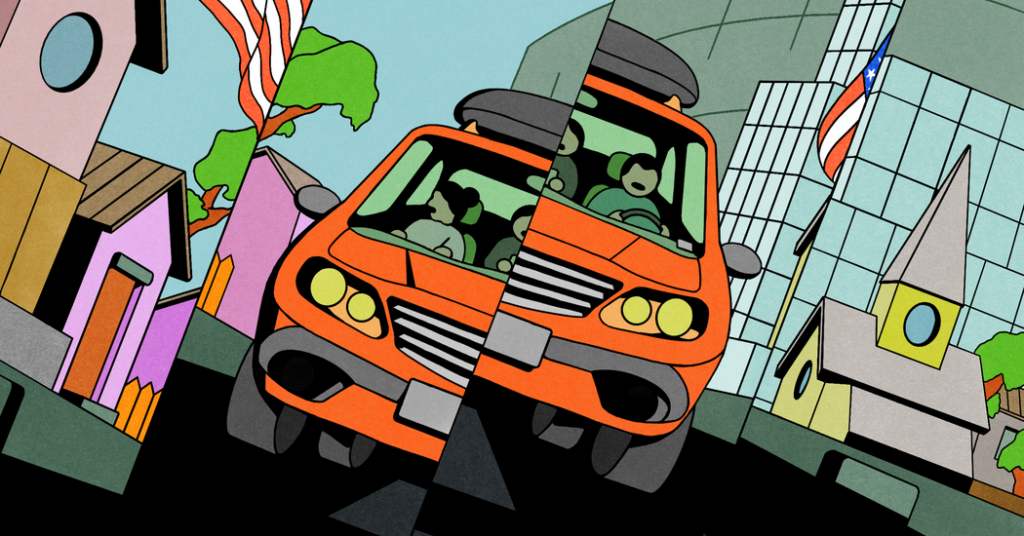
So have they broken up for good? Is politics to blame? They themselves aren’t sure (nor are their two children), and now their hand is forced by the imminence of a long-planned tour of prospective colleges for their younger child, Logan. This tour will take them through the newly reconfigured heartland of America.
It’s a good setup. What’s puzzling is that more than 300 pages of the novel go by before the engine of the Zimbalist family car, and thus of the novel’s plot, finally turns over, and the much-touted road trip begins. Before that comes a vast and dramatically static stretch of what speculative-fiction circles often call “world-building” — a full, inventive, elaborately detailed portrait of Andersen’s vision of the next 19 years of American history. It’s fun to read, particularly since it involves the imagined fates of a great many present-day famous people. (Among the many dozens of such cameos, surely one spoiler won’t hurt: Elon Musk dies of an overdose en route to Mars.)
As a novelist, Andersen — whose works of nonfiction include “Fantasyland: How America Went Haywire” and “Evil Geniuses: The Unmaking of America” — is more philosopher than plot maker. The will-they-or-won’t-they domestic drama of the Zimbalists, when it finally gets out of the driveway, is less than suspenseful; it is very much like spending a week in a car with three people laughing at a series of inside jokes and then explaining to you why those jokes are funny.
But so what? Domestic dramas are already thick on the ground in American fiction. What readers of “The Breakup” will come for, in this moment of what seems like unsustainable polarization and anger and wanton trampling of American civic institutions and ideals, is a vision of our near-term future that is violent and admonitory and cathartically terrible and yet somehow still survivable. On that score, Andersen delivers the dopamine hit that has made his previous work best sellers. In his 2045, there’s still a new Sally Rooney novel (one with a very funny title), and the government even offers tax credits to book publishers who hire human beings as copy editors instead of just letting A.I. do it. How dystopian can things be?
THE BREAKUP | By Kurt Andersen | Random House | 556 pp. | $30
The post It’s Not You, It’s America appeared first on New York Times.