The risk of a catastrophic oil spill in ecologically sensitive waters around the Strait of Hormuz has hung over the region since the start of the war in Iran.
Now the threats are increasing, maritime experts say, as the conflict has widened and more tankers are navigating the region’s waterways with their tracking transponders turned off to dodge military strikes and drone attacks.
The advent of transponders and more advanced navigation equipment has made modern shipping safer and cut down on collisions and spills. Turning them off, or going “dark,” is a perilous activity typically reserved for vessels under sanctions or carrying illicit loads. But since March 1, there have been an alarming 1,514 dark crossings in and out of the Persian Gulf, according to Kpler, a maritime data firm.
“When more ships become invisible, situational awareness declines,” said Kaveh Madani, director of the United Nations University Institute for Water, Environment and Health.
“In a narrow and strategically congested waterway such as the Strait of Hormuz, reduced transparency adds another layer of environmental risk,” Mr. Madani said.
Major spills threaten ecosystems.
Those risks are compounding across the region: Three different oil slicks are spreading through the Persian Gulf and Gulf of Oman, according to maritime security experts who are tracking the spills.
One has reached the coast of Iran’s Qeshm Island and its sensitive mangrove ecosystems. The spill is believed to have been caused when a projectile hit a cargo vessel in the Strait of Hormuz on Aug. 3. By Wednesday, the spill was about 80 percent contained, Ahmadreza Lahijanzadeh, a deputy at Iran’s Department of Environment, said in a statement.
A second slick has been spotted near the island of Sirri, an oil and gas hub in the center of the gulf. The origin of that spill has not been verified.
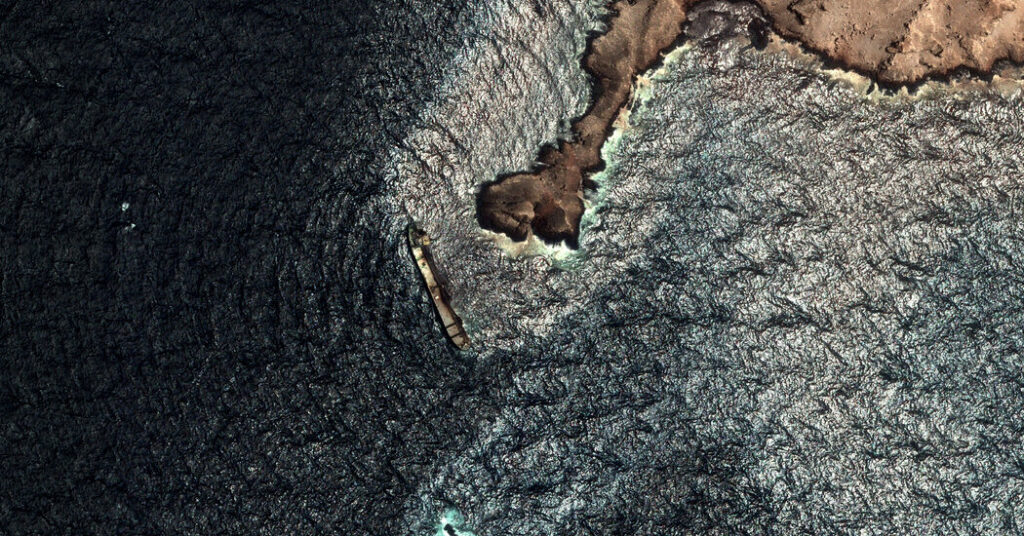
Most worrisome is a tanker known as the Caroline Bezengi, which was carrying nearly one million barrels of Russian crude bound for Asia. The ship, operating under international sanctions, ran aground off Oman after an unexplained explosion in early June. The ship is believed to be part of a so-called shadow fleet that Russia uses to circumvent Western financial restrictions on its oil exports.
The slick now covers an estimated 400 to 500 square miles and is seeping into a nature reserve that is home to endangered hawksbill and green sea turtles, Arabian Sea humpback whales, and thriving coral reefs. The oil has begun to wash up on the beaches of the mainland, in an area known as the Turtle Coast.
“These are not simply slicks that disappear when they are no longer visible from satellites,” Mr. Madani said. The oil can contaminate beaches and coastal habitats, and have lasting consequences for marine species and potentially human health.
None of the active spills have been directly attributed to a vessel’s going dark to avoid Iranian military strikes. Yet experts warn that the tactics of wartime survival are now overlapping with the unsafe habits of illicit shipping. Whether turned off to dodge drones or to evade sanctions, disabled transponders eliminate the safety buffers designed to prevent oil spills.
Wartime tactics meet uninsured vessels.
Before the United States and Israel launched airstrikes in Iran on Feb. 28, more than 130 vessels per day passed through the Strait of Hormuz, a narrow channel between Iran and Oman.
Ships occasionally suspended their navigation devices. Those were mostly vessels linked to Iranian oil and other exports under sanctions. But they occurred in small numbers, and many maritime data firms didn’t even track the tally.
That changed with the war. Tehran has fired drones and missiles at dozens of tankers traveling the Strait of Hormuz, including two in the past week. Days after the war began, ships traveling in and out of the Persian Gulf began shifting off their transponders.
According to Kpler, about 300 ships were responsible for the 1,514 dark crossings since March 1. The vast majority were traveling without insurance.
Iran’s national oil company owns 50 of those vessels. The others are linked to companies in a variety of countries, but primarily the United Arab Emirates, Greece and China, including Hong Kong.
Karen E. Young, a senior research scholar at Columbia University focusing on the Middle East, said that until Gulf oil-producing nations were able to add pipeline capacity to avoid the Strait of Hormuz, unsafe navigation practices would continue. State-owned oil companies will have an advantage, because they are more likely to own their own tankers, she said.
“The future favors national oil companies that can assume risk and pay for things,” Ms. Young said.
Shipping has relied on navigation technology for decades.
Since 2004, the International Maritime Organization, a U.N. standards-setting agency, has mandated the use of ship-identifying systems on virtually all large international cargo ships as well as passenger vessels.
With it, vessels share information like their position, speed and path by radio to coastal offshore stations. Other ships and agencies use it to avoid collisions.
“It’s not ‘nice to have’ equipment,” said Dimitris Ampatzidis, a senior risk and compliance analyst at Kpler.
Ship captains have the legal flexibility to turn off transponders for safety reasons, Mr. Ampatzidis noted. But in normal times, that is done with the permission of the country under whose laws a ship is registered, known as the flag state, and an insurer, he said.
The war in Iran has led captains to make more decisions on the fly. The risks are heightened because captains have become more reliant on the sophisticated equipment.
“They have done this manual way of crossing the seas only as a lesson in their classes,” Mr. Ampatzidis said. “It means we are turning back to the technologies we were having on the vessels 20-something years ago, and we do have increased exposures to collisions.”
That means, potentially, more oil spills.
Robin Mills, the chief executive of Qamar Energy, a consultancy, noted that the waters in the region were already under pressure from overfishing, desalination and climate change.
“Another major spill would be a disaster,” he said.
The post Spike in ‘Dark’ Oil Tankers in Gulf Raises Risk of Catastrophic Spills appeared first on New York Times.