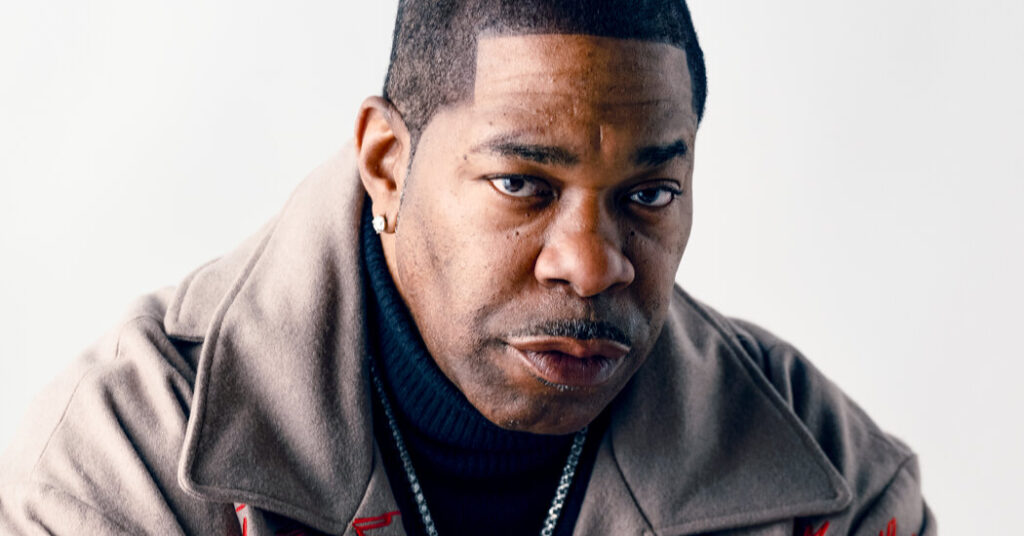
Until his death in 2006, at 32, the Detroit producer J Dilla was a prolific maker of beats that conveyed the warm humanity of his touch. Dilla specialized in grounded but wobbly productions that presented a version of rap music that was affectionately historical. Over the years, Dilla sent many of those compositions — somewhere near 300 — to the lively rapper Busta Rhymes, a friend, collaborator and, eventually, custodian of the late producer’s legacy.
Across the last two decades, Busta Rhymes has parceled Dilla’s beats out sparingly, using maybe one or two on each of his albums, but rarely digging deep into the well — until now. On Tuesday, the rapper will release “Dillagence 2,” an album exclusively composed of Dilla productions that’s a tribute only in the sense that his contributions, dusted off from their vintage storage, underscore that Dilla was a musician unbound by time and mode. (The pair’s original “Dillagence” mixtape was released in 2007.)
“The human timing, it adds a feeling because it’s coming from a soul,” Busta Rhymes said in a new interview on Popcast, The New York Times pop culture chat show, of Dilla’s beats, which were intentionally not quantized to a fixed rhythm. “I feel like he mastered that in a way that was unlike anybody else.”
Busta Rhymes, 54, is an apt partner for those sounds. He has been an eccentric fixture in hip-hop for almost four decades, as the genre evolved from a bedrock of soul samples to the bellwether of technological practices in pop. A master of firework cadences and breathtaking speed rapping, in no era has he sounded out of place, whether alongside A Tribe Called Quest as part of the Native Tongues of the early ’90s or with Missy Elliott and Janet Jackson amid the futurism of the early 2000s.
Busta Rhymes is in patient mode on “Dillagence 2,” which features appearances by Common, Big Sean and Lil Wayne, who has never before rapped on a Dilla beat. There are also unreleased, two-decade old vocals from D’Angelo, the R&B savant who died last year.
“When the word started to spread about this project,” Busta Rhymes said, “people just started to make sure that I had some really special pieces and moments.” He added, of his longtime friends Dilla and D’Angelo, “I loved the both of them, so I wanted to do it whatever justice that I could do it and continue to uphold the legacies of these brothers.”
In conversation with Popcast’s Jon Caramanica and Joe Coscarelli, Busta Rhymes spoke about the intersections of technique and showmanship; being both a beloved elder and an enthusiastic fan; and how artists should never stop advocating for themselves, no matter their age.
COSCARELLI Talk to us a little bit about the relationship that you had with Dilla while he was alive, and then what it was like to return to that music three decades later.
BUSTA RHYMES In my experience with Dilla, he was a man of few words. I heard him talk more when he was rhyming than in actual regular conversation. A lot of the times when I was around Dilla, after we’d have our initial greet, give each other dap, smoke a little spliff together, he’s immediately into the work. He loved to laugh and smile and just be in a feel-good energy space, but he was deeply entrenched in wanting to live in the creative space constantly. And it would make me feel inspired to always want to challenge myself to marry his music in a way that felt as close to perfect as possible.
COSCARELLI You’re of course known for extremely acrobatic speed rapping. Dilla is known for being off-kilter — this idea of “Dilla Time,” the way he mixed straight time and swing time to result in this drunken, uneven rhythm. What does that do to you as a rapper?
BUSTA RHYMES I think the most interesting part about it was he mastered the understanding of knowing that the soulfulness of music comes from human timing. Human timing is never perfectly on time all the time. He’s not the only producer that does it, you know what I’m saying? But he’s the only producer that makes me feel what I feel when he does it.
I don’t think there’s words that can explain it. I think it’s a feeling that it brings out. What you feel from Busta Rhymes when I’m rhyming on Dilla, that might be a little different from what it is when I’m rhyming on everything else, even if it’s not quantized. If you notice, I’ve never tried the speed rap on a Dilla beat. It doesn’t warrant that.
COSCARELLI What’s the state of speed rapping these days? Do people still respect being able to flow quickly in the way that you’re renowned for?
BUSTA RHYMES I don’t think anything is out of style or out of date if you do the [expletive] in an amazing way that [expletive] can’t front on or refuse. I never speed-rapped because I wanted to rap fast. I loved the way the rhythm pattern of what I was doing worked with the beat. Because I played drums — my father got me my first drum set, a six-piece Remo drum set, when I was 7 years old. So I’m into rhythm, and I produce and make beats myself.
A lot of my flow patterns come from the perspective of looking at how I’m gonna add to this track or this production as an instrument. I’m playing dodge ball with the kick and the snare — I can fit this amount of words between the kick and the snare in that little dead space. And in between the other kick and snare after, how do I fit another three, four words? So I don’t speed rap because I thought it was cool. I speed rap because it felt right for the song.
COSCARELLI How did you boil the some 300 Dilla beats you were sitting on down to what’s ending up on this album?
BUSTA RHYMES What felt right — that’s really what it boils down to. I don’t overthink the music no more. I think a lot of the times when you overthink [expletive], it ends up never coming out.
I started it in November 2025. The Dilla estate and [the producer’s mother] Ma Dukes — the respect level and the integrity has to be held for our brothers and everyone that was a part of it. Making sure that every T was crossed and every I was dotted — with the music, the business, the whole aesthetic. And making sure of the opportunity to give people the feeling that a lot of folks in this culture haven’t gotten yet, because it’s been many generations since Dilla passed. For a long time I’ve been like, “Yo, do they even know that this feeling exists?”
COSCARELLI Were these new D’Angelo vocals on this Dilla beat already?
BUSTA RHYMES I didn’t know that it existed, because it was done 20-something years ago. They started something and it just never got finished. I love the both of them, so I just want to do my part in delivering in that way — not just for the culture, but for them and for all of us.
CARAMANICA How heavy is that emotional process for you, when you’re engaging with making music with the ghosts of these folks?
BUSTA RHYMES That doesn’t have anything to do with music. That has everything to do with death being so final. You just miss your family and your friends, and those two brothers, for me — it was very, very long-term friendships. I met D’Angelo before I met J Dilla. I met the both of them through Q-Tip and Ali [Shaheed Muhammad]. So it’s just challenging to not have them, or not have Phife Dawg, or not have a lot of people that you’ve shared a lot of time with over the years.
COSCARELLI When you were coming up as a teenager, rapping in your 20s and finding fame, there weren’t rappers in their 50s still doing it at the level that you and your peers have been lucky enough to see. There wasn’t an infrastructure for people to age gracefully within hip-hop in those early days. What did you think your 40s, 50s and 60s looked like, since there wasn’t a next generation to look up to?
BUSTA RHYMES I didn’t look that far. I think this is the first generation where you’re going to see it lead the charge for it to continue to happen on a regular basis. Because a lot of the generations after us are not actually too far-off from 50 years old themselves in the next five to 10 years. I don’t put a timeline on greatness. You continue to do it as long as you’re amazing at it, you still love it, and you know how to monetize this [expletive] the right way. And I think that’s the most important part.
CARAMANICA One thing I love to see on the internet — I feel like this comes up every couple of months — there’s a great video of you embracing a younger artist and essentially giving them their flowers. Usually it’s the other way around. Why is it important to you to look someone in the eye and say, “What you do is valuable”?
BUSTA RHYMES I do it when it feels right to do it. I don’t have a problem showing love, because that’s kind of how I was treated by the gods of the music when I was coming up. To get onstage with Leaders of the New School, and you got De La [Soul] in the building, or you got Cold Crush Brothers in the building —
CARAMANICA Public Enemy.
BUSTA RHYMES Public Enemy is in the building. These brothers came and embraced us with grace, and they made us understand that they saw some sort of future in what we were doing that was promising. I love to keep my finger on the pulse of what’s going on.
COSCARELLI There’s a lot of cross-generational stuff with you, because you were so major in terms of breaking open our expectation of what hip-hop could look and sound like. You have someone like Billie Eilish saying the first verse she learned to rap was your “Look at Me Now” verse. What is it about what you were doing there that has been able to transcend demographics and generations?
BUSTA RHYMES The feel-good energy, in combination with the way I display my showmanship — from the live performance aspect or the video aspect.
COSCARELLI The total-packagedness.
BUSTA RHYMES Yeah, because it all coincides. When I’m performing on a record, I make sure I’m doing it in a way that’s gonna make people feel good — even if we’re talking our street [expletive], I’ll still display it in a way that’s gonna entertain people, just being free with it. I don’t limit where and how I’m gonna share the music, you know what I’m saying? I’ll be on tour with me, Missy, Timbaland, Ciara. Then I’ll go on tour with 50 Cent and Jeremih. But then I’ll be on a tour from a while ago with David Bowie, Blue Man Group and Moby.
COSCARELLI Where do you see your influence these days?
BUSTA RHYMES I’m never the one that feels like I need to say it. I think a lot of people say it themselves, and I think that’s where the reward is the greatest. Ludacris has said to me many that the Busta Rhymes DNA is in his blood. Missy Elliott says it. Kendrick has said it. Doechii has said it. It’s the same with me — I took a lot of my [expletive] from Cold Crush Brothers and Grandmaster Kaz, specifically. Same thing with Chuck D.
CARAMANICA Are we talking showmanship? All the artists you just named are the showmen and show-women of modern hip-hop. Who were you drawing inspiration from to know how to be not just a great rapper, but a great visual presence?
BUSTA RHYMES Dancehall, but also Parliament-Funkadelic. And then you’d have stuff like Mötley Crüe and Black Sabbath and Queen. Prince and Michael Jackson and Earth, Wind and Fire. Just taking a bit, a piece, an ingredient, from all of these different things.
That’s what made me feel like there’s too much amazing [expletive] you could be doing on the stage to just walk around acting like you’re too cool to show up. It was always weird to me that you get blessed with this opportunity to go up there and tear some [expletive] down, but your ego won’t even let you. Sometimes I watch artists and I’m like, I know that you feel like you can — like you want to give more.
COSCARELLI And you think it’s ego that’s blocking them?
BUSTA RHYMES I think a lot of the times it’s the discomfort of not looking cool in a snapshot, or not looking in a way that could compromise the credibility you feel you’re working so hard to protect — especially when you’re one of those dudes that wants to be out there talking a lot of that street [expletive].
COSCARELLI Do you still write by hand?
BUSTA RHYMES No, I haven’t written by hand in a long time. I started to run into this issue where if I’m writing a 16 but taking my time with it, by the time I get to like the 11th or 12th bar, I might’ve forgotten the way I meant to say the second and third bar. I don’t want to ever lose those moments. So instead of writing with a pen, I sit in front of the mic and I just say it when it comes to my mind.
It’s like — what is it, “Deadliest Catch,” that TV show? With the crabs and the lobster and all of that. That’s pretty much the process for me. You throw your fish net in the universe and sometimes you catch a bunch of lobster and crab and shrimps, and sometimes you go out there and throw your [expletive] in the universe and you don’t catch nothing.
CARAMANICA You have been on hundreds of songs — thousands, maybe. What is the art of talking your way onto someone else’s record?
BUSTA RHYMES It’s just being comfortable enough to go into somebody’s session, and if you like something, you just solicit yourself. Because a lot of the times, you’re not on everyone’s mind. Sometimes you gotta let it be known that you’re very present. It’s almost like you’re not going in there to negotiate it. That’s just me, I step into the situations.
Credits
Popcast is hosted by Jon Caramanica and Joe Coscarelli and produced by Sophie Erickson, Kate LoPresti and Felice Leon. This episode was filmed by Srdjan Stojiljkovic, Dave Mayers and Jack Belisle and edited by Pat Gunther with help from Rebecca Blandon. Our theme music is by Elisheba Ittoop. Nick Pitman is our audio engineer and Amanda Webster is our photo editor. Brooke Minters is our executive producer. Header video cinematography is by Emilio Chavez.
Special thanks to Sarah Bonn, Dahlia Haddad, Mike Cordero, Nicole Huber, Aaron Byrd, Carl Mazurek, Zach Caldwell, Maddy Masiello, Brad Kimbrough, Craig Hettich, Andrew Wilcox, David Malitz, Elena Bergeron, Sia Michel, Nina Lassam and Sam Dolnick.
The post How Busta Rhymes Turned 300 Unreleased J Dilla Beats Into His New Album appeared first on New York Times.