Mikael Hamaoui studies every detail of his latest condominium project in Miami, down to the doorknobs.
Mr. Hamaoui, the founder and chief executive of Riviera Horizons, a development and brokerage firm in North Bay Village, is charged with delivering the world’s first Pagani Residences.
A question about doorknobs was posed by Horacio Pagani, the creator of Pagani, a luxury Italian carmaker known for its racecar designs that is a partner on the condo project.
“‘How do the doors open?’” Mr. Hamaoui recalled Mr. Pagani asking. “It seemed to me like a little bit of a silly question. They’re doors. You turn the knob and they open.”
But “for Horacio, the door in a car is the first touch point with a client,” he said. “It was very important what that first experience was like.”
So instead of traditional latches, a sleek magnetic system was used.
“Nothing slips through the cracks with him,” Mr. Hamaoui said of Mr. Pagani.
“It’s not about trying to make an apartment feel or look like their car,” he added. “It’s trying to take the DNA of the brand that has allowed it to design such beautiful cars, and taking those pieces that are relevant to interior design for a home.”
The attention to detail is a competitive advantage, Mr. Hamaoui said, in a city where an increasing number of luxury-car-branded residential developments fill the skyline.
While residences branded by hotel companies like Ritz-Carlton and Four Seasons have been around for decades, developments closely tied to brands of automobiles are a newer, growing trend in Miami. Two are under construction, joining others recently completed and solidifying Miami’s place as having the most luxury-car-branded residences in the nation, second only in the world to Dubai in the United Arab Emirates.
Their rising popularity highlights the growing numbers of a type of client that developers are trying to attract: wealthy foreign buyers for whom a car brand represents status, said Thomaï Serdari, who oversees the luxury and retail M.B.A. program at New York University Stern School of Business.
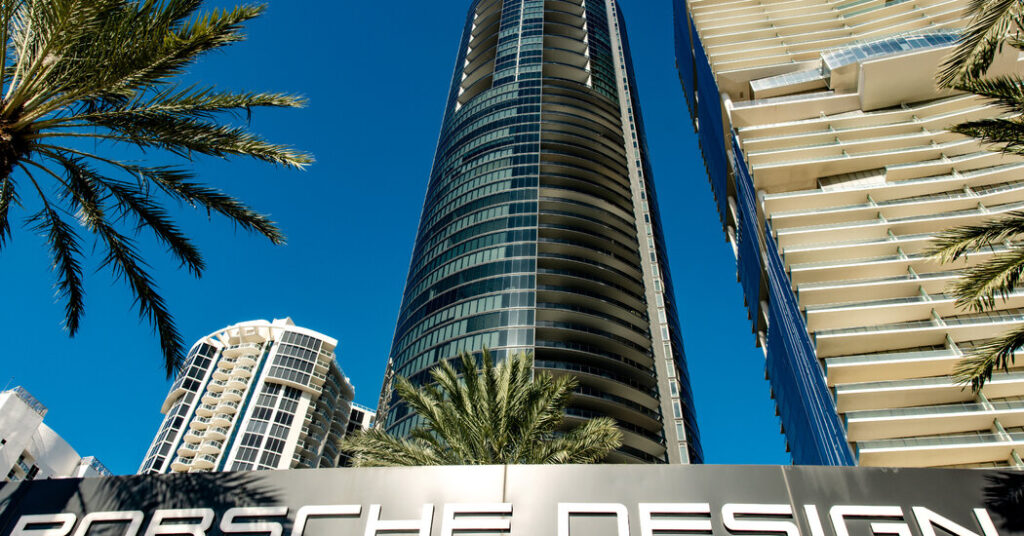
In addition to Pagani, which is expected to open in late 2028, the Porsche Design Tower in Sunny Isles Beach, which was completed in 2016, allows owners to drive directly into elevators that take the car up to a garage attached to their condo. The Bentley Residences under construction, also in Sunny Isles Beach, will offer the same amenity. In downtown Miami, the Aston Martin Residences, which opened in 2024, is designed to look like a ship. And the Mercedes-Benz Places, which is set to open in 2028 in Brickell, Miami’s financial district, will offer homeowners services like a chauffeur-driven Benz, or even one on loan.
“They don’t need to own a car, deal with insuring, parking, maintaining it — they just have a seamless lifestyle,” said Michael Stern, whose company, JDS Development Group, built Mercedes-Benz Places.
Branded residences are condominiums that marry a developer and a brand through a licensing agreement. Some brands exit soon after signing while others stay through the completion to approve designs and materials. Few commit to stay to manage the property.
“The primary challenge lies in seamlessly translating a legendary automotive identity into every square foot of the building spaces,” said German Coto, the man behind Aston Martin Residences, who sold nearly all of his 391 residences before completing the development.
Liam Bailey, a partner and global head of research at Knight Frank, an international real estate consulting firm, said that for buyers unfamiliar with an area, a well-known brand could be a powerful draw.
“A lot of people who buy in a market overseas might not be familiar with the taxation, regulation and so on,” he said. “They’re not always familiar with good quality builders. A hotel brand or car brand is the validation.”
Miami ranks second globally for the most branded residential developments, with 76 projects completed or in the pipeline, behind only Dubai’s 164, according to data provided to The New York Times on branded residences by Knight Frank. Both cities have recently seen more car-branded residences. New York is No. 3 for the most branded residences in the world, totaling 48, but none are associated with auto brands.
Miami also leads the country with the highest concentration of international home buyers, according to the latest report by the Miami Association of Realtors. Last year, international buyers paid $4.4 billion for homes in Miami, up 42 percent from the year before.
The car-branded business model so far seems to be working in the city, where those condos sell at higher prices than non-branded ones. The median sale price at the Porsche tower hovered at $4.25 million last year for the eight units that sold, said Ana Bozovic, founder of the real estate consulting firm Analytics Miami, who used data from the Multiple Listing Service, the platform real estate agents use for transactions. That’s higher than the $2.13 million median sales price for condos in all luxury buildings and even higher than the $740,000 median sales price for all condos in Sunny Isles Beach.
The concept of branded condominiums was introduced to Miami-Dade County by Gil Dezer, president of Dezer Development, in 2008 when he joined with Donald J. Trump to create Trump Towers — three residential buildings in Sunny Isles Beach. Mr. Dezer is behind the Porsche Design Tower and the soon-to-come Bentley Residences.
Mr. Dezer, who owns a collection of 29 cars, got into car-branded residences when Porsche brought the idea to the firm in the early 2010s when the country was still recovering from the Great Recession.
“We said, ‘What does Porsche have to do with real estate?’” Mr. Dezer said. “It was a perfect storm with there being no mortgages at the time. So we went after a really high-end buyer that wasn’t financially sensitive.”
The key was catering to car aficionados through design. For Porsche, the turning point came with the Dezervator, a drive-in elevator that allows residents to take their cars up to their condo. They can park in a glass-encased garage and view their cars from their living room. Lionel Messi, Alicia Keys and Swizz Beatz have all called the Porsche tower their home.
Mr. Dezer also brought his patented elevator system for the 62-story, 216-unit Bentley tower. Sales there started in early 2022, and 60 percent of the building, or about 130 residences, has sold. The remaining condos start at $5.8 million for a three-bedroom.
Because car-branded condos haven’t been around too long, the jury is still out on whether they’ll pay off for the developers or the owners when it’s time to sell compared with other kinds of branded residences.
“What does a car manufacturer know about optimizing daily life for residents?” Ms. Bozovic of Analytics Miami said.
Failing to run a property properly is the accusation in two lawsuits against G&G Business Developments, which built the Aston Martin Residences. The lawsuits, filed this year by the development’s homeowners association, accuse Mr. Coto, chief executive of G&G Business Developments, of misusing condo association funds and allege poor construction of balconies and other safety-related defects. It also mentioned failed promises by the developer, such as the completion of a helipad.
David Haber, a lawyer representing the homeowners association, said Mr. Coto had not fulfilled his promises. A spokesperson for Riverwalk East Developments, a Florida company mentioned in the lawsuits and managed by G&G Business Developments, did not provide a response from Mr. Coto but said Riverwalk East Developments said that “the firm maintains total confidence in the judicial system.”
Despite legal battles and other challenges in building car-branded residences, the developers behind them say their bets will pay off as more of the ultrawealthy move to Miami. The Mercedes-Benz project, for example, is in an area of the city that has attracted more high-net-worth individuals since the Covid-19 pandemic.
Mr. Coto, heir to one of Argentina’s largest supermarket chains, said he would pursue another branded development. “Miami stands as the global epicenter of wealth migration and luxury real estate,” he said.
Mr. Hamaoui is also betting big on that wealth migration. The 30-story Pagani Residences is being constructed on North Bay Village, an up-and-coming neighborhood on a man-made island. It’s one of a handful of projects reinventing an often-overlooked community that was the hangout spot for the likes of Frank Sinatra and the comedian Jerry Lewis in the late 1960s. Residences in the 70-unit building start at $3.9 million.
The post Why More Luxury Car Brands Are Getting Into Miami’s Condo Market appeared first on New York Times.