Good night, Sara.
Of all the sentences, passages and lyrics I heard, read or sang on my family’s 2,000-mile trek across much of America — from the Midwest to the Southwest — those three words stayed with me most.
Good night, Sara.
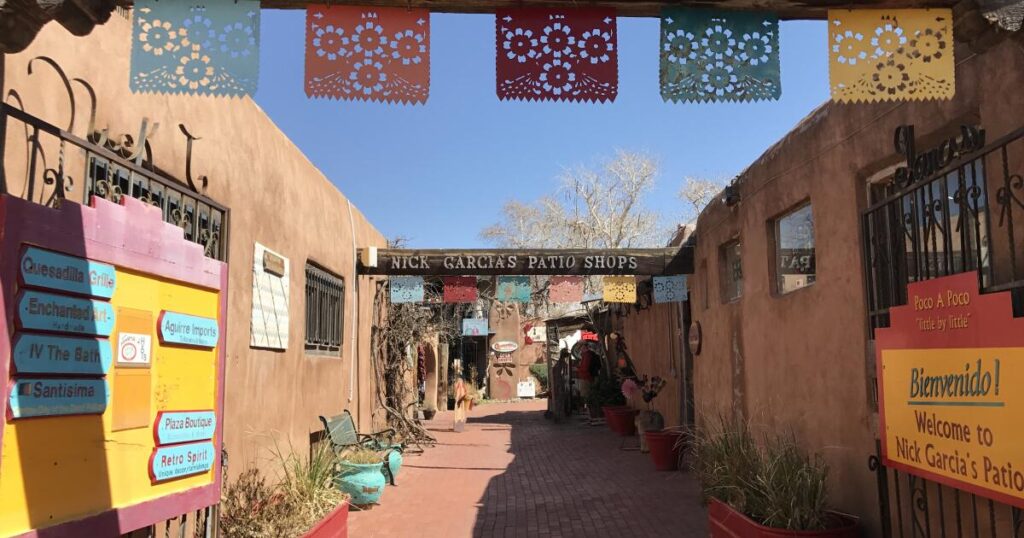
The waitress at the Church Street Cafe in Old Town Albuquerque told me to say them before I left, otherwise Sara Ruiz — the resident ghost, a member of the family that owned the building for three centuries — might follow us home. Now, if Sara was going to chip in for gas, that might not have been a bad thing. Everywhere we stopped to fill up was roughly $70 a pop. However, we didn’t want to take any chances, so we did as we were told.
We were the guests. It was Sara’s home.
I don’t know what you’d encounter in Transportation Secretary Sean Duffy’s new YouTube show “Great American Road Trip,” but on my drive, what I kept seeing — over and over — were the things that hold us together. Like eating a good meal.
In Arkansas, I had ribs so tender the meat kept falling off the bone before I could get it to my mouth. There wasn’t even enough time to catch a photograph. The people who walked through that door were every shape, size, color, coupling and political affiliation. When the food is good, the food is good. Often we characterize bipartisanship as “setting aside differences,” which, of course, highlights our differences. Sitting at a Wright’s Barbecue, watching the whole of Razorback Country walk in and out the doors for an hour, reminded me of what’s possible when the focus is on our common needs. The paradigm shift that’s needed in our politics is one that is moving away from being “nasty” — as Newt Gingrich exhorted Republicans to be 30 years ago — and rather strives to see what we have in common.
I was reminded of that thread while walking around Nashville and Oklahoma City, or standing in the line at small-town gas stations buying lottery tickets. Even there, in line, you’d catch it: different accents, different license plates, rainbow stickers on cars from distant states. A reminder that, most days, we have more in common than not. Like hoping to win the lottery.
The chants of “taxing the billionaires and millionaires” doesn’t mean that folks don’t want to be rich. That’s just the sound of voters realizing the citizens of the richest country in the history of humankind should not have to struggle this much to make ends meet. Call it democratic socialism, call it Occupy Wall Street, call it populism … but whatever you do, don’t call this moment unprecedented. Over the course of 250 years, we have enough data to know that when capitalists run amok, it’s up to the people to right the ship.
Which brings me to another commonality I saw on my drive across America: homelessness.
I don’t know what the secretary and his family saw on their trip, but what I saw, in every county I drove through, was housing insecurity. We like to tell ourselves it’s a California problem, a Chicago problem — something that happens in big blue states. Of the states I drove through, all but one were red and had been red for a long time.
The problem is ours, all of ours.
That thread runs back to my hometown of Detroit, and the corner of Martin Luther King Jr. Boulevard and Third Street. It’s here where KEM, the Grammy-nominated, platinum-selling R&B singer, once roamed as a homeless man some 30 years ago, back when Gingrich was telling his party to be nastier. And it is here where this summer this city renamed a street in honor of KEM for the work he has done on the issue in the decades since. And that thread runs all the way to Phoenix, where it isn’t uncommon to see street signs named after presidents and underneath them, people of every color, age and political affiliation lying on hot concrete, exposed for hours to a desert sun, without sunblock, without water or a meal — and worst of all, without compassion from their neighbors.
College students in Southern and Southwestern schools like Vanderbilt University and Arizona State are learning how not to see the human desperation in front of them, one semester at a time.
Learning how to tell themselves that this is someone else’s problem.
That it’s someone else’s fault.
What other conclusion can be reached considering this country’s approach to homelessness? We’re teaching the next generation that, in the richest country that has ever existed, it is acceptable that some people are reduced to huddling in storefront entryways overnight. The U.S. is wealthy enough that this doesn’t have to be the case, but our discourse ignores the obvious choices that are being made about priorities and instead pretends resources are too scarce for everyone to have a safe home and three meals a day. In the nation that celebrates the Fourth of July with hot-dog-eating contests.
Just as a good meal has the power to pull folks from every corner together in their shared humanity, that is also true of poverty, homelessness and economic insecurity. And yet instead of teaching the next generation to care for people less fortunate, our policies generally reinforce a narrative that America’s poor reflect individual failure and not systemic outcomes. How else is any young person supposed to process walking through debilitating heat and seeing senior citizens — some of them veterans — lying motionless in the street?
And what do you think happens to the heart of a nation when every generation is taught to avoid eye contact, talking to or even caring about what happens to the hurting people around them?
Over those 2,000 miles, I saw a lot that holds us together — some of it ugly. Our treatment of the homeless is a vile, immoral thread of connection. A rich society chooses to live with the immorality of homelessness. As if this were the way things must be.
And yet, we all know nothing could be further from the truth.
YouTube: @LZGrandersonShow
The post My road trip revealed the good and the bad that hold America together appeared first on Los Angeles Times.