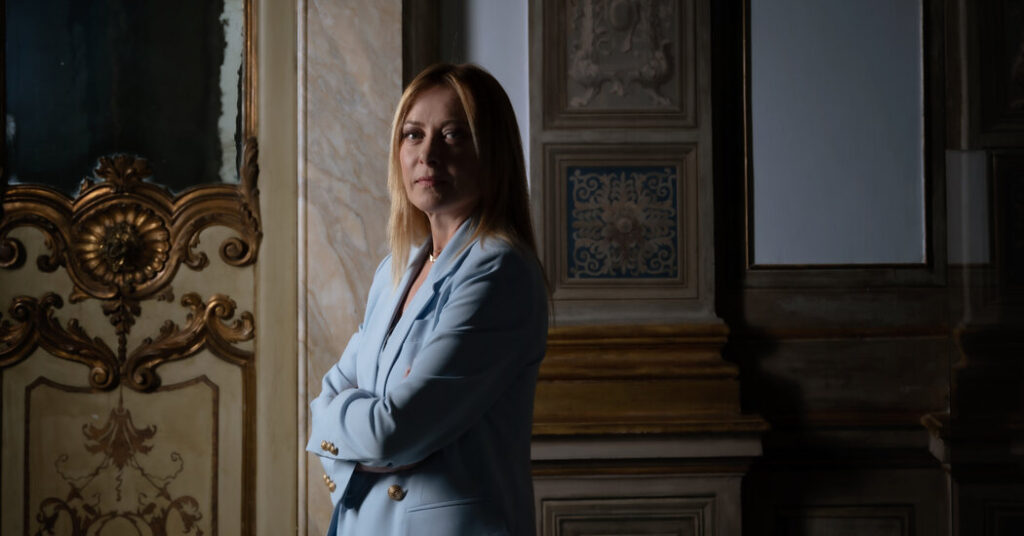
Giorgia Meloni, daughter of the extreme right, likes to set records. As she settles into an armchair opposite a painting of rustic revelry inspired by Titian, she reflects on the secret of the political success that will soon make her the longest continually serving prime minister in the history of the Italian Republic.
“I am a person who imposes rules on herself,” she says in a rare interview. “The first rule is that I never say something I don’t think. There is no way to get me to say something I don’t believe — my brain short-circuits.”
She smiles, as if to say it’s that simple, but of course it is not. She has remained something of an enigma, a tightly controlled one, as she has journeyed from post-Fascist roots to a pivotal place in the European politics she is changing.
Ms. Meloni has chosen to meet in a lounge adjacent to her Rome office. She is gracious to a fault. In such moments it is hard to recall the way she may roll her eyes and stare daggers when angry, as she has been of late with President Trump, her ideological ally, and Pedro Sánchez, the left-wing Spanish prime minister, an ideological foe.
“I think people see the difference,” says Ms. Meloni, who has been in office for almost four years, about four times the postwar Italian average. “They know if something’s untrue, false — and I believe that’s the biggest mistake a politician can make.”
Truth is not exactly the political currency of this age, but Ms. Meloni has always marched to her own drum. The effect has been transformative. “Melonization,” or the numbing of horrifying history, has entered the lexicon.
It denotes the process Ms. Meloni now personifies that allows a post-Fascist party, in this case her Brothers of Italy, to shed the threat of violent authoritarianism and gain acceptance in the mainstream through pragmatic conservatism, or at least its appearance.
“I think what got me here” — to her office at Palazzo Chigi — “was the courage to stand on the uncomfortable side of history,” Ms. Meloni says, speaking Italian. “To opt to be against the current.”
Courage is by some distance her favorite word.
With Marine Le Pen, of the once-outcast French far right, a strong candidate in next year’s presidential election, and the hard-right Alternative for Germany, or AfD, leading polls in that country, the Meloni effect is about to be tested at the core of postwar European integration.
If Fascism in Italy, land of its birth, can be made to seem remote, even irrelevant to political success, so too perhaps can the Holocaust in Germany and the collaborationist wartime Vichy regime in France. It was Vichy’s antisemitic nationalism that inspired Ms. Le Pen’s father in founding the National Front, now rebranded as the National Rally.
Ms. Le Pen, it seems, will have a ready retort as she seeks to reassure French voters: Just look at Italy!
“Meloni is not a visionary leader, but she has become a global star and the emblem of the possibility that far-right nationalists can be absorbed,” said Giovanni Orsina, the director of the LUISS Guido Carli School of Government in Rome.
Far from upheaval, Italy has found stability under Ms. Meloni, who has demonstrated the fiery talents of a demagogue anchored by a cool realism. France has had six governments and Britain three prime ministers since she took office in 2022.
With President Emmanuel Macron of France departing next year, Ms. Meloni could become the doyen of European politics, in the way former Chancellor Angela Merkel of Germany once was, at a time when a fragmenting world order is in profound and uneasy transformation.
Yet the question of what transformation Ms. Meloni seeks remains open. Has she really become a democratic moderate at the age of 49? Or does a 19-year-old Neo-Fascist still lurk inside her, the militant with an angelic face who told French TV in 1996 that “Mussolini was a good politician” and “everything he did, he did for Italy”?
A Bridge Too Far
Ms. Meloni wanted to be the bridge over troubled waters. The only leader of a European Union government invited to Mr. Trump’s inauguration, she aimed to build on their shared nationalism and hostility to immigration, and also to ensure that the Western alliance remained functional.
So last year when Mr. Trump, in a tone of oleaginous flattery, called her “a beautiful young woman,” she feigned indifference. Bigger things were at stake.
Still, provocations cascaded from the White House. The European Union had been created to “screw” the United States, Mr. Trump declared. Greenland, a semiautonomous Danish territory, should be handed to the United States. NATO’s European allies were wimps, holding “a little back” in Afghanistan, where Italy lost 53 soldiers.
“Insulting Italy when we had paid a tribute in blood in Afghanistan was a brutal affront,” said Fabio Rampelli, the vice-president of the lower house of Italy’s Parliament and a longtime Meloni confidant.
Ms. Meloni did her best to turn the other cheek. “It’s evident that with Donald Trump, I believed things would be easier, given our convergence on immigration and woke culture,” she tells me. “Things have turned out otherwise.”
“Otherwise” is an understatement. In June she became the first of several insulted European leaders to hit back hard at Mr. Trump. As a result, she and Mr. Trump have not spoken in several weeks, she reveals.
For her, the red line was crossed first in April when Mr. Trump attacked Pope Leo as “WEAK on crime, and terrible for Foreign Policy.” Ms. Meloni responded that such remarks were “unacceptable.” Trump snapped back: She was “unacceptable.”
You can criticize many things in Italy — the bureaucracy, a spaghetti carbonara, a once-glorious soccer team that for the third time running did not qualify for the World Cup — but not the Holy Father, and certainly not in ALL CAPS.
It was downhill from there. Mr. Trump floated a story that Ms. Meloni had “begged” him for a photograph together in June at the Group of 7 summit in France.
She was incandescent. She berated Mr. Trump: “Italy and I never beg.”
The deliberate fusion of nation and self expressed her sense of a mission to change the perception of Italy, from land of beauty and inefficiency to land of serious intent.
Her shared values with Mr. Trump were eclipsed by her single biggest foreign-policy objective: to overcome Italy’s longtime status as the least of the major powers and give the world’s eighth largest economy geopolitical heft.
“I don’t like the idea of a submissive Italy, an Italy that sees itself as lesser than others,” she tells me in our interview. Her goal, she says, is to achieve “the biggest revolution that can happen in this nation — a revolution of pride.”
She regrets nothing: “I continue to believe that the unity of the West is something very important. I don’t decide Italian strategy on the basis of my personal relations.”
Asked if she and Mr. Trump would speak after the summer break, she hesitates. “Well, we will see.”
In Search of a Cause
Ms. Meloni learned early to shun passivity. “I grew up with the idea that I was worthless,” she writes in “I Am Giorgia,” her autobiography. “My reaction was to commit myself with all my being to demonstrate the contrary.”
Abandoned as an infant by her father, who left for Spain and whose death in 2012 left her “indifferent,” Ms. Meloni buried in a “black hole” the “pain of not having been loved enough,” as she puts it in her book.
She hardened. At 13, she had decided never to see her father again. It was an irrevocable choice, as when in 2023 she dumped Andrea Giambruno, her partner and the father of her daughter, Ginevra. (A video and audio had caught what appeared to be his crude propositioning of female colleagues. The relationship “ends here,” she wrote the next morning on social media.)
The love of her mother, Anna Paratore, who wrote some 140 racy romance novels under the pen name Josie Bell, filled the void. Ms. Meloni grew up with her and an older sister in the Garbatella district of Rome, a working-class area with middle-class enclaves, including the one in which they lived.
The second-floor apartment of her youth stands in a lovely courtyard of orange trees, pines, loquat trees and palms. A Palestinian flag is draped from one window; there are many in Rome. On a wall nearby is scrawled, “Think poetically. Meloni out!”
Garbatella belongs to the left and always has. Yet Ms. Meloni, just 15, opted for the right of Fascist roots.
Her decision stemmed from outrage, she explains. The Mafia’s assassination in the space of two months in 1992 of Giovanni Falcone and Paolo Borsellino, two Sicilian prosecutors threatening it, felt overwhelming.
“I remember on a hot July day watching the images on TV,” she says, “and thinking we can’t go on like this. Basta!”
Mr. Borsellino had once been close to the extreme-right Italian Social Movement, or M.S.I., founded in 1946 by former members of Benito Mussolini’s Fascist party. The fringe party stood apart from the massive political corruption scandal sweeping Italy in the early 1990s, which added to its appeal, Ms. Meloni says.
She called the headquarters of the M.S.I. and discovered that an office of its Youth Front was “right around the corner.”
One day she walked in. At the time, the post-Fascist right had no chance of attaining power, and even two decades later, when she co-founded Brothers of Italy, the party hovered around 3 percent of the vote for seven years. Yet she persisted.
“I don’t like others telling me what my limits are,” she says. “A ‘No’ is one of the things that mobilizes me the most.”
A ‘Complex’ Time
That Garbatella office now houses a branch of Ms. Meloni’s party. There, I found Marco Volponi in charge.
He has known Ms. Meloni since they were teenagers. I asked him about the party logo outside with its tricolor flame in the green, white and red of the Italian flag, a symbol first adopted by the M.S.I. and widely seen today as representing the spirit of Fascism burning still.
“It’s not Mussolini’s,” Mr. Volponi told me, echoing the party line. “It’s the flame of our ardor from 1946 to where we are today.”
Ms. Meloni, of a generation distant from World War II, has denounced but not entirely disavowed Fascism, affirming “our opposition to all totalitarian and authoritarian regimes.”
She used her inaugural speech to say that “the worst moment in Italian history” was when Mussolini promulgated the anti-Jewish race laws of 1938; thousands of Italian Jews were ultimately sent to their deaths under partial Nazi occupation.
In our interview, however, she refers to the Fascist period merely as a “particularly complex” time. So complex that its aftermath haunted her childhood and adolescence.
During the “years of lead,” from the late 1960s into the 1980s, neo-Fascist and far-left groups were intent for different reasons on upending the postwar Republic. Bombings, assassinations and massacres left more than 400 dead, including one prime minister, Aldo Moro, killed in 1978 by the leftist Red Brigades.
Such was the instability in which Ms. Meloni was raised and that, in various, less violent forms, long haunted Italy. She made stability her watchword.
Ushering her post-Fascist party into the mainstream, Ms. Meloni has refused to say that she is an anti-Fascist, which to her seems to denote the leftist groups of her youth for whom, in their words, “killing Fascists is not a crime.”
“I know the name and the story of all the youths sacrificed on the altar of anti-Fascism,” she has written.
Of neo-Fascist terrorism, Ms. Meloni has far less to say. Two rightist bombings left 102 people dead in attacks in Milan and Bologna alone. For her, the left was to blame for Italy’s postwar troubles, and the “complex” period where her party found its roots was best set aside.
Speaking of Italian Fascism, she says in the interview: “Clearly, if we look at this history today it’s one thing. If we looked at it standing in the midst of it probably, we would have seen it differently, no?”
The historian R.J.B. Bosworth, in his biography “Mussolini,” writes that Il Duce’s dictatorship “caused the premature deaths of at least one million people.” They died in killing fields from Africa to Albania and Yugoslavia, and, not least, in Italy itself.
Mussolini also drained the Pontine Marshes, built Milan’s Central Station and, it is said, made the trains run on time.
Any moral appraisal of Mussolini’s rule seem clear enough. But “Italy never settled its accounts with Fascism,” said Davide Conti, a historian. “There was no Nuremberg because nobody wanted it, and if you prosecuted Italian Fascists, you had to turn to the Resistance, most of them Communists.”
Ms. Meloni benefited from this vacillation, navigating a narrow path between commitment to Italian democratic freedom and curious ambivalence over the period of its loss.
She did not open the door to the far right — Silvio Berlusconi, starting in the mid-1990s, did that as prime minister for a total of nine years at the head of four governments. But she was the ideal politician to step through it.
Just 14 years after she walked into the Garbatella office, she was elected to Parliament and became the youngest deputy speaker in the history of the Republic. Two years later, in 2008, she set another record, as the youngest minister, age 31. The third record, for governmental longevity, awaits her on Sept. 4.
The extreme right had always been seen as “dangerous, nostalgic, Fascist, racist, xenophobic,” said Mr. Rampelli, who headed the Roman Youth section of the M.S.I. when Ms. Meloni joined it.
“And here was a very young woman, 5 feet 3 inches tall, blonde and blue-eyed, smiling and sarcastic, who had nothing to do with Fascism — and from that moment on, all the people who continued insulting us just became ridiculous,” he said.
“Perhaps I was the right person at the right time,” Ms. Meloni suggests.
Meloni and the Tide of History
To understand Ms. Meloni’s ascent, I went to Piombino, on the Tuscan coast, a once-thriving steel town whose streets are now hushed. For decades after World War II, its steel industry employed more than 8,000 workers. Today, no more than 500 hang on.
Once a center of anti-Fascist resistance, Piombino was long a stronghold of the left and hard-line unions. Today, Ms. Meloni’s party has taken over.
Francesco Ferrari is the mayor. A suave lawyer, he was elected in 2019 as the first right-wing mayor since 1945 and re-elected two years ago. The left — through empty promises and poor management — exhausted the patience of Piombino’s workers.
They joined a vast 21st-century migration from left to right across Europe of a working class angry at globalization and its cost in jobs, at uncontrolled immigration and at the alien values of a liberal urban elite.
A sign at the exit of the factory, a ghostly sprawl, says, “Thank you,” alongside an image of a handshake. “Thanks for what?” laughs Michele Nardini, who worked for 25 years on the blast furnace before losing his job in 2024. “They screwed us.”
Mr. Nardini now receives $1,250 a month in unemployment benefits. “I was betrayed by an entire political class,” he says over a coffee in the main square. “We were under the left for 70 years, so now I’ll give the right 70 years!”
Mr. Ferrari, the mayor, is trying to revive the steel industry and diversify the town into fish farming, tourism and other activities suited to its seafront location opposite the island of Elba.
“I have no problem pronouncing the word Fascist, or even anti-Fascist,” Mr. Ferrari says. But surely, he suggests, the judgment of Piombino’s people proves his party’s complete break with its forebears.
An agreement was reached in July for a Ukrainian company, an Italian steel producer and local authorities to invest $3.7 billion to create a cutting-edge plant. But Piombino has gone through too many promises for there to be much optimism.
Mirko Lami, a former senior official of the leftist C.G.I.L. union that once held sway, says Ms. Meloni has failed to deliver. Salaries are “among the lowest in Europe” and “the health service is going belly-up.”
Mr. Ferrari differs, arguing that an urban revival has begun, and he tells a story about his party’s leader.
“It was 2020 and Meloni came to visit,” Mr. Ferrari recalled. On the eve of his tenure, he said, the center-left Democratic Party had approved a project to expand a vast nearby garbage dump where stinking refuse rotted.
“Days before, she demanded the documentation on the dumpsite, details of the enlargement project, the nature of the garbage, my positions. And when we had meetings, she knew the dossier better than I did!”
The project was abandoned. The mayor beamed. “That is Giorgia Meloni.”
A Tight Inner Circle
When Ms. Meloni took office, Matteo Renzi, Italy’s former center-left prime minister, decided to give her a smart ring. Bill Clinton had advised him that the worst decisions were the result of too little sleep.
“I said, ‘Giorgia, this job is beautiful but agonizing, please keep track every night of how much you sleep.’ ”
Ms. Meloni soon tossed the monitor. “She thought I was trying to control her,” Mr. Renzi said.
“She trusts nobody,” Gianfranco Fini, the former M.S.I. leader who redefined the party as a democratic force in 1995 and steered Ms. Meloni toward a rapid ascent, told me. “She makes her own calculations.”
Ms. Meloni works in a small cabal that includes her older sister, Arianna, and several of the extreme-right activists she met in her youth. They get the top jobs in the Senate, cultural institutions and elsewhere.
Her insular style has infuriated the left. Mr. Renzi, who heads a small center-left party called Italia Viva, recently caused a ruckus by suggesting that “the Addams Family” was governing Italy. He is trying to unite the left to defeat Ms. Meloni in the elections next year.
Elly Schlein, the leader of the Democratic Party, the largest party of the left, cited Italy’s paltry economic growth rate of 0.5 percent, an 8 percent decline in real wages, some of Europe’s highest energy bills and depleted public hospitals as evidence of a “wasted historic opportunity.”
“Stability can be a value but when it’s immobility, people are unforgiving,” Ms. Schlein told me of Ms. Meloni.
The prime minister hits back in our interview. She rattles off a long list of “parameters” — employment, inflation, illegal migrant landings, health spending, market spreads. “Tell me if they are not better!”
These numbers have indeed moved in a positive direction, albeit sometimes fractionally.
“But it’s possible,” she says with characteristic sarcasm, “that I did nothing!”
“The best you can say is that there’s been no disaster,” said Veronica De Romanis, a professor of economics at LUISS Guido Carli University in Rome, noting that 1.2 million Italians are not in employment, education or training, with many leaving the country.
What Ms. Meloni has brought is fiscal discipline. Under Giancarlo Giorgetti, a respected finance minister, the budget deficit has come down from 7 percent to close to the European Union’s 3 percent limit. Italy’s debt has been upgraded for the first time in 23 years.
For Ms. Meloni, who said in 2014 that “we are for leaving the euro,” the flip-flop to achieve this has been marked.
She knew Italy needed E.U. money, including about $221 billion in pandemic recovery funds, an enormous boost to the economy.
So like a good European technocrat, the kind she had reviled, Ms. Meloni got in line on Italy’s deficit. Like a good European NATO member, she backed Ukraine against Russia.
“Just about anything is reversible,” said Salvatore Merlo, the deputy editor of Il Foglio newspaper, who knows Ms. Meloni well.
‘I Am Giorgia’
If Ms. Meloni’s father gave her little, he did, by living in Spain, afford her a perfect command of Spanish. On Oct. 7, 2021, in a 17-minute speech in Madrid, she uttered, not for the first time, words that have become her anthem.
“Yo soy Giorgia! Soy una mujer!” and on and on. “I am Giorgia, I am a woman, I am a mother, I am Italian, I am Christian. They cannot take this away from me! They will not take this away from me!”
“They” were the objects of Ms. Meloni’s loathing: the “barbarians of Black Lives Matter,” as she put it; the left trying to “turn Europe into a Soviet state”; the Greens “bankrupting us”; the “monsters” who propose the use of a surrogate uterus.
I asked Ms. Meloni why her cri de coeur resonated. “Because it struck a chord that millions of people felt,” she says. “Feeling threatened in your most authentic, basic identity. It gave an easy slogan to an emotional rebellion.”
Part of that “basic identity” is being a woman, Ms. Meloni says, without saying how it is threatened. She demurs when I inquire if she is a feminist. She tends to play to a sexist culture effectively, with arch self-deprecation.
When an A.I.-generated deepfake photograph of her in lingerie spread online recently, she posted it on her Instagram account. She denounced it, sort of, while commenting that it “improved my appearance a lot.”
Ms. Meloni has been criticized for choosing to be called “il presidente” in the masculine form. She tells me she thinks that feminists have fought “the wrong battles” over things like gender quotas.
“What interests me is whether I’m free to become president of the Council of Ministers,” she says, using the formal name for the Italian cabinet and its prime minister. “That’s equality, not being called ‘la presidenta.’”
She argues for a similarly tough and practical path to global respect for her nation.
Italy had to stop acting as “the spare wheel to France and Germany,” she says. It needed to be “seated at the table of those who set the direction” and it needed stability — “not a point of arrival but a point of departure,” she tells me — to achieve this.
Ms. Meloni’s quest to reshape Italy’s self-image is evident in small details. She almost never refers to the “Republic” or the “country” when speaking of Italy, but always to the “nation.”
It is a marked shift from her predecessors designed to reinforce the idea of a community of blood and culture with every right to renewed national pride.
Of course a Republic is the home of equal citizens; nation as understood by Ms. Meloni has a lot to do with immemorial Italian lineage. For this reason, immigration has been a central and divisive issue.
This month, Ms. Meloni led a broad E.U. assault on Mr. Sánchez, the Spanish prime minister, for supposedly lax immigration policies after thousands of migrants surged into Ceuta, the small Spanish territory in North Africa.
The clash demonstrated Ms. Meloni’s influence in pushing Europe rightward, as well as her capacity to engineer overheated emotion to feed her far-right base.
At home, her immigration policies have been fiercely contested.
She quietly authorized some 450,000 visas for migrants to work in Italy’s fields and factories and to look after Europe’s oldest population. She also devised an investment plan for Africa to increase the appeal of making it at home rather than leaving.
A plan to send asylum seekers to Albania still faces legal challenges and has proved expensive with paltry results. It looked like a fiasco until, in June, the European Union approved the “use” of “return hubs” to asylum seekers in “safe third countries.”
This has allowed Ms. Meloni to claim victory in European immigration policy.
The Lingering Question
Italians are surrounded by vestiges of the Roman Empire. They know the zenith of their power was reached long ago and they know the vanity of great ambition. “Italy shall repudiate war,” says its 1948 Constitution.
One such reminder can be found at the Colle Oppio, an area behind the Colosseum that holds the ruins of the thermal baths of the Emperor Trajan, where Ms. Meloni and her far-right cadre used to convene. For a teenage Ms. Meloni, the place assumed near-mystical importance.
“In Colle Oppio I learned to defend my ideas,” Ms. Meloni tells me. “I became the person I am thanks to the years of youthful militancy.”
Guido Crosetto, the defense minister and a co-founder with Ms. Meloni of Brothers of Italy, said in an interview at the ministry that she “has sacrificed everything for what she built.”
Around him hung portraits of all past Italian defense ministers, including Mussolini. Having worked in Germany for some years, I tried to imagine an equivalent in Berlin. A Hitler portrait on display! I failed. Fascism is a different word to Germans and Italians.
I was reminded of this on May 22 when Ms. Meloni published a eulogy on Instagram for Giorgio Almirante, an ardent Fascist under Mussolini who was the founder in 1946 of the M.S.I., the neo-Fascist precursor to her party. His conception of politics lived “with passion, dignity and respect” would live on, she promised on the 38th anniversary of his death, and be ever recalled by an Italian right determined to act “with courage.”
Mr. Almirante was a prominent contributor to a racist, antisemitic review, “The Defense of the Race,” published under Mussolini. In it he wrote: “Our racism must be that of the blood in our veins.” Otherwise, he warned, Italy would fall to “the half-castes and the Jews.”
Later in life, Mr. Almirante embraced democracy. “He taught us something very important in terms of values,” Ms. Meloni tells me in the interview. “That you can fight your battle with dignity even from a very marginal initial position.”
“Meloni has never said or done anything Fascist,” Stefano Feltri, who edits a Substack newsletter called “Appunti” (Notes), told me. “But she is not a part of anti-Fascist Italy, the culture of the Resistance that produced our Constitution.”
Ms. Meloni tried this year to change that Constitution in a referendum that would have brought Italy’s judges, long resented by rightist leaders as a liberal force, under tighter political control.
The shattering defeat she suffered on her most ambitious single piece of domestic legislation appeared to be an indicator that not all Italians trust her with power.
“A victory would have led later to more profound modifications to the Constitution, in the direction of a stronger executive, a more presidential system,” said Mr. Conti, the historian. “That is her fundamental aim.”
Yet there is no sign of her support crumbling. It hovers around 27 percent, slightly above her score in the 2022 election. For now, a divided left does not have a leader of her stature, leaving the next year’s election wide open.
A fresh challenge has emerged to her right in Roberto Vannacci, a retired general whose new party, National Future, has grown rapidly. “Nazism certainly had some negative sides, as did so many other historical periods,” he told me.
He has called for Italian “cultural homogeneity,” declared that gays are “not normal” and urged “remigration” of 500,000 undocumented immigrants.
“The basic mistake of Meloni is to have diluted herself,” he said.
Return of the Right?
Ms. Meloni’s achievement as prime minister has demanded disciplined moderation. But her past positions and nationalist core suggest that if she were re-elected next year, and Marine Le Pen came to power in France, the uncertainties surrounding Europe’s fate would grow. The AfD could also one day govern Germany.
“Memory fades after three generations,” Thomas Bagger, the German ambassador to Italy, told me. “Even the Holocaust does not resonate as it once did, and nor does the imperative of integration in Europe.”
Nazism and Fascism are not returning but nationalism, xenophobia and the war on its border present a serious challenge to the European Union, with Mr. Trump and President Vladimir Putin of Russia also seeking to weaken or even undo it.
“At best, Meloni wants a light-touch Europe,” Nathalie Tocci, a professor at the Johns Hopkins School of Advanced International Studies, Europe, told me.
The balance of power has already changed. This summer, I watched Ms. Meloni stand beside Mr. Macron, her sometime critic, answering questions from journalists at the first Franco-Italian summit since 2020, held in a sumptuous villa on the Côte d’Azur.
“I don’t think I am in a position to give advice to the French on what is best for them,” she said, turning her gaze to Mr. Macron. “Because I do not forget what was done to me.”
When Ms. Meloni was elected in October 2022, France provoked outrage in Rome by calling for the monitoring of “rights and freedoms” in Italy.
Here, with an edge to her voice, was Ms. Meloni reminding Mr. Macron of his perceived presumptuousness. Her Italy has since proved more stable than his France.
Ms. Meloni moves today with the authority of an established leader. At the recent annual general meeting of Confindustria, Italy’s most powerful business association, her voice rose steadily as she told the assembled heads of industry not to be afraid “because times of uncertainty are times of courage, and times of courage are inevitably also times of choice.”
Which choices Ms. Meloni will make we do not know. But we do know her advice to her daughter, Ginevra, who is learning Korean at the age of 9: “Take the long road, because short cuts are always an illusion.”
How, I asked Ms. Meloni, does her imminent milestone at the end of the longest political road affect her?
“You know, people say to me, ‘Giorgia, you must realize that you have made history!’ and all I can think of is all these kids after my death who one day will say, “Mamma mia, this afternoon I have to study Giorgia Meloni!’”
The history-maker laughed.
Gaia Pianigiani contributed reporting in Rome and Piombino.
The post Giorgia Meloni Cuts the Hard Right a Path to Power appeared first on New York Times.