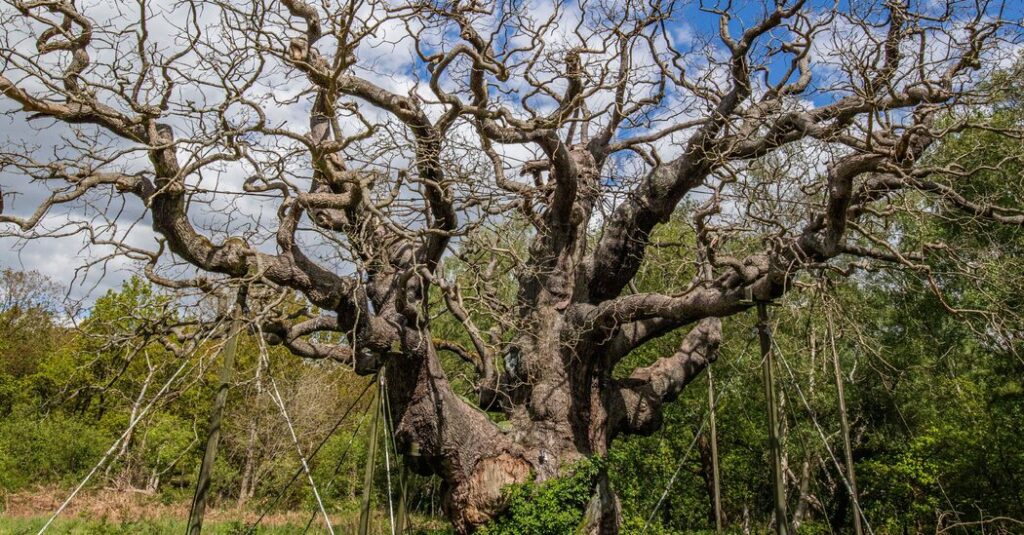
When Sally Kellard moved in 2018 to her home in Shropshire, in the English countryside, the old oak tree near her front door had a vibrant canopy of leaves.
In the eight years since, the tree — the Crow Leasow Oak, estimated to be about 1,000 years old — has withered nearly to death, with only a single living bough remaining, Ms. Kellard said.
“To be living next to such an iconic tree is a real honor,” said Ms. Kellard, who runs a bed-and-breakfast. “To think we’d see his final demise is heartbreaking.”
The tree is thought to be one of up to 3,500 ancient oaks in England that more than 600 years old. Many of these trees, which hold a significant place in English history, culture and imagination, have been suffering in sweltering temperatures and consecutive years of drought, according to Ed Pyne, a conservation adviser at the nonprofit Woodland Trust.
The threat was underscored in June when the Major Oak in Sherwood Forest, perhaps the most famous tree in the country, estimated at 800 to 1,200 years old, died. Conservationists cited a combination of factors, including climate change and over-tourism.
Dr. Pyne said that the demise of the Major Oak was not unique: England is losing one or two such trees a year.
“Losing trees of that caliber is something that’s just going to increase and increase as we go on,” he said.
England is at the tail end of one of its hottest summers on record, and the warming climate adds to the stress on trees, Dr. Pyne said. This month, a wildfire at the New Forest, a national park in England, destroyed a “significant number of ancient beech and oak trees which have been standing at this site for hundreds of years,” according to Forestry England, a government agency.
Ancient trees are less resilient than younger ones. They often suffer from compaction around their roots because humans and animals have walked around them for hundreds of years, making it harder for the roots to absorb water. And the dry conditions mean there is less water in the ground anyway, said Jon Stokes, the director of tree science and research at the Tree Council, a nonprofit in London.
“If you’re an already stressed old tree and then you get a soil moisture deficit drought as well, it’s not going to do you any huge favors,” he said.
The loss of ancient trees reverberates far beyond their surroundings because they house multiple species, said Dr. Pyne, who described a tree as “its own ecosystem.”
“It’s truly irreplaceable,” Dr. Pyne said. “We know that we don’t have the next generation of trees to replace these trees.”
Here are a few of England’s oldest and most noteworthy trees that experts say are in critical condition.
Crow Leasow Oak
This oak, one of the oldest trees in England, stands near the town of Ludlow, whose recorded history goes back to the 11th century, according to the local government. (The nearby Ludlow Castle is where Henry VIII’s older brother died, which led to Henry VIII becoming king.)
Ms. Kellard, who owns the 400-year-old house beside it, said local folklore holds that proposing under an ancient oak bodes well for a marriage.
Old Knobbley Oak
This 800-year-old tree in Essex, northeast of London, potentially tells a lurid story.
The area was home to Matthew Hopkins, who styled himself a witch hunter in the 17th century. Locals say that the tree was used as a hiding place by women he accused of being witches.
King John’s Oak
King John’s Oak is estimated to be over 800 years old and has a circumference of nearly 33 feet. It grew in a medieval deer park in Devon, in southwestern England, and is named after King John, who ruled England in the early 13th century.
According to folklore, the monarch hunted in the surrounding area of the tree.
Tea Party Oak
This more than 700-year-old tree is in Ickworth Park in Suffolk, in eastern England.
The tree takes its name from a gathering that the 4th Marquess and Marchioness of Bristol hosted beneath its branches in the early 20th century. The event became a tradition for children from a nearby village, according to the National Trust.
The tree is home to more than 300 species, including bats, birds and small mammals, according to the National Trust.
The post England’s Ancient Trees Are Dying in the Heat appeared first on New York Times.