Ferdinand Marcos, the longtime dictator of the Philippines, suffered the indignity after losing power. So did Viktor Yanukovych, Ukraine’s kleptocratic leader, and Nicolae Ceausescu, Romania’s Communist tyrant.
All had their private offices, off limits to all but loyal courtiers for years, suddenly thrown open to the public. Throngs of people clumped through their quarters, marveling in disgust at over-the-top, gold-trimmed décor and extravagant luxury.
Viktor Orban, the prime minister of Hungary for 16 years until his humiliating defeat in an April election, was never a despot, but his downfall has still opened his long sealed inner sanctum to the public gaze.
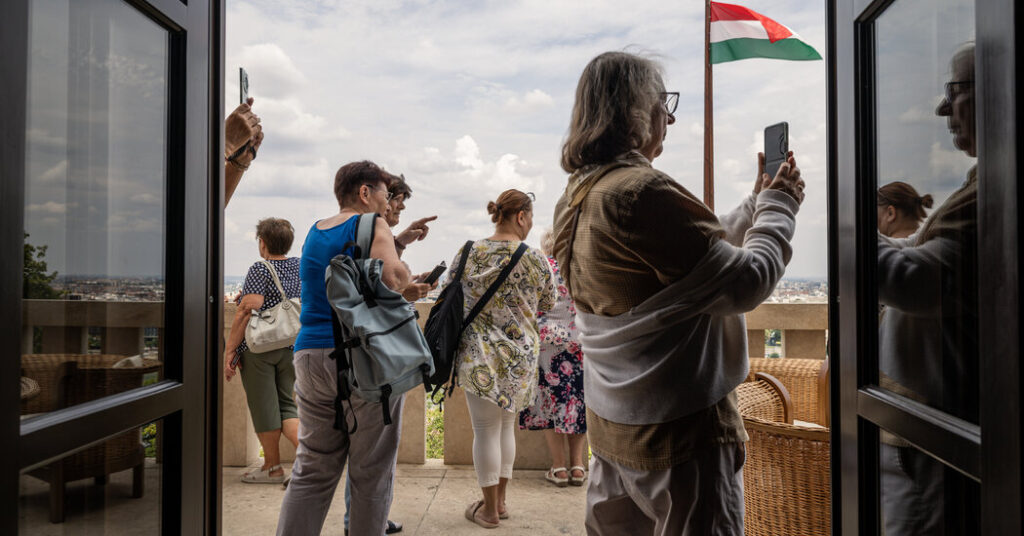
For the past three months, Mr. Orban’s suite of offices in a lavishly renovated 17th-century Carmelite monastery overlooking the Danube River has been crowded with Hungarians eager for a peek inside the rooms from where their country was run.
Peter Magyar, Mr. Orban’s successor as prime minister, started the stampede shortly after he was sworn into office, in May. He visited the former monastery, known as Carmelita, livestreaming his wanderings through empty corridors of deposed power and declaring them “a symbol of the lordliness, opulence and lies” of Mr. Orban’s rule.
As an exercise in political theater designed to shock, however, the opening up of Carmelita has disappointed some visitors. The building’s interior is not particularly opulent and looks more like a high-end boutique hotel than a spendthrift dictator’s pleasure dome.
In Mr. Magyar’s telling, Mr. Orban’s election defeat was not a routine democratic transition but “a total regime change” and was the start of what he calls “Operation Cleansing Fire,” the exposure and purge of the previous government’s wasteful extravagance.
Balazs Orban, the former prime minister’s political director, said Mr. Magyar was trying to fuel a fiction. “Our liberal political enemies always accused us of being dictators, but we never crossed the line,” he said, noting that Mr. Orban accepted his election defeat without complaint and made no attempt to hang on to his offices in Carmelita.
“The conservative experiment is over for the moment, and we will see whether the Hungarian people will like this new experiment or not,” he said. Mr. Magyar is a conservative, too, but rallied many liberals to his side.
Guided tours of Carmelita, perched on a hill in Budapest’s castle district, have given more than 25,000 people a chance to see fine artwork hanging on the walls and to enjoy a spectacular view of the Hungarian capital spread across both sides of the Danube.
“I was surprised that it was not more luxurious,” Aviko Acsai, 54, said after a recent visit with her husband. “I expected more grandiosity and pomp.”
Her husband, Andras Veszpremi, 55, was also underwhelmed. “I’m a bit disappointed,” he said, grumbling that he “was expecting to see the cigar room.” An adjacent building used by Mr. Orban’s cabinet chief does have a cigar room — shown off with glee by Mr. Magyar in a separate live-streamed visit — but there is no sign of one at Carmelita.
Nor is there anything like the four-pound solid gold paperweight in the shape of a loaf of bread that President Yanukovych of Ukraine left on his desk when he fled to Russia in 2014. There is not even Mr. Orban’s desk; he took it with him.
The only hint of gilt bling is the faux gold patine on an elevator door. Expensive oil paintings by celebrated Hungarian artists decorate the walls, but they are all on loan from the national museum so they were left behind when Mr. Orban moved out.
A small bedroom off Mr. Orban’s main office on the second floor is almost monastic in its simplicity. It looks as though it was furnished from IKEA, with a narrow metal bed frame and a fiberboard cabinet. “Such a puritanical resting place,” Mr. Magyar said during his live-streamed visit in May.
Public interest has still been huge, and the state property agency that owns the building restricts access to people who sign up for entry tickets online. The waiting list is weeks long.
With no evidence of opulent living on display, Mr. Magyar focused during his tour of Carmelita on two paper shredders left behind by Mr. Orban, decrying what he said was the previous government’s efforts to destroy incriminating documents.
Mr. Orban and his ministers, he said, “thought that all documents could be shredded or deleted — but I am sure this is not the case.” A priority task for his new government, he said, would be setting up a National Asset Recovery and Protection Office to return and safeguard state assets that he believes were stolen by the previous government.
Fidesz, the former governing party of Mr. Orban, has condemned efforts to recover what the new government says are stolen assets as evidence of Mr. Magyar’s “aggressive tyranny.”
Aside from the shredders, a few chairs and tables, a library full of antique books and the borrowed artwork, Mr. Orban and his staff left little behind. They left a Bible on a table in the anteroom to Mr. Orban’s office, opened to a page with a cryptic passage underlined: “The Most High is sovereign over all kingdoms on earth and gives them to anyone he wishes and sets over them the lowliest of people.”
Nobody is sure what message that was intended to leave for the new government.
Mr. Orban was not particularly religious, though he did have a priest mark the frame of the door leading to his office in chalk with a benediction.
For visitors, the main draw of Carmelita is that it loomed so large for years in their imaginations as a closed, secret world atop a hill in which Mr. Orban plotted Hungary’s transformation to “illiberal democracy.” It appeared daily in opposition media outlets as shorthand for Mr. Orban’s style of politics — haughty, self-absorbed and increasingly detached from voters’ concerns.
One of Mr. Magyar’s first moves after his Tisza party’s landslide election victory in April was to announce that he would not move into Carmelita but relocate the prime minister’s office from the hilltop in Buda to a drab office block near Parliament on the other side of the Danube, the flat land of Pest where most people live. This, he said four days after the vote, would demonstrate the new government’s determination to break with Mr. Orban’s “regime” and reconnect with Hungary’s democratic traditions.
The former prime minister’s political director scoffed at Mr. Magyar’s decision not to take over Mr. Orban’s offices in Carmelita as empty virtue signaling, deriding his choice of an “ugly, irrelevant building” on the other side of the Danube.
Carmelita has seen many residents come and go in the more than 300 years since it was built. The three-story building was originally constructed to house an austere order of monks dedicated to contemplative prayer. The land was previously the site of a mosque built during Hungary’s occupation by Ottoman Turks.
The monks were booted out in the late 18th century after the Hapsburg emperor dissolved their order and turned their monastery into a theater. Beethoven and Joseph Haydn performed there.
The theater survived centuries of turmoil but was badly damaged at the end of World War II, when the surrounding area saw Nazi troops and their Hungarian fascist allies stage a last, doomed stand against the advancing Soviet Red Army.
Renovated after the war, Carmelita again became a theater but was taken over by Mr. Orban’s government in 2014. After years of yet more renovation, Mr. Orban moved his office from Parliament into a second floor office suite in 2019.
The renovation stirred outrage among his political foes, who complained of excessive spending, particularly on the construction of a new balcony outside Mr. Orban’s office. Preservationists accused Mr. Orban of destroying the building’s facade in violation of Budapest’s status as a UNESCO World Heritage site.
Akos Kovacs, an employee at the state property agency now responsible for Carmelita, said “nobody really knew or cared about this building until Mr. Orban moved in.” After that, he said, “it became burdened by politics. Now everyone is interested.”
Janos Arva contributed reporting.
The post Orban’s Office, Thrown Open, Is Not the Den Hungarians Expected appeared first on New York Times.