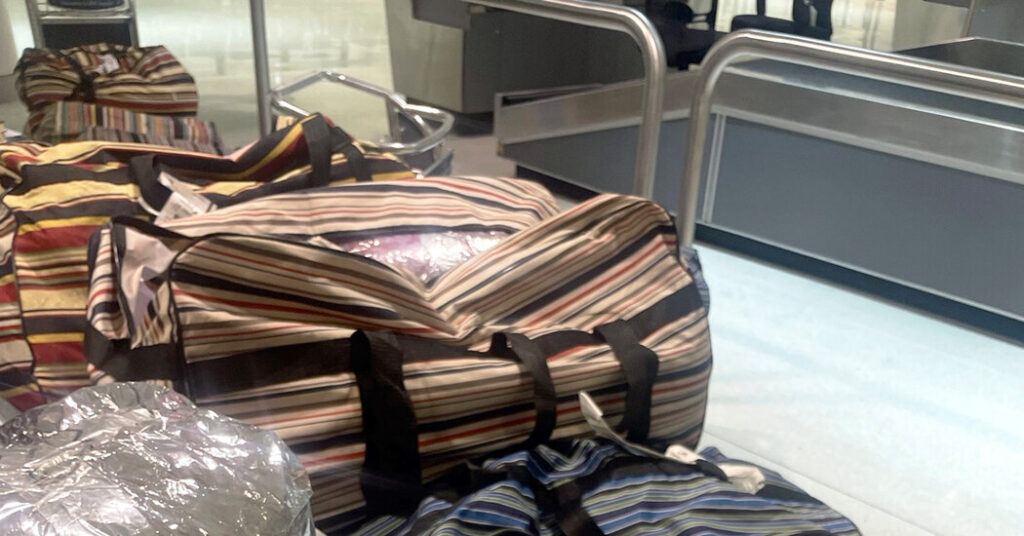
A traveler arrived in Baltimore from London on Tuesday of last week, but rather than collecting his luggage — five large duffel bags — he abandoned it on the baggage claim carousel.
U.S. Customs and Border Protection officials inspected the duffels and found what looked like dried, reddish-green tea leaves. Testing, they said, identified what they really were: khat (pronounced “cot”), a controlled substance used for its amphetaminelike effects that is typically grown in East Africa and the Arabian Peninsula.
There were approximately 300 pounds of it in this shipment. The next day, an additional bag, carrying 80 more pounds of khat, arrived at Baltimore/Washington International Thurgood Marshall Airport, in Maryland, according to officials. Then, last Thursday, officers at the airport seized another almost 850 pounds from two United States citizens who arrived from London.
The approximately 1,200 pounds of khat had a street value of only about $150,000, federal officials said. The customs agency said that the investigation into all three incidents was continuing, and it offered no other details on Thursday afternoon.
On Friday night, customs officers seized another 370 pounds of khat, this time at Dulles International Airport, outside Washington, D.C. Mohamed Diawara, 25, of New York was charged by the airport police with possession with the intent to distribute and with transporting a controlled substance into Virginia.
The busts add to the nearly 19,000 pounds of khat seized by Customs and Border Protection from Oct. 1 last year to July 31 this year, according to the agency. But experts say far more of the substance, which is used regularly in a variety of East African cultures, is routinely shipped into the country.
Khat is an evergreen shrub valued for its stimulant-producing properties when chewed fresh, brewed in tea or smoked.
But fresh leaves are rarely found in the United States. The plant has to be consumed within 24 to 48 hours of picking to have the most potent effect, experts said. The dried leaves found across the United States, though not on any store shelves, have far less of an effect, they said.
The plant is classified as a controlled substance in the United States because of its two active ingredients, cathine and cathinone.
In much of the Horn of Africa, which includes the countries of Somalia, Ethiopia and Djibouti, as well as in the Arabian Peninsula, khat has traditionally been used for treating headaches, diarrhea, depression, muscle aches, arthritic conditions, tooth aches and sore throats, said Ezekiel Gebissa, a professor at Kettering University in Flint, Mich., who has written two books on the political economy and history of khat in the Horn of Africa.
“It’s not for the high,” Dr. Gebissa said in an interview on Thursday. “People chew it for togetherness, for friendship, for making deals, for pastime, for prayer.”
“For those who migrated here,” he added, “it gives them a sense of home.”
The seizure was not surprising, he said.
“A lot of khat gets through, and some of it is seized,” he said. “You can find khat all over the United States, easily. There’s khat where I am right now in the D.C. metro area.”
Chewing khat is akin to smoking a cigarette or having a coffee, he said.
Dr. Gebissa said that if khat were a more powerful stimulant, it would have crossed into more mainstream use after being available in Western countries for decades.
“People don’t care about this when they have more potent and instantly reacting drugs,” he said.
The post Duffel Bags Full of Stimulants Seized at Baltimore Airport’s Baggage Claim appeared first on New York Times.