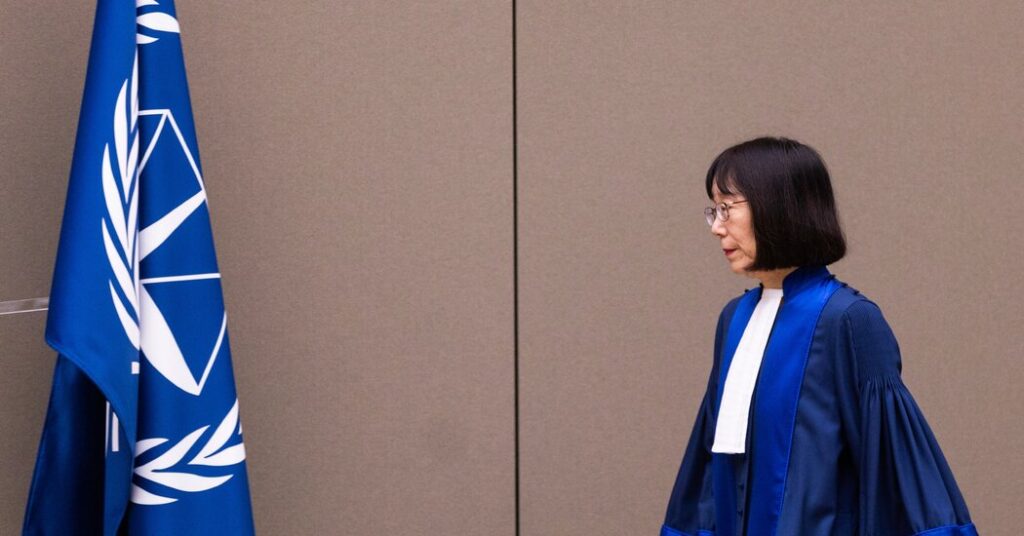
When the Trump administration escalated its attacks on the International Criminal Court last year, imposing sanctions on several judges, the court’s president, Judge Tomoko Akane, was distraught.
Judge Akane, who has long championed international law, called an emergency meeting. A colleague who had been sanctioned was in tears, lamenting that the move had taken away her dignity — a judge relegated to a list meant for terrorists. Judge Akane had not been sanctioned, but she cried, too, she later recounted.
“The situation is truly an existential crisis” for the court, she wrote in a book published in Japan last year, “Fighting War Crimes: The International Criminal Court Will Not Yield.”
This week, the situation got worse.
The U.S. government imposed a new round of sanctions on Tuesday that included Judge Akane, a force at the court who helped issue arrest warrants for President Vladimir V. Putin of Russia and Prime Minister Benjamin Netanyahu of Israel. Secretary of State Marco Rubio announced the sanctions, accusing the court of being “corrupt and fatally politicized.”
Japan had hoped it would not come to this. Behind the scenes, Japanese officials worked feverishly over the past year to urge their American counterparts to avoid blacklisting Judge Akane.
Japanese officials were concerned that penalizing the judge would undermine the integrity of the international legal system and harm relations between the two countries, according to two people briefed on the talks, who requested anonymity to discuss private conversations. Such a move could also embarrass Japan, they warned. Judge Akane is well regarded, and her ascension at the I.C.C., the world’s highest criminal court, was a point of national pride.
Some experts worry that the episode is yet another example of President Trump backing away from decades-old alliances. This week, the Pentagon said it was ending a major training exercise with South Korea earlier than scheduled, in part to punish the country for declining to support U.S. war efforts in Iran.
Judge Akane, 70, started her career in Japan in 1982 as one of only two women among 50 government prosecutors appointed nationwide that year. The Trump administration’s decision to impose sanctions on her has raised concern about the future of the I.C.C., which tries people accused of war crimes, genocide and crimes against humanity. Japan, one of the court’s biggest backers, contributes about one-sixth of the court’s $230 million budget, more than any other country.
Hoping to avoid antagonizing American officials, the Japanese government refrained from signing a statement from 79 countries last year in support of the “independence, impartiality and integrity” of the I.C.C., the people briefed on the talks said. Japan’s absence was notable.
But ultimately, Japan could not dissuade the Trump administration from acting on its promise to dismantle the court “brick by brick.” Many conservative politicians in the United States have treated the court as a threat, worried it could expose Americans, especially in the military, to politically motivated prosecutions. The United States has imposed sanctions over the past year on half of the court’s 18 judges.
Prime Minister Sanae Takaichi of Japan is now facing an outcry from politicians, lawyers, academics and others over the sanctions, which include freezing the judge’s assets and banning her from traveling to the United States. On Wednesday, Ms. Takaichi, who has cultivated warm ties with Mr. Trump, called the situation “deeply regrettable” — expressing a rare note of displeasure with the United States, Japan’s main security ally.
The I.C.C. did not respond to requests for comment. In a statement on Wednesday, the court said it “deplored” the Trump administration’s actions.
“These sanctions are a flagrant attack against the independence of an impartial judicial institution,” the statement said.
Japan’s foreign ministry declined to answer questions about the discussions with the Americans, pointing instead to a statement on Wednesday about the case.
Trump Administration: Live Updates
Updated
- Trump officials move to fund Gaza peacekeepers, even as a peace plan falters.
- The Abraham Lincoln leaves the Middle East after 9 months at sea.
- The State Department has declared a U.S. citizen wrongfully detained by China.
“Japan intends to continue working to strengthen the rule of law in the international community while maintaining close communication with relevant countries and parties,” the statement said.
A Confident, Dedicated Prosecutor
Judge Akane, who grew up in Nagoya, an industrial metropolis in central Japan, initially thought she might be a scientist. Her father suggested a career in medicine, but she was terrified of surgery, she wrote in her book. She set out to study law instead.
After graduating from the University of Tokyo, she struggled because of sexism.
“I was simply told, ‘We have no use for women here,’ and sent away,” she wrote about applying for work at a government office.
She eventually became a prosecutor in the city of Yokohama, near Tokyo, in 1982. But she sometimes found it hard to be taken seriously. Once, while visiting a detention center, she was asked to wear an oversize white coat to avoid attracting attention from male inmates, she recalled in her book.
Judge Akane rose rapidly through the Japanese legal system, eventually joining the Supreme Public Prosecutors Office in Tokyo, which oversees government prosecutors across the country, before being tapped to join the I.C.C. in 2018.
At the court, she took part in several high-stakes cases, including the arrest warrant issued against Mr. Putin in 2023 for the abduction and deportation of Ukrainian children. In 2024, she became the first person from Japan to lead the court as president and was involved in that year’s decision to issue arrest warrants for Mr. Netanyahu and a former Israeli defense minister, Yoav Gallant, for crimes against humanity and war crimes in Gaza.
Judge Akane has frequently been the target of intimidation campaigns for her work. In December, Russia responded to the arrest warrant for Mr. Putin by convicting her and eight other officials in absentia for “unlawful prosecution” of Russian citizens.
Still, she has projected a confident image. “Our independence and impartiality,” she told a gathering at the I.C.C.’s headquarters in The Hague last year, “are our polar stars and remain unaffected.”
She has urged Japan to more forcefully defend the I.C.C. In her book, she recounted trying to lobby Japanese officials to “do everything in their power to support the I.C.C.” She criticized Japan’s decision not to sign the statement last year in support of the court.
‘Large Nightmare Scenario’
The Trump administration’s campaign against the I.C.C. and Judge Akane has garnered wide attention in Japan, with some commentators saying that the country should distance itself from the United States.
Kazuko Ito, a prominent human rights lawyer, said Japan risked “repeating the mistakes of World War II” if it aligned with a country that openly disregarded international law.
“Allowing such an outrage to stand risks destroying the very international order built in the postwar era,” she wrote in an email.
The penalties imposed on Judge Akane have also resurrected fears about the durability of the military and economic alliance between Japan and the United States under Mr. Trump.
“There should be a limit to friendship,” said Naoko Hashimoto, an associate professor at International Christian University in Tokyo. “There should be a red line that Japan cannot allow the U.S. to cross.”
Over the past several decades, Japan has become deeply invested in global alliances and international institutions like the I.C.C., seeing them as necessary to counter aggression and abuses by autocratic countries. Now, Mr. Trump appears intent on demolishing that system.
Jeff Kingston, a professor of modern Japanese politics and history at Temple University’s Tokyo campus, said the concern for Japan was whether Mr. Trump would continue to erode the rules-based system.
“Japan is not only worried about the assault on the independence and autonomy of the I.C.C., but also the larger reverberations for America’s security alliance with Japan,” he said. “All of this is sort of a large nightmare scenario playing out in reality.”
The post Japan’s U.S. Ties Could Not Save a Top Judge From Trump’s I.C.C. Sanctions appeared first on New York Times.