They are not seriously negotiating, nor are they shooting at each other. Instead, Iran and the United States have settled into an uneasy, in-between state that risks either a return to fighting or a hardening stalemate.
At the core of this unresolved status are calculations, perhaps miscalculations, by each side.
Iranian officials believe they have more to gain from withstanding U.S. economic pressure and maintaining control over the Strait of Hormuz than they do from making major concessions in a negotiated deal, analysts said. And the United States appears to be betting that putting Iran in a tighter economic stranglehold will succeed where military strikes have not. On Wednesday, President Trump vowed to impose “tremendous economic consequences” on countries that do business with Iran.
So far, neither the United States nor Iran has gotten what it wants.
When the countries agreed to a cease-fire two months ago, it was supposed to put them on a path to a broader deal within 60 days, covering Iran’s nuclear program and the lifting of U.S. sanctions. That deadline passed this week and, on Tuesday, Mr. Trump said on social media that there were “no talks or conversations” going on or scheduled.
Instead, the two countries are “in a state of constant limbo,” said Nicole Grajewski, an assistant professor at the Center for International Studies at Sciences Po in Paris. “Not that much has fundamentally changed over the past several months,” she added, “beyond a further entrenchment of the Iranian position and repeated, so far unsuccessful, U.S. efforts to find some kind of way out.”
This month, Tehran issued a list of demands on Washington for reopening the Strait of Hormuz, which sits along Iran’s southern coast and is a major transit point for much of the world’s oil.
The demands included the removal of sanctions, the release of frozen assets and the payment of war reparations. Similar conditions were previously mentioned as being part of a possible future deal between the two sides, outlined in a memorandum of understanding that was agreed on in June but quickly unraveled.
For weeks, Iran has been negotiating with Oman over future management of the strait, but the list of demands suggested that, even in the event of a deal, Iranian forces would continue to threaten and attack transiting marine traffic. At least two ships have been attacked in the strait in recent days.
“Having recovered from the initial shock of the war, Tehran is now determined to demonstrate strength,” said Mehrzad Boroujerdi, dean of the College of Arts, Sciences and Education at Missouri University of Science and Technology. “Its weaponization of the Strait of Hormuz and hard-line bargaining in parallel talks with the United States and Oman should be understood in that context,” he added.
Over the past few months, Mr. Trump’s rhetoric has swung between threats of annihilation and promises that a diplomatic deal was close.
If that approach was meant to scare Iranian officials into making concessions, it seems to have had the opposite effect. They appear to have become convinced that Mr. Trump is unwilling to fully relaunch a war that threatens to raise oil prices and has been unpopular with the American public, especially before midterm elections.
“Iran appears to believe the United States will eventually tire of an expensive, open-ended confrontation,” said Alex Vatanka, a senior fellow at the Middle East Institute, a Washington-based research organization.
At the same time, the United States has emphasized the economic pressure on Iran.
Mr. Trump’s son-in-law and envoy, Jared Kushner, told Fox News on Monday that Iranian officials were “not showing any interest in doing something that makes sense for us.” When asked where talks stood, he pointed to a naval blockade aimed at further hobbling Iran’s economy as Mr. Trump’s current focus.
On Tuesday, Mr. Trump said on social media that the blockade remained in full effect. He also asserted that the strait was fully open, even as maritime officials noted the attacks on ships recently.
U.S. Treasury Secretary Scott Bessent said in an interview with Newsmax recently that his department planned to apply measures that “have never been seen in the history of the economic isolation” of a country.
Iran’s leaders have survived international economic pressure before, though they did agree to concessions on their nuclear program in 2015 after a ratcheting up of sanctions during the Obama administration.
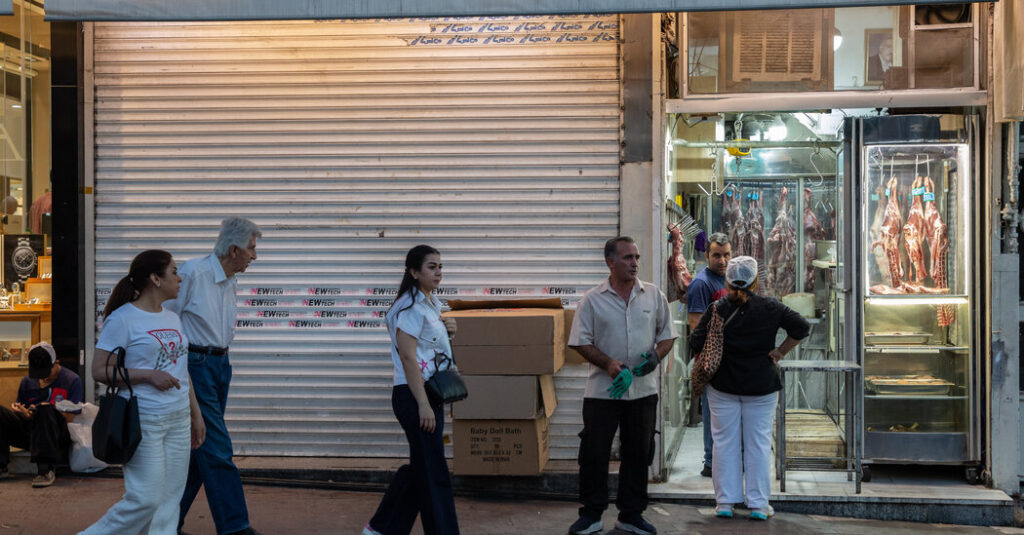
Given Tehran’s stance so far, the immediate cost of sanctions will most likely be borne by the Iranian people, who are already contending with sky-high inflation and struggling to afford basic goods.
In the face of American sanctions, Iran “will try to transfer the resulting economic pain onto its population for as long as possible, betting that Washington will blink first,” Mr. Boroujerdi of the Missouri University of Science and Technology said.
Iran’s supreme leader, Ayatollah Mojtaba Khamenei, has appointed hard-line loyalists to key military positions, signaling his intent to keep the country on a war footing. A renewed conflagration would probably drag in regional energy infrastructure, U.S. bases in the Middle East and commercial shipping, Mr. Vatanka said.
For now, it appears just as likely that the stalemate will continue with the core issues unresolved — including Iran’s nuclear program and the Strait of Hormuz.
“The longer this limbo persists, the more entrenched it becomes and the harder it is to construct an off-ramp that either side can present as anything other than a concession,” Ms. Grajewski said.
The post As Iran and U.S. Settle Into an Uneasy Standoff, Who Will Blink First? appeared first on New York Times.