On the day in February that President Donald Trump took over the John F. Kennedy Center for the Performing Arts, his new board ousted Deborah Rutter, the longtime president of the institution. She gathered her staff to offer a hopeful farewell. That evening, she welcomed other leaders to her home to mourn.
“As with any wake, you drink a little too much, and you tell stories, and you laugh, and you cry,” Rutter told The Washington Post in a conversation in the spring.
Rutter had planned to step down at the end of 2025 after leading the Kennedy Center through a decade in which it had diversified its offerings, endured the 2020 lockdown and emerged to boast robust ticket sales and, according to publicly available tax filings, steadily grown revenue.
She still had four major items on her to-do list: growing the center’s endowment; furthering its work as an arts educator around the country; strengthening the financials of the National Symphony Orchestra; and renewing the contract with CBS or finding a new broadcast partner to air the Kennedy Center Honors.
Those plans died. But the Kennedy Center did not.
The center is now guided by a board of Trump loyalists and a new staff including the center’s president, Richard Grenell, a pugnacious veteran of the first Trump administration. They have terminated much of the former staff, lambasted the former leadership and made changes including the addition of high-wattage events like the World Cup draw. They have embarked on a $257 million renovation, in line with Trump’s broader effort to leave his mark on Washington’s cityscape. They’ve boasted about hefty fundraising.
Now, nearly 10 months in, a picture of a transformed institution has come into view. Standbys of the Kennedy Center’s stages like the National Symphony Orchestra have been strained by plummeting ticket sales and organizational uncertainty. Traveling productions and acts have pulled out. And a new kind of right-leaning programming has begun to take root.
So what is the Kennedy Center now?
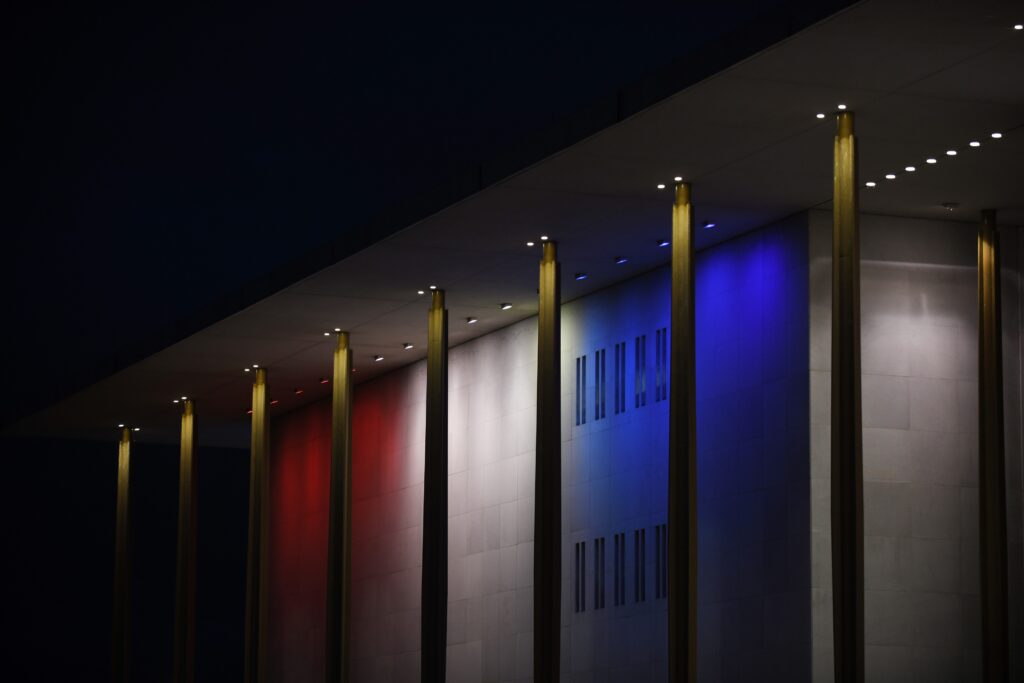
For one thing, it’s getting a Trumpian revamp. He ordered new marble and the repainting of the exterior columns in austere white. Portraits of the first and second couples now hang in the center’s Hall of Nations, and the building exterior is occasionally lit up in red, white and blue (a move that, many staffers joke, makes the building look like the flag of France, not America). Even the medallions for the Kennedy Center Honors, created by Ivan Chermayeff and made for nearly 50 years by a D.C.-area family, have been redesigned by Tiffany & Company.
And — wittingly or not — the new leadership has made the center a political football for the first time since its opening in 1971. House Republicans have suggested renaming it for Trump (the whole building) and the first lady (just the Opera House). Conservative groups have flocked there to host conferences and meetings. Senate Democrats are investigating the Kennedy Center, accusing Grenell of “self-dealing, favoritism, and waste,” which he has denied.
The Kennedy Center did not respond to a request for comment for this article and has declined most requests from The Post for months, including to interview Grenell or other leaders. To understand the organization’s changes, The Post reviewed the center’s slate of programming, internal documents and public comments from Trump, Grenell and other members of the center’s new leadership, and interviewed more than a dozen former and current employees, who spoke on the condition of anonymity out of fear of retribution or to not violate a non-disparagement agreement.
The year of Trump’s takeover will culminate Sunday with the Kennedy Center Honors, the building’s marquee event. It, too, is reflective of Trump’s tastes, whims and imprint on cultural life in Washington.
During his first administration, Trump skipped the ceremony each year, breaking with a long-standing presidential tradition. Now, he routinely refers to the building as “the Trump Kennedy Center.” And he’s not just attending the honors — he’s said he’s hosting it and that he was “98 percent involved” in picking the talent.
The 2025 honorees — Gloria Gaynor, Sylvester Stallone, Michael Crawford, George Straight and Kiss — “all went through me,” Trump said when he revealed the lineup in August. “ … I had a couple of wokesters. Now, we have great people.”
Trump continued, summing up his honors and his takeover in one breath: “This is very different than it used to be. Very different.”
The Kennedy Center opened in 1971. The idea, dating to the Eisenhower years, was simple: a nonpartisan “national cultural center.” In early 1964, President Lyndon B. Johnson had signed legislation designating the center a “living memorial” for his assassinated predecessor.
For over 50 years, the Kennedy Center occupied a unique space among major performing arts centers. Even if Washington didn’t have a top-tier symphony or theater scene during that time, the center represented a vision of a worldly capital city, a magnet for artists from around the globe. Over time, the center’s focus widened to include all manner of programming — from jazz to hip-hop to children’s theater to “Shear Madness,” the campy, participatory murder mystery that arrived at the Kennedy Center in 1987 and appears to be in no danger of closing.
While the Kennedy Center is a public-private partnership, with the federal government funding its building operations, the president of the United States has never played a major role beyond appointing board members. Until this year, appointees from Republican and Democratic administrations served alongside one another.
Trump announced his plans to take charge of the Kennedy Center in a Truth Social post on Feb. 7, calling the center an “American Jewel” and promising that it will “reflect the brightest STARS on its stage from all across our Nation.” He promised an end to “drag shows specifically targeting our youth.”
Trump fired every member of the board of trustees not appointed by him, including its chair, the private-equity billionaire David Rubenstein, who had donated more than $100 million to the center. Trump’s newly fashioned board included several White House aides, second lady Usha Vance, and Fox News hosts Laura Ingraham and Maria Bartiromo. Other top executives were shown the door alongside Rutter.
Grenell, who directed his staff refer to him as “Ambassador,” quickly began overhauling the center’s leadership. Hires included Roma Daravi, a White House communications aide from the first Trump administration and a former ballerina, as head of the public relations team; and Lisa Dale, a former senior campaign adviser to Trump ally Kari Lake, as the senior vice president of development. He installed the former national chairman of the Young Republicans, Rick Loughery, and his longtime adviser Nick Meade in top roles. None of the three had any previous arts expertise. (Staffers quickly dubbed the trio “The Icks.”) Grenell spends a significant amount of time in California, where he primarily resides, and is rarely seen in the building, staffers say.
More than 100 employees have resigned or been dismissed. The cuts included members of the small social impact team, which meant to reach new and diverse audiences beyond those who regularly attend symphony and opera performances. Nearly every major head of programming under Rutter is gone.
Grenell has defended many of the staff cuts as fiscal prudence. The center reduced the development department, responsible for fundraising, from 94 employees to 16, according to a letter he sent to Democratic senators, and raised more than $100 million from donors. According to minutes obtained from a board meeting in May, Grenell reminded the board of a “give or get” policy — a standard fundraising practice on nonprofit boards — in which each trustee would need to raise or contribute $100,000 by the end of September.
He and other executives have said that the center was deep in debt before the takeover and accused the former leadership of fraud, threatening to report the findings to the Justice Department. Former leaders denied the claims, and it’s unclear if Grenell followed through.
In an interview last month with the right-leaning Washington Examiner, Grenell said, “I told every department: If you want to put on a show, it needs to break even,” adding, “If you can’t sell enough seats, you find a donor.” Corporations, he said, were now “writing checks because they trust us not to turn every show into a political statement.” (Grenell has largely limited interviews to outlets on the right, including Matthew Foldi, the author of the conservative publication the Washington Reporter, whose mother works as a senior director in the center’s fundraising department.)
It is unclear how current underwriting, which is not new to the center, compares with previous years.
Any increase in giving or sponsorships would help offset the Kennedy’s Center revenue issues. In early June, The Post found that subscriptions were down by about $1.6 million, or roughly 36 percent, compared with 2024. In September and October, ticket buyers spent less on the center during any other year since 2018, except 2020, when the venue was largely locked down, according to spending data drawn from 40 million credit and debit cards analyzed by the consumer data and analytics company Consumer Edge. Current and former staffers attributed the drop-off to an audience boycott over the politicization of the center.
Theater shows are scheduled through August, including productions of “Spamalot,” “Chicago,” “Moulin Rouge!” and “Mrs. Doubtfire.” But the center struggled this year to fill the room many nights for crowd-pleasers like “The Sound of Music,” according to a Post analysis of ticket sales.
Ticket sales were so low for an upcoming run of the usually reliable Broadway show “Spamalot” that the center moved it from the 2,364-seat Opera House to the 1,161-seat Eisenhower Theater, staffers with knowledge of performance bookings said. The change was visible in the center’s online ticketing platform.
Some changes, however, illustrate how the Kennedy Center is trying to find new audiences. The center now regularly hosts Christian and conservative-leaning programs, including a red carpet premiere for the Christian Broadcasting Network’s documentary “The Revival Generation” and a “Christian Persecution Summit” associated with CPAC, the annual conservative gathering. It has also partnered with Museum of the Bible to create a prayer wall for guests attending screenings of the movie “King of Kings” in June and held a prayer vigil for the slain conservative activist Charlie Kirk.
Next year’s lineup lists a worship concert with Christian singers Kari Jobe and Cody Carnes and a “Freedom Gathering” concert to celebrate “God & Country” ahead of America’s 250th birthday.
Religious offerings are not an entirely unusual development, in part because the Kennedy Center’s venues are available for rentals. The center has hosted performances by the Shen Yun dance troupe, which is associated with the Falun Gong Chinese religious movement, before and after the takeover. But there has been a notable uptick in what the new leadership has termed “faith-based programming.”
Some events have aligned with the Trump administration’s foreign-policy priorities. Last month’s U.S.-Saudi investment summit at the Kennedy Center came as Trump faced criticism for his meeting with Saudi Crown Prince Mohammed bin Salman. The royal’s visit to Washington was the result of a White House effort to restore diplomatic relations with the country, which had been strained since Saudi agents killed Post contributing columnist Jamal Khashoggi in 2018.
Other rental deals have prompted scrutiny from Democrats. A theater license agreement showed that Grenell waived fees for the American Conservative Union Foundation’s Oct. 30 CPAC event, amounting to a $21,983 discount off an initial estimate of $41,990. And in a venue use agreement with FIFA, the Kennedy Center granted free rental space for the soccer giant during its nearly three-week takeover for the World Cup draw, held on Friday.
Both of these deals are a focus of an investigation by Democrats on the Senate Environment Committee. Grenell pushed back in a strongly worded letter to Sen. Sheldon Whitehouse (D-Rhode Island). “When I arrived, we were paying a bloated staff with our future debt reserves account,” he wrote. “Today, and for the first time in decades, we have a balanced budget at the Kennedy Center.”
Grenell has insisted that FIFA is paying several millions of dollars to the center in sponsorships and donations, describing it as part of his record of responsible management, but he has not provided documentation to support that claim despite requests from The Post, and FIFA has declined to comment on the matter.
Even as the Kennedy Center widened its scope over five decades, it has upheld its core purpose as a palace of the fine arts. Some of the world’s most prominent performers and most beloved shows came to the Kennedy Center. The National Symphony Orchestra and the Washington National Opera were homegrown companies with affluent support bases.
But these well-established institutions within the center have seen disruptions from the Trump takeover.
The dance program is now led by Stephen Nakagawa, a former Washington Ballet performer who criticized the “rise of ‘woke’ culture” in ballet in a letter to Grenell obtained by the New York Times. While prominent troupes like the Stuttgart Ballet kept their dates with the Kennedy Center recently, one major company, the Alvin Ailey American Dance Theater, stayed away, opting to perform at a venue “where everyone felt welcome.”
One notable staff exit was of Jeffrey Finn, the senior vice president of artistic programming, who oversaw theater and the Kennedy Center’s bookings of touring Broadway shows, including “Hamilton.” The lead position for theater programming, which generates some of the highest-grossing ticket sales for the center, has remained vacant since his August resignation. (At the time, the center said Finn would continue as a consultant.)
During a September board meeting, Grenell said a search for a new theater head was underway and that he had received “hundreds” of résumés, according to meeting minutes obtained by The Post.
Financial and structural turmoil have led the Washington National Opera — which has an affiliation agreement at the Kennedy Center — to consider a possible move out of the building, artistic director Francesca Zambello told the Guardian last month. The opera’s board chair publicly subsequently stated that the company is not planning to leave.
Opera performances that once hovered near capacity are now around 60 percent, Zambello told the Guardian, a shortfall sometimes masked by the distribution of complimentary tickets to present fuller houses.
Sales were below expectation for the opera’s recent “The Marriage of Figaro,” according to a person familiar with the company’s performance who was not authorized to discuss it publicly, but tickets for its holiday show, “The Little Prince,” have been performing well. The Washington National Opera typically plans its seasons two years in advance, but programming for the 2026-2027 season is running behind because of budget constraints, the person said, adding that regular season sales and contributions are down.
According to The Post’s sales analysis, ticket sales have also been a challenge for the National Symphony Orchestra, whose functions are enmeshed with the Kennedy Center.
The extension of music director Gianandrea Noseda’s contract in March was widely welcomed among musicians as an anchor of stability. The orchestra reported that its annual gala raised a record $3.45 million. And programming for the 2025-2026 classical season, which ends in June, has largely remained intact. One of the few visible disruptions to NSO programming happened when FIFA took over much of the center ahead of the World Cup draw, forcing several concerts to be postponed or relocated to accommodate the soccer federation.
The clearest sign of top-down influence has been Grenell’s directive that the NSO perform the national anthem before every concert. Last month, he even took the podium himself to lead a rendition — and soon, others might have a chance to pick up the baton.
“With a large contribution,” the center later announced, “you can conduct the National Anthem at The Kennedy Center.”
The Kennedy Center is intended to be a place for everyone, a mission articulated by both old and new leadership. But its health also depends on certain people: regular attendees, donors, underwriters, expert staffers and prominent performers. The Trump takeover has repelled many in those groups. Now, the center’s success may rely on attracting and keeping new ones.
During her farewell speech in February, Rutter articulated what had drawn many to the Kennedy Center.
Addressing a packed room of solemn staffers, she said, “I’m not saying goodbye as a friend and colleague to all of you,” and she imparted one final charge to the remaining staff: to hold fast to the five ideals by President John F. Kennedy that had guided the institution through her decade of leadership.
“Let’s remember courage, justice, freedom, service and gratitude” Rutter said. “I pray for the best for each of you and for all the things that are so wonderful that happen here at the center.”
But she and others have now moved on.
In July, Rutter took a job at Duke as vice provost for the arts. Three months later, the university received $25 million to support arts programming and a new arts center from an alumnus of the university.
The gift was from David Rubenstein.
The post Donald Trump’s Kennedy Center is showier, emptier and more political appeared first on Washington Post.