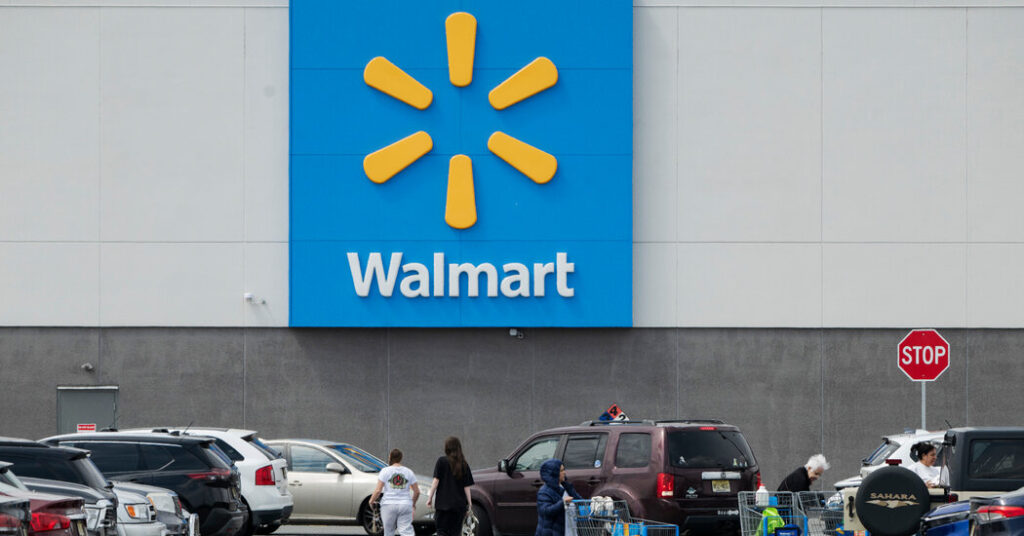
Walmart posted the slowest sales in years in its home market of the United States as consumers worried about their finances tightened their wallets.
Comparable sales at Walmart’s U.S. stores rose 2.6 percent in its most recent quarter, the retailer reported on Thursday, its slowest growth in more than six years. The company’s stock fell more than 9 percent, erasing tens of billions of dollars in market value in its steepest daily decline since 2022.
The world’s largest retailer had been on a roll, with cost-conscious shoppers flocking to its stores in search of deals in an uncertain economy. Walmart said that lower drug prices brought on by regulatory changes dragged down its U.S. sales last quarter. Still, the company raised its outlook for sales and profit for the full fiscal year.
Company executives said the business saw shoppers’ behavior change when the national average price of gasoline surpassed $4 per gallon in July, an indication that American consumers were feeling more pressure than they did at the beginning of the year.
“Perhaps there’s a psychological impact to that,” John David Rainey, the chief financial officer of Walmart, said on a conference call with investors and analysts. “There are choices that consumers are making.”
America’s biggest retailers said this week that consumers had been wary with their spending and keen to get value from every dollar spent, even if household balance sheets seemed healthy.
Reported earnings this week from Walmart, Target, Home Depot, Lowe’s and TJX, the parent company of TJ Maxx, provided a snapshot of how American households are faring as the cost of living remains high, including grocery bills, housing costs and gas prices. At the same time, the job market has remained fragile and wage growth has slowed. Delinquencies on credit cards, auto loans and student debt are on the rise.
“Households’ balance sheets remain healthy in aggregate, but the saving rate is very low and elevated loan delinquencies suggest that a significant minority are struggling to make ends meet,” Samuel Tombs and Oliver Allen, economists at Pantheon Macroeconomics, said in a note.
Shoppers also pulled back on spending at the start of the second half of the year, with retail sales down 0.6 percent in July from the prior month, according to nationwide data released by the Census Bureau.
But with back-to-school season kicking off and as retailers prepare for the impending holiday rush, the companies are hoping that shoppers become less stingy.
Retailers have tried to keep prices down. Some have cited tariff refunds, the repayments to businesses after the Supreme Court’s ruling in February that struck down many of the Trump administration’s emergency import taxes, as giving them leeway to keep prices down.
Target said that it had lowered prices on about 10,000 items in its stores over the past year, and that it would push for more price reductions. Almost its entire selection of school supplies is priced at or below what they were last year.
“We’re proud of that price investment,” Michael Fiddelke, the chief executive of Target, told investors. “We think it matters to consumers right now.”
Walmart has been reducing prices too, and the retailer has told investors that it has made it a priority to use its tariff refund on price cuts. In the United States, Walmart temporarily lowered the prices of 11,000 items last quarter, up from 7,200 in the previous quarter, and intends to make those reductions permanent when possible.
“We’re investing heavily in price because customers need us to,” John Furner, the chief executive of Walmart, told investors.
TJX, the owner of the off-price chains TJ Maxx and Marshalls, said that its selection of cheap goods had put it in a good position to capitalize on economic trends, and that it saw higher customer traffic and a rise in what shoppers spent per visit. Comparable sales rose 4 percent in its most recent quarter, and company executives are plowing ahead with plans to add hundreds of new stores.
“We are confident that consumers will continue to look for value in the current environment,” Ernie Herrman, the chief executive of TJX, told investors.
Home improvement stores have been struggling for several years. Households worried about their finances amid economic uncertainty and high mortgage rates have put off big-ticket renovations. Housing turnover has also been low.
“There’s just no sign of an inflection point at this moment,” Richard McPhail, the chief financial officer of Home Depot, told investors.
Marvin Ellison, the chief executive of Lowe’s, said high interest rates, inflation and the price of gas had weighed on his customer base, which is made up of middle-income homeowners.
“It’s a combination of fuel prices, geopolitical events and other uncertain things,” Mr. Ellison said. “People are just being cautious with their discretionary spend.”
Resilient consumer spending in the first half of 2026 was fueled by a robust tax refund season, said John Mercer of Coresight Research, a research and advisory firm. “The question as we head later in the year is: What happens when those tax refunds start to deplete and diminish?” Mr. Mercer said.
The post Walmart Posts Slowest Sales Growth in Years as Americans Tighten Wallets appeared first on New York Times.