Andrew Klavan is the author of “The Kingdom of Cain: Finding God in the Literature of Darkness.” Spencer A. Klavan is the author of “Light of the Mind, Light of the World: Illuminating Science Through Faith.”
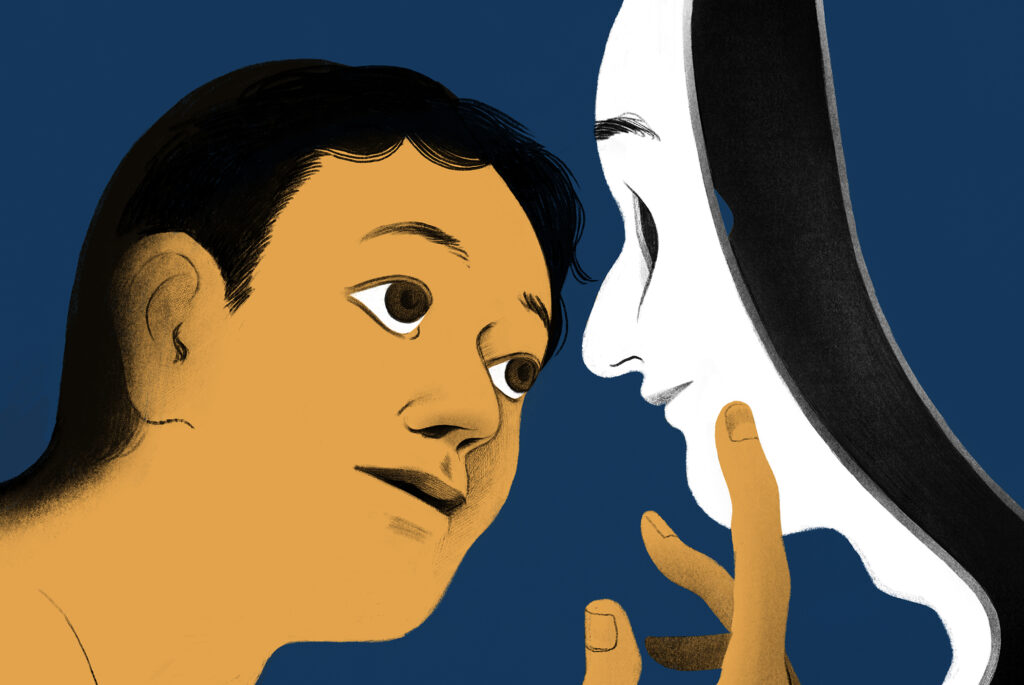
“Their idols … are the work of men’s hands,” writes the author of Psalm 115. “Eyes have they, but they see not. They have ears but they hear not … They that make them are like unto them.”
The biblical psalm is a bitingly exact description of those idolaters who confuse man-made artifacts with human souls. In our day, we are in danger of making this age-old mistake with artificial intelligence.
In every generation, some advanced piece of machinery comes to seem like a model of the human mind. When the written word was the cutting edge in information storage, Plato had Socrates compare the human mind to a wax writing tablet in his “Theaetetus.” In the era of the steam engine, Sigmund Freud began to think of the mind as a dynamic pressure chamber in which repressed energy returns with gathered force. And for the past several decades, we’ve come to picture the mind as a computer, hardwired to run certain kinds of software.
But by using machines as metaphors for our minds, we fall prey to the illusion that our minds are nothing more than machines. So it’s not surprising that now, when the possibilities of AI are enthralling Silicon Valley, those who think programs can become conscious are trying to tell us that consciousness is just a program.
Here’s computer scientist Stephen Wolfram in a recent interview, discussing the large language models, or LLMs, that enable AI chatbots to generate humanlike sentences: “In terms of consciousness, I have to say, you know, the idea that there’s sort of something magic that goes beyond physics that leads to sort of conscious behavior, I kind of think that LLMs kind of put the final nail in that coffin.”
To rephrase it more succinctly: If AI can produce language via algorithmic patterns, then that’s what human beings must be doing as well. Our words, in that case, have no more inherent meaning than those produced by AI. Our sentences are simply patterns that we falsely experience as self-expression.
But this is the old idolatry again. Our machines are products of our minds. It doesn’t follow that our minds work like machines. LLMs are trained to imitate the outward forms of human speech — the sounds and sequences of the words we say — but they’re not capable of understanding the subjective thoughts and experiences behind those words. They’re not designed to even try.
The defining feature of human language is what ancient philosophers called “the inner logos” — the unique interior apparatus we have for structuring and understanding our experience of the world. LLMs — probability functions designed to detect and mimic patterns in words — are coded to reproduce our exterior language. They have no access to the inner logos.
The great Louis Armstrong, performing the George David Weiss and Bob Thiele song, “What a Wonderful World,” put it this way:
“I see friends shaking hands, saying ‘How do you do?’ / They’re really saying: ‘I love you.’”
Jesus put it similarly in Matthew 15: “The things that come out of a person’s mouth come from the heart.”
A person who says “How do you do?” or, for that matter, “I am going to punch you in the face,” means something by it, even if it’s not exactly what the words express. An AI that says these things means absolutely nothing at all.
We have frittered away too much of human history toying with the fantasy that there is no self and no truth to which the self is privy. The idea that LLMs dispel the metaphysical mystery of consciousness works only if we are deceived by the psychological quirk that causes us to view ourselves as “like unto” the machines we make.
We are not. We are not machines at all, in fact, but organic unities — brain, heart, loins and senses — animated by spirit and collaborating with creation on unique but interconnected experiences of life.
The psalmist’s warning still applies: Those who project an inner life onto their own creations will cease to cherish the inner life unique to humankind. Those who make idols become like them.
If we wish to fulfill humanity’s inherent purposes of love and connection, art and culture, we can’t afford to keep making that mistake.
The post Let’s not idolize AI. That’s an age-old mistake. appeared first on Washington Post.