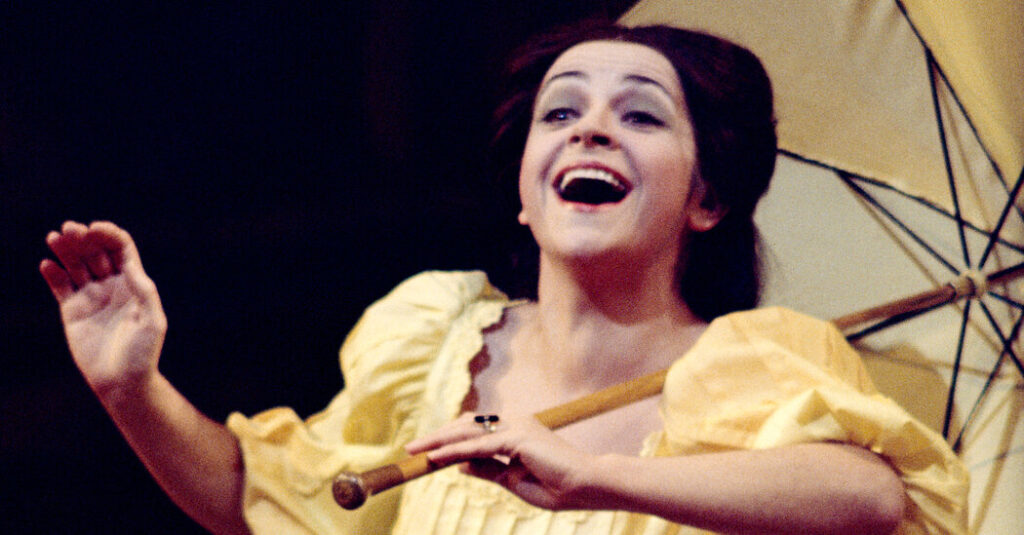
Ileana Cotrubas, a tender, pure-toned Romanian soprano who was preternaturally able to convey the pathos of the heroines in operas like “La Traviata,” “La Bohème” and “Rigoletto,” and who was also known for some prickly disputes with directors and conductors, has died. She was 87.
Her death was confirmed in a Facebook post by the Romanian National Opera in Bucharest, where Ms. Cotrubas got her start as a singer. No further details were provided.
Born into a family of enthusiastic amateur singers, Ms. Cotrubas (pronounced COE-troo-bash) won acclaim for her expressive voice and the subtle sensitivity of her performances. When she sang Violetta in “La Traviata,” the Verdi classic, at the Metropolitan Opera in 1981, Donal Henahan wrote in The New York Times that “it is unlikely that there is a better Violetta now on the world’s stages.”
“She gave a transfixing performance,” Mr. Henahan added. “A singing actress of great imagination and temperament,” she “played on our sympathy like a virtuoso.”
But that “Traviata” also spoke to her tendency toward tension with some colleagues. The production was supposed to be directed by John Dexter, but after Ms. Cotrubas reportedly threatened to drop out of the leading role over disagreements about the staging, the director Colin Graham took over. This was a year after she walked out during rehearsals for Mr. Dexter’s Met production of Donizetti’s “Don Pasquale.”
“We are not puppets or marionettes,” she had told The Times in 1977, explaining why she had ended her involvement in a new production of Tchaikovsky’s “Eugene Onegin” in Vienna a few years before. “I have my own ideas, and I like to talk to the stage director and work out what is best for him and what is best for me.”
In 1984, she withdrew from the final performance of a run of “La Bohème” at the Met after a spat with the conductor, whose interpretation she disliked. “Friends told me to just sing for the money,” she told The Times. “But my conscience will not permit me to go on. I will not prostitute myself for the money.”
But when she appeared, it was often magical. She had, Alan Blyth wrote in Opera magazine, the power “to make the audience’s heart beat just that much faster as soon as she appears onstage, and to convince it that for the moment nothing in the world matters more to her than to convey the particular predicament of whichever character she is portraying.”
Ileana Cotrubas was born on June 9, 1939, in Galati, in eastern Romania, to Maria and Vasile Cotrubas. Her father was a civil servant in the agriculture ministry, and both her parents were amateur opera singers.
Ms. Cotrubas sang in children’s choirs from the age of 9. Her family moved to Bucharest in 1952 and she attended a school for musically gifted children, studying piano, violin, conducting, acting and voice. She was initially rejected by the Ciprian Porumbescu Conservatory (now the National University of Music) because of the small size of her voice, but was accepted after her second audition. In 1964, she made her stage debut as Yniold, the frightened child in Debussy’s “Pelléas et Mélisande.”
She won several international singing competitions in the years that followed, and was awarded contracts with the Frankfurt Opera and Vienna State Opera. By the late 1960s and early ’70s, she was singing major roles across Europe, and made her American debut as Mimì in Puccini’s “La Bohème” in 1973 at Lyric Opera of Chicago, opposite Luciano Pavarotti.
Mr. Pavarotti was also involved in her dramatic debut at the Teatro alla Scala in Milan in 1975. The soprano Mirella Freni had canceled a performance of “La Bohème” scheduled for that evening, and Mr. Pavarotti suggested that the company call Ms. Cotrubas. In England at the time, she initially refused, because she had not sung the role in a year. But she eventually agreed, did her makeup during the flight and arrived at the theater 15 minutes before curtain.
While she was particularly gifted at underplayed (and therefore all the more heart-rending) tragedy, she was also noted for comic roles like Adina in Donizetti’s “L’Elisir d’Amore” and Susanna in Mozart’s “Le Nozze di Figaro.” She excelled in lieder (or art song), as well as in Baroque music, playing the title role in Cavalli’s “La Calisto.” Her large discography includes a superb “La Traviata,” also starring Plácido Domingo and conducted by Carlos Kleiber; Bizet’s “Carmen” with Teresa Berganza and Mr. Domingo, conducted by Claudio Abbado; and Verdi’s “Rigoletto” with Mr. Domingo and Piero Cappuccilli, conducted by Carlo Maria Giulini.
In the early 1980s, she suffered vocal problems that she attributed to a hormonal imbalance, followed by surgery, but she continued singing through that decade. She announced her retirement during a rehearsal at the Royal Opera in London in 1989, and went on to focus on teaching. Her best-known student was the soprano Angela Gheorghiu, a fellow Romanian also notorious for conflict with directors and opera company administrators.
Ms. Cotrubas married Manfred Ramin, her coach and manager, in 1972. They wrote two books together and railed against what they perceived as the excesses of so-called Regietheater, in which directors offer modernized (and sometimes outlandish) stagings. Ms. Cotrubas also disapproved of supertitle translations in the opera house and urged the public to study an opera’s plot and learn about the composer before attending a performance.
Mr. Ramin survives her. He and Ms. Cotrubas had no children.
“It is a mad world, a dangerous one for children,” she said in 1977. “And when you live like gypsies, as we do, then the children are no more yours. A child needs a real family and a good education, and these we cannot provide.”
During a 1995 master class with a young mezzo-soprano, Ms. Cotrubas offered some tips. “Do you agree or not?” she asked, with a laugh, and added: “You have to agree, because I’m right.”
The post Ileana Cotrubas, Sensitive Soprano Known for ‘Traviata,’ Dies at 87 appeared first on New York Times.