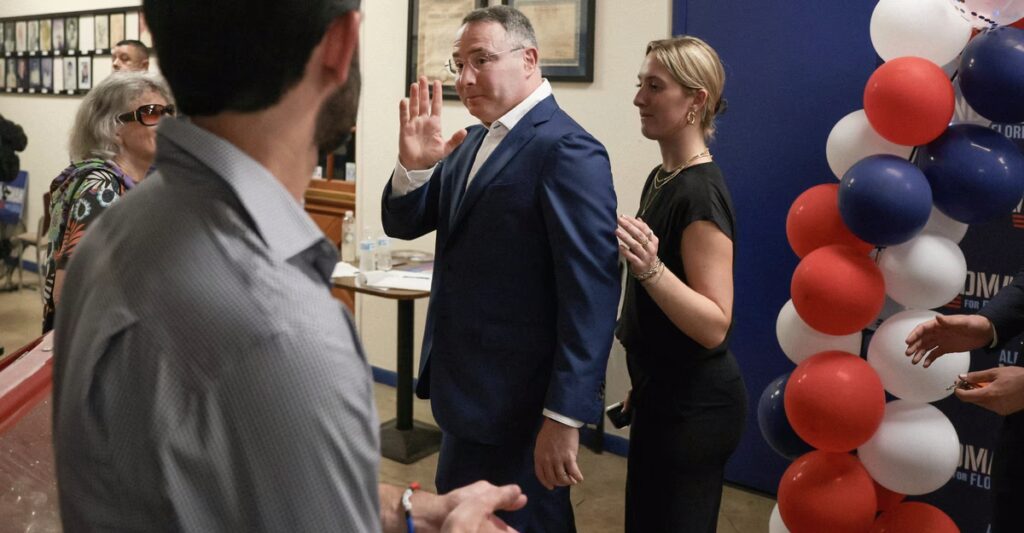
Donald Trump celebrated the defeat of one of his first impeachment nemeses—retired Army Lieutenant Colonel Alex Vindman, who lost the Democratic Senate primary in Florida on Tuesday—in typical form. “SleazeBag Vindman loses tonight to a Radical Left Lunatic. How cool is that???” Trump exulted on Truth Social.
Vindman served as a witness in Trump’s first impeachment. Whatever currency this once gave him with Democratic voters has long since expired. In this, he is not unique. Democrats such as Dan Goldman, George Conway, and Tom Steyer, all of whom pushed for or played prominent roles in Trump’s first impeachment, have discovered in primaries this year that this credential means little to their party’s voters. Diana DeGette, a House manager during Trump’s second impeachment trial, and Harry Dunn, a Capitol Police officer who battled insurrectionists, have also lost primaries.
The rout of the Democratic Party’s impeachment stars has been interpreted, generally, as a sign of the end of resistance politics. “The string of losses for resistance candidates from the first Trump term illustrates a new era for the restive Democratic base, where vocal opposition to the president through official channels and public remonstrations no longer guarantees success,” Politico reports.
[David Frum: The ‘resistance’ is over]
The “resistance,” once a dominant mode of Democratic politics during the first Trump administration, was never cool. But in the second term, the “resistance liberal” has fallen out of favor so completely that the phrase has become a derisive punch line across the political spectrum. Which is a shame, because the resistance was, broadly speaking, correct. It was right about Trump’s nature, and also right about how to defeat him.
Resistance politics depicted Trump as a crook and an aspiring authoritarian with a troubling fondness for dictators, especially Vladimir Putin. He was a con man, unfit for office, and had broken faith with the best traditions of American politics. The Robert Mueller investigation found, among other things, that Putin had dangled a lucrative no-risk deal to Trump during the 2016 campaign. The Senate Intelligence Committee, found, in a bipartisan report, that the campaign’s links to Russia posed a “grave counterintelligence threat.” The first impeachment charged Trump with having “placed his own personal and political interests above the national interests of the United States, sought to undermine the integrity of the U.S. presidential election process, and endangered U.S. national security.”
These much-derided processes turned out to supply an accurate, almost banal, description of how Trump has operated during his second term. His corruption and abuses of power have been let loose at a scale that was previously only imagined. Trump has all but severed America’s system of alliances, mocked and bullied Ukraine’s president, and showered praise upon Kim Jong Un.
What discredited resistance politics in liberal eyes is that it was closely associated with institutional procedures that were deemed to have ultimately failed to restrain Trump. Mueller’s investigation ended anticlimactically. Neither impeachment drew enough Republican support to remove Trump from office. Somewhat similarly, conservatives have sometimes claimed that the Russia investigation and first impeachment helped Trump politically by drawing to his side Republicans who resented the overreach.
One Republican who doesn’t seem to believe either of these arguments is Trump. The president has worked hard to ensure that no such humiliations recur during his second term, by stacking the Justice Department with loyalists, firing inspectors general en masse, purging the armed forces of “woke” officers, and generally eliminating any potential source of independence within the federal government.
Trump himself does not seem to think that the investigations that were avidly followed by resistance liberals did nothing to restrain his actions during his first term, or that they helped him shore up partisan support. And the absence of any such processes in his second term has not made Republicans in Congress feel freer to criticize the president. To the contrary, their fealty is more absolute than ever.
Even in the first term, resistance Democrats were dogged by their populist left-wing critics. This split first appeared in the spring of 2017, when Jon Ossoff ran to fill a special election for a House seat in Georgia, in a previously Republican district. Ossoff’s campaign, which attacked Trump’s corruption but declined to articulate a sharp progressive alternative, fell short.
Supporters of Bernie Sanders blamed Ossoff, and the party, for not taking up the Sanders message. “Ossoff’s campaign has failed to support or address any progressive issues. He embraces a centrist—not progressive—message, that both political parties waste taxpayer money, rather than politicians being corrupt by outside money,” the progressive writer Michael Sainato complained in the Observer. Winnie Wong, a co-founder of People for Bernie, told The Guardian of Ossoff, “He didn’t have a core progressive message and that ultimately is why he lost.” (Ossoff won a Senate race in 2020 and is leading the polls again this year, making slashing attacks on Trump’s personal corruption while steering clear of controversial left-wing policy stances.)
[Jonathan Chait: Liberals are now fighting a two-front war]
Like the Republican critics of resistance politics, progressive ones depicted it as substituting legal tactics for electoral victories. Yet the resistance was never limited to cheering on Mueller or hoping to persuade Republicans to convict the president of high crimes and misdemeanors. Resistance themes inspired the Democrats’ political message during Trump’s first term. And that message landed. Democrats retook the House in the 2018 midterms, despite a hot economy, and then defeated Trump’s reelection effort. Joe Biden, a link to a bygone era of civility and bipartisanship, ran in 2020 on a message of restoring the soul of America. He won.
Once in office, however, Biden ceded his domestic agenda to progressives who believed in Sanders’s vision of transformational change. They believed that only overturning the neoliberal order, handing control of domestic policy to neo-Brandeisians and climate hawks, and giving unions almost every policy they demanded would allow Democrats to regain the trust of working-class voters. This theory, not the resistance, failed. Biden’s support collapsed within his first year, and Kamala Harris’s half-hearted efforts to distance herself from her unpopular boss were too little, too late.
Trump’s return to office has left Democrats casting about for a stronger and more effective response. Perhaps the most obvious solution is the one they hit upon when Trump was first elected nearly a decade ago: Rather than promise to change everything about American politics, focus relentlessly on Trump’s unfitness. The crisis in the United States is not the general corruption of both parties; it is the specific corruption of Trump and his enablers. And the solution is simply to replace the corrupt, racist authoritarian with a governing party that respects the rule of law, equality, and basic decency.
The post Resistance 1.0 Was Not Crazy appeared first on The Atlantic.