Over four decades, Steve Hanke has pursued a worldwide quest to tame the hyperinflation that so frequently ravages developing nations. His solution: tying their currencies to the U.S. dollar so their governments are no longer free to unleash an avalanche of pesos or sucre to fund their giant overspending, at the expense of their citizens, who pay for the blowout in rocketing bills for rent, medicine and groceries that way outpace their incomes.
The success that the professor of applied economics at Johns Hopkins University has had in advising governments across three continents — whether achieving straight “dollarization” or establishing Hong Kong-like currency boards that fix their monies to the greenback — has won him the title, you might even say the “brand,” of globetrotting “Money Doctor.”
Now, the doctor’s making the most important house call of his career. Venezuela’s National Assembly has just named him Special Adviser on Economic, Monetary, and Energy Affairs, tasking him with curing hyperinflation now running at a 400% annual clip — the worst in the world — as the country tries to rebuild after the ouster of Nicolas Maduro. Hanke’s fix: a full dollarization law that would abolish the bolivar and the central bank outright. He told Fortune he puts the odds of passage at 50% to 80% — the best shot that sound money has had in Venezuela since the country rejected the money doctor’s last surgery attempt, three decades ago.
What does a money doctor have to do with oil? The problems are deeply interconnected. The nation of 29 million boasts arguably the greatest “underground” wealth in Latin America via holding the world’s largest crude oil reserves and immense wealth in minerals from copper to lithium, and still harbors a highly-sophisticated professional class. Meanwhile, an exiled intelligentsia numbering in the millions stands ready to return and rebuild their stricken homeland.
They won’t return until the oil-driven economy revives and Venezuela is producing just 1.1 million barrels per day, around 1.3% of the world total and one-third the pre-Chavez mark of 3.4 million in 1998. Shockingly, it’s only a little over 7% more than before Maduro’s exit, not what the administration hoped after the U.S. Special Forces raid on January 3rd that removed Maduro, the dictator who savaged the economy.
“Taming inflation is the key to restoring stability in Venezuela, and all the other progress flows from that,” Hanke told Fortune. “Stability isn’t everything, but without stability, which means stable prices, you have nothing. And there’s no better case study showing that’s true than Venezuela.”
Ramping oil output is the ticket to restructuring Venezuela’s mountainous $250 billion debt load, equal to roughly 150% of GDP, the highest number in Latin America and fourth in the world. It was sending crude to China as part of a repayment program for as much as $15 billion in loans from Beijing.
The U.S. and other foreign enterprises that could make it happen remain on the sidelines, fearing the kind of expropriations inflicted under Maduro and his predecessor, Hugo Chavez. The government led by President Delcy Rodriguez has so far failed to pass new laws that sufficiently safeguard private property rights, progress essential to attracting heavy overseas investment.
Today, U.S. oil majors are purchasing Venezuelan oil, shipped mostly to China only a year ago, for their Gulf Coast refineries specializing in its staple heavy crude. But none has committed capital to reviving the country’s devastated petroleum infrastructure, even though the Trump Administration is basically now decision-maker for the state-owned oil enterprise, PDVSA. Exxon Mobil CEO Darren Woods expressed his concern that Venezuela won’t “uphold the sanctity of contracts” and slammed its past record of “steal[ing] investments,” concluding that the sleeping oil colossus is currently “uninvestible.”
In short, Venezuela is facing the biggest lender-borrower workout ever. Crude is the country’s life blood, accounting for as much as 98% of the country’s exports. In any new agreement, petroleum production would provide virtually the entire flow of dollars required for paying principal and interest to its creditors. The faster that Venezuela generates petrodollars, the better the deal it will get from the lender group comprising the governments of Russia and China, distressed debt hedge funds, ConocoPhillips and Exxon Mobil, and the quicker an accord gets signed.
By Hanke’s calculation, prices measured in Venezuela’s coin of the realm, the bolivar, are now rising at a 400% annual clip. That’s down from 700% before Maduro’s capture, but it’s still 6x the figure in Iran and tops in the world by far. It’s an 8% weekly increase in prices for eggs, beef and rent paid by consumers, along with electric bills, salaries and taxes by companies, and in turn it’s crushing purchasing power and profits.
As Hanke points out, the stalled oil industry and raging inflation have a seesaw, cause-and-effect relationship. “When oil revenues dried up because the government let the infrastructure fall apart, it paid its bills, including paying government employees and pensioners, by printing money,” he observes. And even post-Maduro, that’s still the practice. It’s the punishing option Hanke wants to totally eliminate.
Hanke has drafted a full “dollarization” law that would shelve the bolivar and replace it with the world’s reserve currency. It would also shutter the central bank, ending the government’s ability to issue new money and manipulate interest rates. On the project, Hanke is working closely the dollarization advocate Antonio Ecarri, 52, an Assembly member and former presidential candidate, and founder of the pragmatic, centrist Pencil Alliance party.
A second shot at the dragon
This is Hanke’s second shot at battling Big Inflation in Venezuela. In 1995 and 1996, he designed the blueprint for a currency board while serving as chief economic adviser to President Rafael Caldera. That plan failed to win a majority in the National Assembly. This time, Hanke said he believes that sound monetary reform finally stands a good chance, pointing to numerous surveys showing that the vast majority of Venezuelans want to dump the bolivar and adopt the dollar.
Hanke estimates the odds the bill will pass in the Assembly and become law at 50% to 80%. That such an upheaval is even somewhat likely may seem farfetched, but at the very least, the possibility is supported by the facts on the ground: If they’re not paid in bolivars, Venezuelan shoppers are already buying virtually everything in greenbacks. And so far, the Trump Administration seems fine with this grassroots near-takeover for the U.S. currency.
“It would be the biggest switch from domestic currencies to an alternative since the introduction of the Euro in 1999,” intones Hanke. Still, dollarization would prove an incredibly bold gambit for a nation of Venezuela’s size and importance. It also introduces policy constraints that opponents abhor because they eliminate monetary discretion, but that Hanke swears are actually beneficial. He stresses that dollarization blocks a nation from depreciating its currency “on the phony grounds” of gaining more competitiveness. If that were the case, he argues, “Venezuela would be the most competitive economy in the world. The bolivar has lost 78% of its value to the U.S. dollar in the past year.”
Still, charismatic leaders who have pushed for dollarization have failed to date, suggesting that the patient may not want the money doctor’s medicine. Case in point: In Argentina, President Javier Milei ran on a peso-to-greenback platform in 2023, but abandoned the plan while in office, in favor of a conservative monetary and fiscal policy that lowered inflation somewhat, though prices are still chugging at over 30% a year, and proving an albatross around Javier Milei’s neck.
The resistance that dollarization often meets with isn’t just political cowardice — it reflects a real and almost permanent trade-off. A company that dollarizes gives up its currency-printing power, along with tools that many economists consider essential in a crisis: seignorage, the revenue a government earns from issuing its own money, and the ability to act as lender of last resort to its own banks. Dollarization is also much harder to reverse than a currency board, something Hanke consider an advantage. All told, it’s usually a price worth paying when hyperinflation climbs to the worst level in the world, or close to it.
Hanke predicts that dollarization will ignite the Venezuelan economy overnight. The monetary transformation would unlock a flood of animal spirits, he claims. “If it happens soon, Venezuela would take off from negative growth this year to positive growth next year,” he says. “You’d get big foreign investment flowing into the oil sector, and for example, the broken electrical infrastructure that’s subject to daily blackouts. It’s tough to renegotiate debt in an unstable and uncertain environment of almost 400% inflation. If you’re holding Venezuelan debt, the rise in oil exports would tremendously increase expectations of getting your money back. The debt resolution would occur far more rapidly.”
Today, consumer loans are virtually extinct in Venezuela. No one can get a mortgage in bolivar. The low rates brought by dollarization, notes Hanke, would create an extensive credit market from scratch that would drive domestic business investment and fire the housing market. Venezuela would be Hanke’s biggest dollarization yet in a nearly 50-year career of engineering the biggest ones on three continents.
The swift rebound when a nation switches from a wobbling to hard currency is a scenario Hanke has witnessed many times before in his adventures as the Money Doctor. And he wants to make it clear that it’s the fruits of those dollarizations and currency boards, not his salesmanship, that gets governments to enlist his expertise. (By the way, he clarified to Fortune, “the term dollarization refers to any change from a weak local currency to a major, stable one, not just to the dollar.)
“The bottom line is that the leaders in these countries know who the Money Doctor is,” he avows. “And they know what works. I never offer my services, the best way to do it is not to peddle. Waiting for the call is how you make sure the government is really serious about getting it done.” He also does the work pro bono and pays his own way, “So then you have the freedom to say and recommend what you want to.”
A series of inflation battles
Indeed, Hanke absolutely relishes the task at hand. In a long campaign wielding the sword, converting Venezuela to the dollar would stand as his biggest dragon-slaying victory ever. His five-decade record is a living referendum on the dollarization debate: where the political commitment held, inflation has largely vanished for good; where the commitment didn’t hold, the hard currency proved only as durable as the government that adopted it.
Hanke’s been the architect in all three of the four cases in the last quarter-century where a state switched from a hyperinflating to a hard currency since World War II. The first came in Montenegro, the Adriatic nation bordered on the south by Albania and on the north by Bosnia-Herzegovina. As a cabinet member, he persuaded Montenegro in 1999 to dump the hyper-inflating Yugoslav dinar for the Deutschemark. Hanke even survived a close call when Yugoslav strongman Slobodan Milosevic spread rumors the economist was a French spy and dispatched a hit squad to assassinate him. Montenegro remains a hard-currency domain: After the European monetary union arrived in 1992, the Euro replaced the Deutschemark as its legal tender.
Next, Hanke moved on to Ecuador. As a counselor to the minister of finance in 2000, he oversaw its switch from the wobbling sucre to the dollar. It was the first dollarization in Latin America since Panama a century earlier, and El Salvador followed suit a year later. In the past two decades Ecuador has enjoyed one of the world’s lowest inflation rates. But critics cite that it has also lost the ability to devalue and has hence ceded market share in cut-flower exports to Colombia.
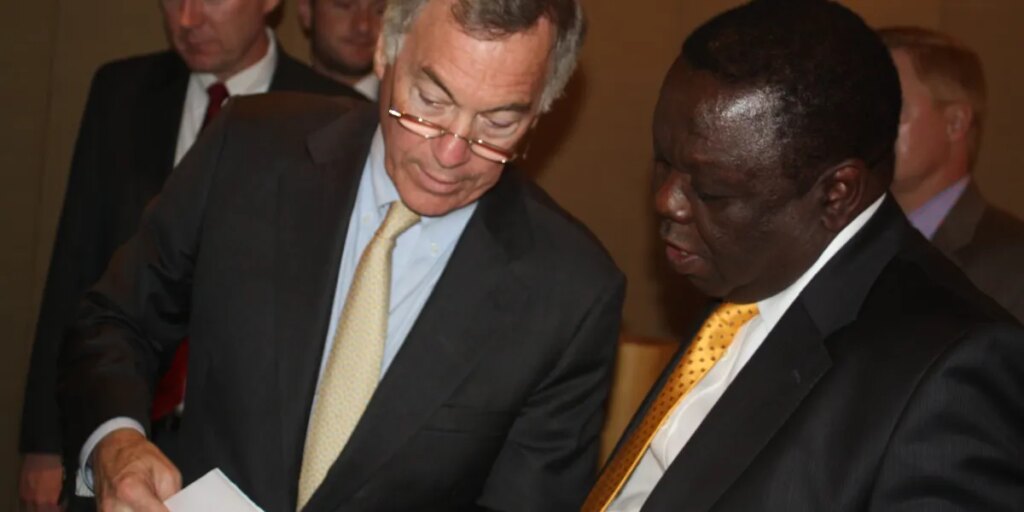
In 2009, Hanke again traded continents. He became informal advisor to the new prime minister of Zimbabwe, Morgan Tsvangirai, who served as a head of a relatively enlightened National Unity government that included the opposition under dictator Robert Mugabe. (“I didn’t want to be official, because Mugabe and his henchmen would have posed a danger to any foreigner who showed up on the radar,” Hanke recalls.)
The scenario echoed the current one in Venezuela. People en masse refused to use the Zimbabwe “dollar.” To avert a crisis, the government at first allowed its citizenry to use U.S. dollars instead. The greenback effectively took control by popular acclaim. Then in 2009, Zimbabwe officially dollarized, and as Hanke puts it, “Inflation virtually disappeared.” When the National Unity Government fell in 2013, so did dollarization, and triple-digit inflation returned to Zimbabwe. It was a live demonstration that dollarization’s stability is politically contingent, not permanent.
Prior to those dollarizations, Hanke helped institute a number of “currency boards,” where inflation-plagued nations keep their local currencies but tie their value to the dollar or the Euro at a fixed exchange rate, and hold the reserves in the anchor currency equal to the money in circulation. Folks or businesses can exchange the local money for, say, dollars or euros at any time.
In 1991, Hanke advised Argentine President Carlos Menem to institute a currency board, but Menem chose a weaker “convertibility” alternative that still for years enabled the nation to thrive. But in 1995, Menem requested that Hanke draft a dollarization law that never advanced. Then in 2001, the convertibility system collapsed, and inflation collapsed and the peso took off, suggesting that dollarization treats a symptom of the disease, not the underlying cause.
Four years later, Hanke earned great controversy, and the enmity of the Clinton administration, by heeding a request from Indonesia’s president Suharto. Evening after evening, Hanke joined the strongman in a small den at his private residence as they huddled to design a blueprint for a stable rupiah. But President Clinton, according to Hanke, wanted Suharto gone, and feared that sound money could keep him in power. Clinton deployed the threat of withholding billions in aid to nix the Hanke plan, and a weak rupiah hastened Suharto’s departure months later. It was a lesson in how a country’s monetary anchor can become a lever that foreign powers pull for their own political ends, not a neutral technical fix.
Hanke also designed or advised on currency boards in Estonia, Lithuania, Bulgaria and Bosnia — all of which still anchor to the euro today — and pushed similar plans in Kazakhstan that stalled on Moscow’s objections, respectively. Moscow preferred a weak, unstable tenge [the nation’s currency], and a neighbor that was not sure-footed,” he explained. His exploits were never less than swashbuckling, like the time he was greeted in Albania by a deputy prime minister with a revolver strapped to his waist, standing before a picture of Mother Teresa. That country’s currency board didn’t end up going through.
It’s been quite a journey from a boy who grew up in rural Iowa, working on his grandfather’s egg operation, and became fascinated by the farmer’s practice of selling supplies “forward” on the Chicago Mercantile Exchange. Divining that investors could make money simply by speculating on contracts he opened a CME account trading soybeans at age 14. By the 1980s, he served as chief economist at famed Toronto commodities firm Friedberg Mercantile, where he advised a massive short position in crude, betting that Saudi Arabia was set to punish its fellow OPEC members for brazenly cheating on their quotas. His timing was quicksilver when oil prices tumbled from $30 to under $10.
‘Pump to the max, baby’
For Venezuela, Hanke’s championing a maverick strategy he first formed while serving on the UAE’s financial advisory council from 2008 to 2014. In that role, Hanke developed a framework showing that the federation would generate the greatest wealth for its people over time by pumping as much oil as possible. “I called it the ‘take the money and run strategy,’” he says.
But OPEC was imposing a tight limit on how much oil the UAE could sell. “The UAE kept pushing for a much higher quota, and OPEC kept saying no,” says Hanke. He advised the UAE to exit OPEC. But UAE remained a reluctant member, while accepting Hanke’s view that the cap greatly curbed the true value of the deposits under its sands. Hanke stayed in touch with the UAE authorities, and kept recommending the split.
On May 1, 2026, the UAE departed OPEC after 59 years of membership. Hanke’s convinced it was his analysis of the economics that inspired the move. “I argued that unless oil prices rise a lot in real terms, the longer you wait to produce, the lower the ‘present value’ of the reserves,’” he says. “That’s exactly the argument that motivated the UAE’s leaving. It was because of the framework I’d been counseling for almost 20 years.” In four months on its own, the UAE has lifted production 80% from 600,000 to 1.1 million bbd, on track to raise an extra $15 billion annualized revenue.
Venezuelans are abandoning the bolivar already in a kind of “spontaneous dollarization,” Hanke said, raising the chances the switch will become official. Hanke’s brief also encompasses advising on energy policy. And he’s recommending a bold stance he’s successfully advocated to major OPEC-rejector the UAE that can be summarized as, “pump to the max, baby.”
Hanke’s prescription to produce as much of the black stuff as possible, as fast as possible is colliding with the world’s lowest “depletion rate,” meaning the percentage of its reserves produced each year. Venezuela is extracting just 0.2% of its 380 billion barrels in reserves each year. It would take the nation 350 years to exhaust just one-half of its below-ground supply. Venezuela’s depletion rate’s one-fourth the Saudi figure of 1.2%, and one third one-fifth Kuwait’s 1.5%. The number for ExxonMobil and other majors is estimated in the 6% to 7% range, meaning they’d exhaust half their reserves in roughly a decade. “When you apply a discount rate to all the time it takes to get Venezuela’s oil out of the ground, the present value of a huge amount of their oil is effectively zero, and at these anemic production rates, it’s amazing how little the world’s biggest deposits are worth.”
Of course, the reason Venezuela lags by such a huge margin is the dilapidated state of its oil infrastructure. In Hanke’s vision, as dollarization brings big investment to its petroleum patch, Caracas should take a position similar to the super-aggressive posture pursued by the UAE. Today, Venezuela’s an OPEC member, but remains such a petty producer that it doesn’t merit a quota at all. “But as capacity increases, the government should keep pushing for bigger and bigger quotas to match those capacity gains,” says Hanke. “If OPEC refuses, Venezuela should do just what the UAE did, drop out, and pump a lot more.” Hanke proudly adds that Venezuela will gain clout from a credible example when it constantly pushes for higher production caps: If the UAE can walk out, and collect multiple billions in added revenue, so can Venezuela. “That Venezuela has the same advisor who advised the UAE also adds to its clout,” he declares.
Put simply, Hanke sees Venezuela’s future as the world’s leading oil maverick that will go rogue if OPEC’s strictures prevent it from maximizing the worth of its sumptuous reserves. Once again, the best sign that Venezuela’s ready for the dollar is that pretty much everyone not employed by the government, or receiving state aid or pensions in bolivar, is using the world’s most prized and safest currency.
In 2019, the bolivar lost almost all of its value, forcing Maduro to allow full convertibility into dollars. Today, all prices in the stores are posted in dollars. The payments take two forms, physical dollars, or dollar-backed stablecoins; the most popular by far is USDT, known as Tether, which accounts for the vast bulk of remittances from abroad. As Hanke notes, the use of Tether accelerates the shift to the dollar, since it’s convertible into greenbacks. The rub: Some 7 million public employees and pensioners get paid in a bolivar that’s losing a third of its worth every month. The sums they receive can’t keep pace with the prices of the likes of food, medicine and rent. “That’s why they[re dumping their bolivars and getting dollars as fast as they can. And the constant crunch on a huge swath of the nation’s purchasing power is an enormous drag on the economy,” says Hanke.
Still, Venezuela’s already gone a long way towards something Hanke calls a “spontaneous dollarization.” The phenomenon garnered an interesting reaction from Francisco Zalles, the Ecuadorian economist with whom Hanke worked in dollarizing that economy a quarter-century ago, and recently collaborated on a Spanish book about its success. “The Venezuelans have already chosen the currency they want,” said Zalles. The citizens are voting with their wallets, and it’s a landslide. The Money Doctor’s crusade will be a tough one. But it boosts his chances of success that the currency he advocates already reigns as the people’s choice.
The post Exclusive: Venezuela, sick with hyperinflation, engages the ‘money doctor’ Steve Hanke for a dose of dollarization medicine appeared first on Fortune.