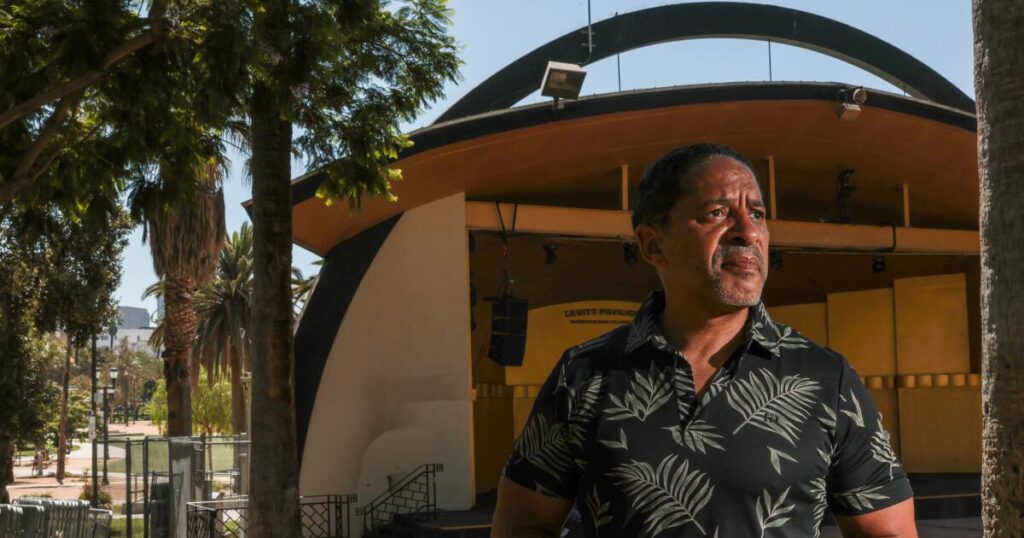
This weekend, Martin Ludlow thought he would finally be on Dockweiler Beach, waiting for fans to arrive at the LA Jazz Festival.
Ludlow, the founder of the festival and event promotion firm Bridge Street Inc., imagined that he would be perched on the stage at sunrise, waiting for John Legend and Janelle Monáe to play for 40,000 people. “In a matter of hours, this place is going to get filled up with thousands of people dancing and celebrating,” he said, recalling his hopes for the show.
Yet on a scorching Monday afternoon, Ludlow sat alone at a streetside coffee shop in Eagle Rock, trying to account for how the biggest jazz event in Los Angeles history fell apart.
Instead of reveling in ferocious solos and ocean breezes, the city’s music and civic communities watched the festival collapse in the wake of missed permit deadlines, blown budgets and angry artists left stranded without shows. Fans asked how such a prominent festival, with pop headliners and vocal support from City Hall, imploded on Aug. 7, the day its programming was due to begin.
A consultant familiar with LA Jazz Festival’s finances (who requested anonymity as they still work on similar events) and several performing artists said the fest had longstanding financial issues, which were increasingly evident in the weeks before the show. Acts questioned whether Ludlow, a former City Council member who pleaded guilty to misappropriating funds in 2006, was the right person to attempt such an enormous festival, and how he plans to make amends to an angry jazz scene.
After the startling cancellation, vendors, artists and crew were out thousands of dollars in unpaid advances, after spending on rehearsing and traveling to the festival. Several artists said Ludlow, though remorseful about the festival’s outcome, failed to communicate updates about the cancellation beyond last-minute form letters.
“Right now, it’s a brutal fishbowl,” Ludlow said. “There’s the disappointment of people who were just really looking forward to this. And then there’s the disappointment of folks who don’t know me, who don’t know the real intentionality behind it, and just see it as the flop of the moment. They’re both super painful.”
The LA Jazz Festival debuted in February with a star-studded announcement on the steps of City Hall. Ludlow, flanked by Mayor Karen Bass, councilmembers Heather Hutt, Traci Park and Tim McOsker, drum legend Pete Escovedo and other music luminaries, described his ambition with the fervor of the civil rights era — a jazz festival on a slice of beachfront significant to Black history, with free programming in parks, clubs and restaurants across every council district. He hoped for 250,000 fans across a month of shows.
“This festival is intended to lift up our ancestors that came to this country in bondage, terrorized, brutalized,” Ludlow said then.
Bass, beaming, turned to Ludlow, saying, “Martin, I’ve been on this 15-year journey with you. Through all of the ups and downs, I’m so excited this is the year.”
In the early 2000s, Ludlow was a charismatic rising star on the City Council. Yet he faced investigation for illegally steering schoolworker union funds into his 2003 council campaign. Bass, then a state assemblymember, supported his efforts to raise funds for his legal defense. Ludlow pleaded guilty to a felony charge of conspiring to embezzle union funds in 2006. He was sentenced to five years’ probation and 2,000 hours of community service, which he alluded to in an interview with The Times as “my first public setback.”
After leaving government to serve as executive secretary-treasurer of the Los Angeles County Federation of Labor, Ludlow then founded Bridge Street Inc., which produced concerts and street fairs in Los Angeles, including a large 2019 event at the renaming ceremony for Obama Boulevard in the Baldwin Hills/Crenshaw neighborhood.
Bridge Street Inc., which produced the LA Jazz Festival, staffed its leadership with several well-connected political and labor figures. Pilar Freeman, who served as the LA Jazz Festival’s chief operating officer, pleaded guiltyin 2012 to a misdemeanor count of failure to file a 2008 tax return for money that Local 6434 of the Service Employees International Union paid to her firm. Freeman received $540,000 in consulting payments from the union group, led by her husband Tyrone Freeman, who was convicted of embezzling assets fromSEIU Locals 6434 and 434-B, among other charges, in 2013.
Bridge Street’s policy and communications advisor, Ed Sanders, recently worked for Groundswell for Water, a consortium of groups funded by Cadiz Inc., a Los Angeles firm that has tried for decades to siphon groundwater from the Mojave Desert.
Ludlow said Freeman “did a great job,” but her position ended in 2024, while Sanders remained as a consultant.
With A-list talent atop the bill, though, and a noble mission to bring free jazz shows to every corner of Los Angeles, organizers hoped to put the city on the global jazz-festival map alongside New Orleans and Montreal.
Yet for all the star power at the fest’s kickoff event, the LA Jazz Festival may have been in trouble from the start.
Internal emails reviewed by The Times between Ludlow and a consultant show that Bridge Street was underwater trying to finance the initial proposed $16-million budget for the festival. Expenses for the fest were formidable — the beachside main event required fencing, flooring, stage builds, environmental mitigation, sanitation and more on a stretch of sand that had never hosted a comparable event.
The festival’s initial seed funding came from, Ludlow said, “private individuals and private corporations” and not city or county coffers. The for-profit LA Jazz Festival has a separate nonprofit, LA Jazz Festival Foundation, that produces year-round community events.
An email from Ludlow to organizers said the company sought venture capital investments for 20% of the festival at $5 million, and a title sponsorship for $1 million. However, Ludlow said those figures were not accurate. The sponsorship was eventually claimed for $750,000 by Airbnb, which had previously paid Ludlow’s firm more than $2.2 million to canvass for more lenient short-term rental rules in Los Angeles. Airbnb also donated $750,000 to a committee backing Bass’ mayoral reelection. In April, Bass supported regulations letting Airbnb hosts rent second homes and investment properties into 2028.
While the majority of local shows would be free, the headline event on Dockweiler had paid tickets starting under $70, with luxury boxes and VIP packages running into the thousands. (Ludlow said all paid ticketholders will be refunded within 30 days of the cancellation.)
A spokesperson for the California Coastal Commission said Ludlow got a permit for the main event in 2021, but “Due to delays on the applicant’s side, the event was never implemented.” The commission approved four amendments each year since 2023 to keep the permit updated, but said this year’s festival was canceled “for issues unrelated to the CDP process.”
The Coastal Commission’s permit was contingent on the festival’s slate of free programming citywide. As he consolidated the festival, Ludlow acknowledged he didn’t secure permits for many of the planned neighborhood shows just weeks before kickoff. Ludlow considered abandoning the beach fest and moving the headline shows into the Greek Theatre in Griffith Park and Peacock Theater in downtown Los Angeles, which led to several headliners dropping out.
Ludlow said Los Angeles Police Department and Los Angeles Fire Department security and permit costs, and a significant gross receipts sales tax, ultimately doomed the festival.
As first reported in LA Material, LAPD’s Commission Investigation Division commanding officer Lt. Scott Moffitt wrote in a July 23 letter to Ludlow that “Despite multiple outreach attempts by my office on July 8, 2026; July 16, 2026; and July 21, 2026, the required paperwork remains outstanding and no response has been received.” On July 31, Moffitt wrote that “I am doubtful that the organizers will meet this final deadline, a deadline that has already been extended far beyond any prudent or reasonable boundary.”
Ludlow said he did his best with a demanding multi-agency process. “That moment where we finally got hit with, ‘Here’s what we need, and we need it right now, or you’re not getting this permit,’ that was the biggest shot to the solar plexus,” Ludlow said. “I kept telling the guys on Police and Fire through this whole process that I know that you’ve got these systems and policies. How do we help change these structures so that they have a bit more flexibility?”
Ludlow scrambled after a call with the festival team the week before the cancellation. “I started calling billionaires, millionaires. I went into campaign mode,” he said. “I knew right at that moment there’s only one way out of this. We’ve got to pivot, and we can’t. That is not financially feasible.”
The festival died just hours before the planned first notes from singer-songwriter Lalah Hathaway at the Leimert Park opener.
Organizers blamed “significant, unanticipated last-minute public safety and municipal costs associated with the final permitting” in a statement announcing the cancellations.
Leah Concialdi, a saxophonist whose Afrobeat band the Neighborhood Orchestra was slated to play the fest’s Caribbean street carnival in Venice (and a publicist representing several acts on the bill), said her band was never paid its advance, and first learned her show was in jeopardy from a broken ticket link.
“I felt blindsided. I don’t think it was handled appropriately,” she said. “The public deserves better. I feel terrible for the street vendors. So many people invested their time, reputation and good names to be a part of this ecosystem. For all to collapse as it did was a total bummer.”
Ludlow said around 20 artists had not yet received their advances, a figure which he said may include Concialdi’s band. Ludlow said he planned to pay them soon. “I’m just nonstop doing everything I can to get those deposits to them. I plan to call every single artist that will take the call,” he said.
Saxophonist Isaiah Collier called the surprise cancellation a “wake up call.” His Jazz in the Park show was nixed after he had already flown into Los Angeles as part of his tour. He picked up impromptu gigs, one at the Echo Park restaurant Grá and another through the Leimert Park jazz institution World Stage. Yet Collier wondered if organizers overpromised.
“This is an example for anybody who aspires to these things. You have to consider what happens when you get people invested,” Collier said.
There was potential for L.A. Jazz Festival to rise to the level of the Newport or North Sea jazz festivals, said Gengis Don, a New York musician and promoter. His L.A. artist friends were “excited but also hesitant” about LA Jazz Festival, he said, because “the show was so big, but thrown together last-minute.”
After the fest went under, he pulled together a raucous show, “Can’t Cancel Jazz,” at the Slow Jamz Gallery in downtown L.A. for affected acts.
“I felt bad for everyone in L.A., especially given the jazz renaissance in L.A. going on,” he said. “It could have set us back in regards to progression of jazz becoming popular out here.”
LA Jazz Festival was, he said, “a case of right message, wrong messenger.”
Ludlow, even with his bitter experience producing a show at this scale, still thinks he is the right messenger. He believes LA Jazz Festival is workable.
“This idea is so fundamentally sound that I’m sort of living on the hope of how do we rebuild it,” he said.
Ludlow will have a lot of work to do to restore his reputation within the jazz community. He said he’s spent over $1 million on performance fees.
Some artists are still skeptical. “This is what we’ll talk about years from now, good or bad, when we’re asked to participate,” Collier said.
“It’s a really bad look,” Concialdi said, noting her band paid for photographers, a video team and rehearsal time. “I’m still paying out of pocket and not yet recouping.”
Meanwhile, Ludlow’s not the only ambitious jazz promoter with an eye on the beach.
Stanley Clarke, the bass legend and educator who has influenced generations of acts in Los Angeles, threw the Santa Monica International Jazz Festival in Tongva Park and at the BroadStage in Santa Monica in May. Headlined by Kamasi Washington and emerging acts like the band Knower, Clarke said the festival, curated with executive producer Martin Fleischmann, exceeded his and the city’s expectations.
“I know lots of promoters and I know the good ones who are all about the music,” Clarke said. “When I look at the curation of jazz festivals, it has to line up so that the people that come and buy tickets feel some legitimacy. When you come in to have a festival and you just put big names out there but don’t take time to promote, terrible things can happen.”
Clarke said cultivating deep ties within the scene was crucial. “Don’t shoot too big, don’t shoot too small,” he said, adding that his planning took two years. “To get into this, you need smart, ethical people.”
The post LA Jazz Festival imploded on opening day. Can its creator make amends to an angry jazz scene? appeared first on Los Angeles Times.