As a longtime Angeleno, I’ve got the same beef with AI as everyone else in this town. I don’t want it stealing stories from writers, voices from actors or trust from audiences.
But the condemnation of artificial intelligence has now blown past scripts, scraping and unscrupulous studios. Earlier this month, New York Times opinion columnist Bret Stephens begged readers never to write with AI — not even to organize notes. It’s “mentally enfeebling,” he wrote, “an escalator toward a result when you really need to make a daily habit of taking the stairs.”
Not everyone can take the stairs.
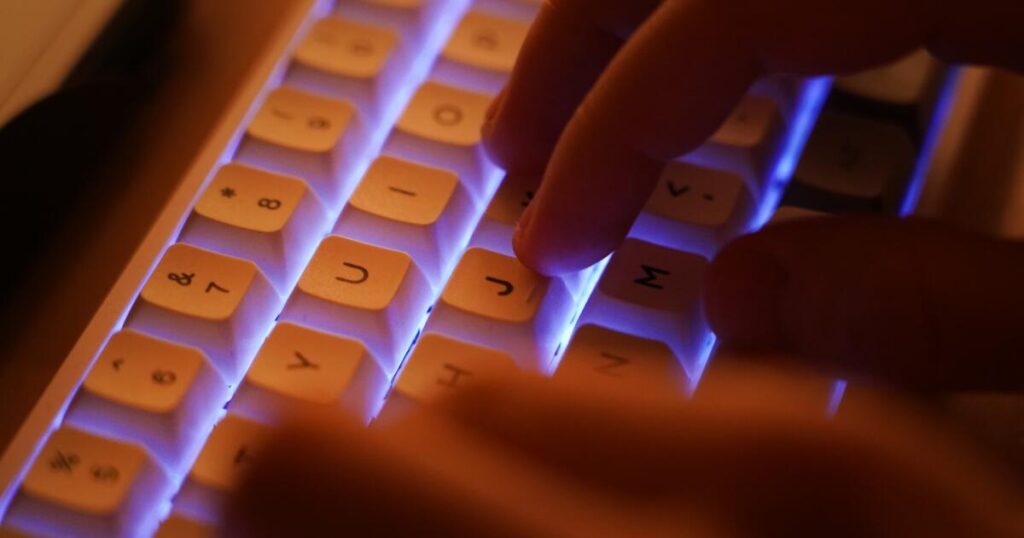
I’m a freelance writer with shredded tendons, a wrist tear and nerve compression that sets my arm on fire after only a few minutes of using a pen, keyboard, mouse or trackpad. So I dictate everything instead — this sentence, flowery Yelp reviews I never post, texts to myself reminding me to set timers, and timers reminding me to send texts.
I write clean but talk dirty, and dictation means it all lands on the page — the intended prose, the unintended profanity, the inevitable parentheticals and the “Who’s a good boy?” when my cursing summons Walter the anxious labradoodle into my office with his giant squeaky Xanax pill toy.
The result is pages of unpunctuated chaos.
I use AI to clean up the dictation debris — the cursing, the editing commands, the typos you get when you swap a keyboard for a microphone and “raise the stakes” becomes “raise the steaks.” It does not write. It cuts. Nothing is added. What remains is only what came out of my mouth — a marginally less chaotic, poorly punctuated vomit draft.
Then I go through six or seven or 70 rounds of revision — yelling at my laptop as I over-enunciate. “Start dictation.” “Em dash not en dash.” “Arghhhh no, M as in Mary.” “Noooo! Delete M as in Mary!”
I hate writing this way, but it’s the only way I can. What Stephens sees as a mentally enfeebling escalator is actually my access ramp to the page. To Jen Statsky, co-creator of the hit TV series “Hacks,” taking that ramp exposes me for what I am: “If you use it in your work, you’re a hack,” she said on a recent podcast episode.
Ouch.
I don’t feel like a hack. At 61, I’ve MacGyvered a way to write out loud — impressive for someone who still can’t get from KTLA to Hulu with the Amazon Fire TV Stick.
I agree with Statsky on this much: Writing is hard, and that’s OK. “The grist and the struggle and the friction is part of the process. It’s what makes art good,” Statsky said, arguing against AI. And while I wouldn’t call what I write art, I’ve got plenty of grist and struggle and friction. A burning arm, throbbing hands and pages of dictation garbage don’t make my writing better. They just get between me and what I’m trying to say. I still have to do the hard part — thinking, deleting, overthinking, revising, agonizing, Command-Z-ing, as I try to turn the mess in my head into words that say what I mean. It’s exhausting and frustrating and painful — which just might be enough suffering to meet Statsky and Stephens’ threshold for a real writer.
I doubt either of them had me in mind when they condemned writing with AI. My particular use is weirdly niche and, I think, ethically defensible. But when one writer says “never” use AI and another says anyone who does use it is a hack, there isn’t much room left for people like me.
And there are a lot of us: 1 in 4 adults in the U.S. has a disability. The ways we use AI for access, if we use it at all, vary greatly. I use it to clean up my verbal wreckage — someone else might use AI to describe an image they can’t see or communicate words they can’t vocalize.
That doesn’t mean we all embrace AI. Disability isn’t a monolith, and I don’t presume to speak for anyone but myself. In fact, a 2025 study of 54 queer disabled fiction writers found them “markedly more pessimistic than others” about generative AI’s impact on their industry. In a 2026 focus group study, 13 of 20 disabled adults used generative AI for accessibility, even though none trusted it unconditionally.
You can acknowledge the danger AI poses in one context and still value the access it gives you in another. That’s why “never” is a lousy rule.
Scraping someone else’s work or passing off AI-generated prose as your own is different from using AI to get your words on the page. AI needs guardrails — in writing, in schools, in art. But a blanket prohibition is easy to make when you’re the one able to take the stairs.
When Stephens and Statsky sit down to decide what the limits of AI in writing should be, the rest of us deserve a seat at the table, too. Some of us will need a ramp to get there.
Sharon Schindel writes about what keeps her up at night — chronic pain, invisible disability and getting old. Instagram: @ithurtsmetosaythis
The post Stop shaming the use of AI. For some with disabilities, it’s a godsend appeared first on Los Angeles Times.