HOUSTON — For years, travelers passing through Texas’s two biggest airports have had access to small washing stations for a ritual called wudu, in which Muslims clean their hands, arms, head and feet before the five daily prayers.
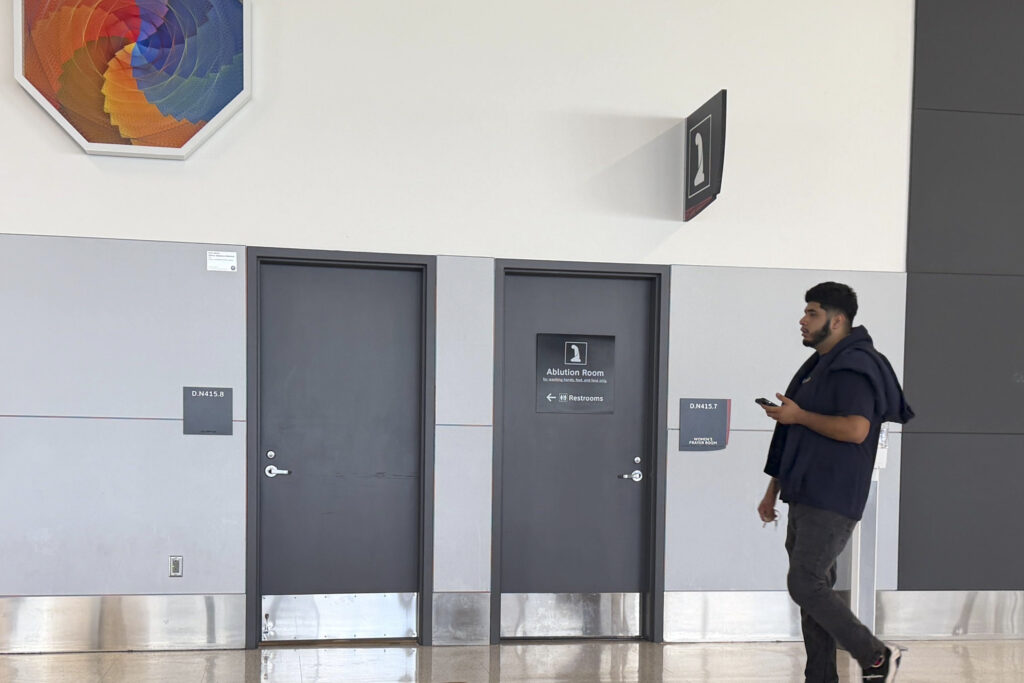
Such facilities have become more common in states with the largest Muslim populations, including Texas, where on Wednesday travelers and others popped in and out of washing stations at Houston’s George Bush Intercontinental Airport. The tiled wudu room sits along an airport hall just past a vending machine, with a small sign showing a draped person kneeling.
Public wudu stations are also open at places including the University of Minnesota, the University of Michigan, LaGuardia Airport in New York and O’Hare International Airport in Chicago.
Now, amid rising attacks on Muslimsby Republican elected officials, Texas Gov. Greg Abbott is making the stations a target. He sent a letter Friday to the heads of the Houston airport and Dallas-Fort Worth International Airport that said facilities aimed at serving one religious group are discriminatory against everyone else.
Abbott said he has asked the U.S. Department of Transportation to investigate both airports and warned that his office is “reviewing all grants to any local governmental entities involved in these schemes.”
Later that day, DFW announced it had scrapped plans to add additional washing stations in men’s and women’s restrooms that are available to passersby outside the security perimeter.
Airport spokesman Heath Montgomery wrote in an email that officials “determined the originally anticipated benefit may not be achieved” if the stations were built.
Asked if the decision was a response to Abbott’s letter, Montgomery said it was made before the letter was issued, but that airport officials “were aware of his and other public officials’ emerging concerns.”
Muslim leaders and experts in religious liberties rejected Abbott’s claim that the facilities would discriminate against non-Muslims. Several said opposition to the washing stations is the latest example of GOP leaders, perhaps most visibly in Texas, railing against Islam.
“If there is one thing all religious liberty scholars and advocates across the ideological spectrum have agreed on, it is that the Free Exercise Clause forbids government discrimination because of religion,” Steven T. Collis, a University of Texas-Austin law professor, said in an email. “Although Gov. Abbott’s letter characterized what the airports were providing as discriminating in favor of Muslims, this newest saga is actually part of a much broader pattern of state officials targeting Muslims and trying to make Texas an inhospitable place for them.”
Asma Uddin, a constitutional law scholar who writes about Islam in America, said the Supreme Court has long ruled that neutrality “does not mean that every religion gets treated exactly equally; it means the government cannot coerce, endorse, or exclude based on religious identity.”
The experts noted a range of public services targeted to specific groups, from kosher food served at airports to special low-sensory hours at museums or parks for autistic people. The public-private Texas waterpark chain Hawaiian Falls has hosted events for Christians including “Modesty Matters” and mass baptisms. President Donald Trump this summer hosted a massive evangelical Christian worship event on the National Mall in D.C.
“We can choose to be coy about it and pretend like there are actually sophisticated ideas or sincere concerns here about discrimination, religious encroachment, public safety or spending,” said Imam Omar Suleiman, who leads the think tank Yaqeen Institute outside Dallas. “Or we can embrace the fact that bigotry toward Muslims is alive and well and being fanned, funded and fueled to increase, in Texas and across the country. And people like Governor Abbott are at the center of that phenomenon.”
Abbott’s office declined to comment Wednesday, referring The Washington Post to social media posts in which he repeated his claim that the washing stations were religious discrimination.
The office also noted a Sunday interview on Fox in which Abbott was asked why he opposes the stations but supports a new state law mandating the posting of a Protestant version of the Ten Commandments in every classroom.
Abbott called the two things “apples and oranges.” The biblical commandments, he said, were part of Texas history all the way up until “who we are today,” while “other faiths” don’t have “the same applications over the course of history of the state of Texas and hence don’t need to be recognized.”
Suleiman, who uses airport wudu stations when he’s traveling, called the washing facilities an important part of making Muslims comfortable and described Abbott’s letter as part of a movement looking to curtail that group’s religious freedoms.
“Putting one’s foot in the nasty sink of a public restroom — often trying to carefully ensure that no part of the body touches some yucky bathroom surface while balancing on one leg — isn’t really something Muslims are thrilled to be doing,” he said.
There are about 4.6 million Muslims in the United States and about 313,000 in Texas, according to the World Population Review. Muslims have become more visible in American public life in recent years, with milestones including the election of Mayor Zohran Mamdani (D) in New York and the Michigan Democratic primary win of Abdul El-Sayed, who would become the nation’s first Muslim U.S. senator if he defeats his Republican opponent this fall.
At the same time, anti-Muslim sentiment has become more public and more pointed.
“The blatant and mainstreaming of Islamophobia is worse than after [the Sept. 11, 2001 attacks],” said Haris Tarin, vice president of the Muslim Public Affairs Council, an advocacy group that focuses on policies of interest to U.S. Muslims.
Trump, who has declined to condemn anti-Islam comments from members of his party, last week described Democratic candidates in the midterm elections as “jihadists.” Earlier this month, Rep. Nancy Mace (R-South Carolina) said “every single Muslim holding public office in America is a Trojan horse.”
The growth of Muslim communities in Texas is impossible to miss.
The Houston area is now home to Texas’s largest Muslim community, with more than 200 mosques and Islamic centers. The Muslim population in the Dallas-Fort Worth area doubled in a decade, and Muslim state lawmakers represent suburban districts in both the Dallas and Houston metro areas.
Houston Mayor John Whitmire released a statement in response to Abbott’s letter saying 22 percent of all international travelers departing from Terminal D — where the wudu station is — are flying on airlines based in Muslim-majority countries. “IAH is a global gateway,” Whitmire wrote. “The ablution room was created in response to passenger requests and serves a practical need.”
Abbott, who is running for reelection, and Attorney General Ken Paxton — a Trump ally who is waging a competitive race for the Senate — have both embraced Islamophobic rhetoric on the campaign trail.
Last year, Abbott designated the Council on American-Islamic Relations, a Muslim civil rights and advocacy organization, as a foreign terrorist group. He and Paxton fought to revoke the group’s nonprofit status, a move that CAIR has challenged in court.
Abbott has also led GOP efforts to block a residential development planned around a large mosque complex in the Dallas area.
Texas officials denied Islamic schools access to the state voucher program until a judge ordered them not to. At the Texas RNC convention in Houston in June, Republicans added to their platform a provision banning “sharia,” or Islamic law, even though sharia law does not apply under U.S. civil law.
At the airport in Houston on Wednesday, people came in and out of the wudu rooms ahead of Dhuhr, the midday prayers. A man and woman wearing airport employee tags — she also wore a blue head scarf — slipped into their respective rooms shortly before 1:30 p.m. A mother and her teenage son, traveling home to Toronto after visiting family, said ablution stations are common in Canada.
Ubaid Mian, who manages several airport restaurants, said he uses the prayer and wudu rooms multiple times each day.
“The airport is a place where everybody travels. Diversity should be appreciated,” he said, shaking his head at the controversy. Texas ”has so many people here who have so many different beliefs. There’s no harm in it. It should be respected.”
Mian said he would be back at the wudu room to prepare for evening prayer before heading home.
The post Texas Gov. Greg Abbott takes aim at Muslim washing stations in airports appeared first on Washington Post.