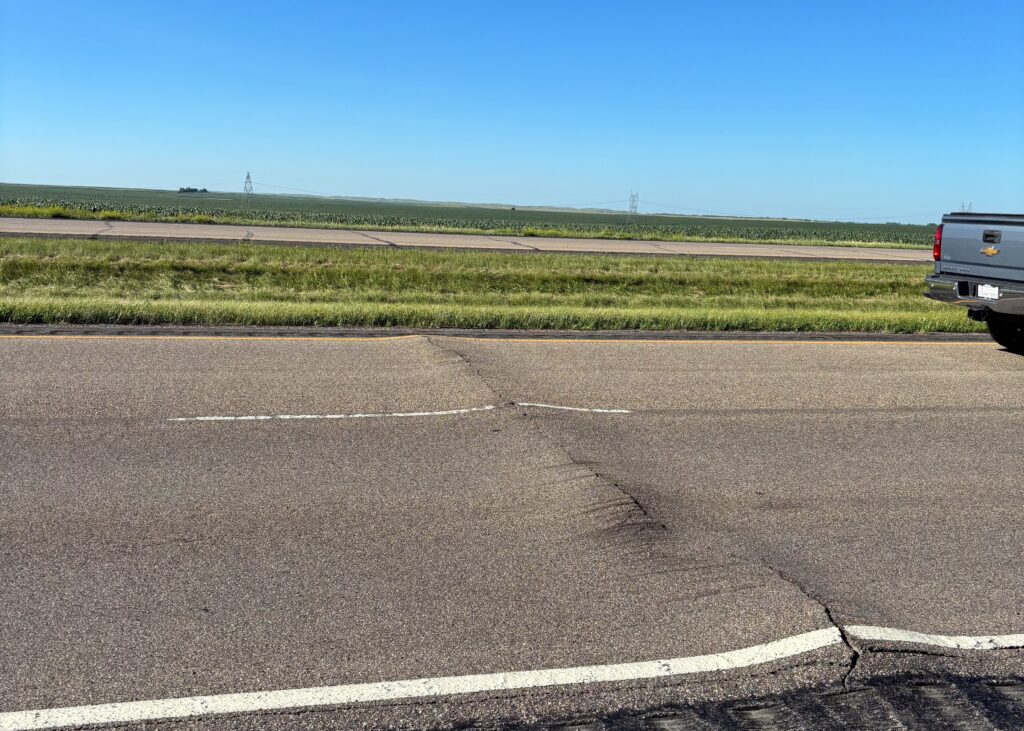
It was another sizzling summer day in late July, with temperatures nearing 100 degrees, when one of the main roads cutting through Greenville, Texas, finally just gave up.
The stretch of U.S. Highway 69 kept expanding in the extreme heat until it exploded, creating a sharp, two-foot-tall ramp where it broke at the pavement joint. Most of the traffic in this Dallas exurb drove around it.
But then a black pickup hit the ramp going about 30 mph, sending the truck airborne, “Dukes of Hazzard”-style, flying several feet in the air and slamming down on its front tires.
“Oh, my god!” an onlooker said, as the scene was being recorded. “That’s crazy!”
It was a dramatic example of what has been playing out repeatedly this summer along the nation’s roadways, railroad tracks and bridges: Intense heat is causing surfaces to expand to the point that they break.
The failures illustrate how the nation’s transportation networks, built for a different era, increasingly struggle to handle hotter modern-day summers. And this summer has been brutal. July, federal scientists have said, was the single hottest month on record in the contiguous United States.
Heat waves melt asphalt into goo. Train tracks twist. Overhead power lines sag. Concrete snaps into pieces in what are known as “blowups” — the technical term for what the Pennsylvania Department of Transportation defines as “a heave in a concrete or brick pavement caused by pavement expansion from excessive heat.”
The entire state of Wisconsin was cautioned earlier this summer to “watch for pavement buckles.” A blowup last month closed part of Interstate 97 near Severna Park, Maryland, clogging traffic for a quick repair and then for three straight nights. Interstate 49 in Shreveport, Louisiana, was also shut for hours while crews raced to deal with a blowup. After a bike path next to U.S. 36 buckled, officials in Boulder County, Colorado, warned residents to prepare for more.
“You start seeing them in early summer, and then they surge as the heat builds,” said David North, a district engineer with Louisiana’s transportation department.
Blowups, he said, are “unpredictable and instant.”
In New Jersey, a vertical-lift bridge over the Point Pleasant Canal has been forced to close to boat traffic four different times this summer — on June 11, June 30, July 14 and Aug. 7 — because unrelenting heat kept cooking bridge components and preventing the span from moving.
The bridge, which opened in 1972, was built for a different climate.
State officials now “are working with our consultants to see if there can be any modifications made to mitigate these issues,” Steve Schapiro of the New Jersey Department of Transportation said in a statement.
In Wisconsin, the rate of pavement buckling had been increasing over the last decade, with higher temperatures partly to blame, according to a 2022 state report.
The Federal Highway Administration in 2023 warned against relying on historical climate records when designing new roads and suggested looking instead to predictive climate models.
“I do think there is a recognition that [road] specifications and standards are static, but weather patterns are changing,” said Shane Underwood, an engineering professor at North Carolina State University and president of the Academy of Pavement Science and Engineering.
He was the lead author on a 2017 paper that warned that failing to change methods “significantly threatens” the nation’s roads.
Underwood said he’s seen some progress. He pointed to an online tool developed by federal officials that uses site-specific climate data to help engineers select the correct blend of binders for asphalt pavement. Roads in Arizona, for example, need to be stiffer than those in Minnesota to survive the high temperatures.
The regional recipes for new roads have changed over the years, like how the U.S. Agriculture Department updated its plant hardiness zone map to account for warm-weather plants surviving further north these days.
Road engineers also are experimenting with other ways to protect the nation’s infrastructure.
“It’s really taken off in the last 10 to 20 years,” said Kim Roddis, professor emerita of civil and environmental engineering at George Washington University.
Some asphalt roads — which can soften like chocolate chip cookies — are now dusted with plastic polymers for better rigidity, Roddis said.
Several cities have tested out what is essentially white asphalt, to reflect more heat. San Antonio, Phoenix and Los Angeles have launched “cool pavement” pilot programs.
New Jersey has stopped building concrete roads with asphalt on top due to hotter temperatures, calling it an outdated design, Schapiro said. Next year, it plans to repair concrete pavement slabs along 11 miles of Interstate 287, in part to get ahead of potential future blowups caused by the heat.
Railroads are struggling with hotter days, too.
Metal tracks can bend in extreme summer heat, creating what’s known as a “sun kink” as rails exert force against the ties. That can cause trains to derail.
Train operators have responded by stepping up rail inspections and going slower during heat waves.
Washington’s Metro uses “heat ride” inspections to look for rails reaching 135 degrees, the trigger for speed restrictions. Amtrak runs into the problem so often that it offers an explainer page on its website so customers understand why trains might run slower during heat waves.
In February, a trade group for public transit agencies issued new guidelines “to improve its resilience to climate hazards,” with ideas such as replacing wood ties with concrete ones.
Union Pacific, one of the nation’s largest freight railroads, said this summer it was spraying white paint on its rail network in some places to cool the metal, borrowing a page from European railroads.
In Greenville, that flying pickup truck was not the first time extreme summer heat caused problems on U.S. Highway 69.
Just three weeks earlier and 10 miles away, a different section of the highway also succumbed to the heat when the asphalt pavement softened and vehicles pulled up the roadway in chunks.
It was a mess. But it was no match for what was to come.
The viral video of the pavement blowup was the talk of the town, said Greenville spokesman Daniel Starks.
“I was shocked,” he said. “You don’t want ever your road buckling — and definitely not like that.”
The post Why one highway exploded this summer — and why many more are at risk appeared first on Washington Post.