The Democratic Party made its mark Tuesday for the second time in a place anchored to Donald Trump’s identity, dramatically overperforming in a Pennsylvania district near where the president survived an assassination attempt during the 2024 election.
Democrat Brandon Dukes was narrowly leading Republican Scott Timko in a special election for a Pennsylvania state House seat. As of Wednesday afternoon, the race remained uncalled, but Dukes’s lead is remarkable considering Trump won the district by 18 percentage points in 2024, and Republicans have held the state seat for decades.
Dukes’s feat comes months after another Democrat, Emily Gregory, pulled off an upset in a special election for a Florida state House seat, defeating a Trump-endorsed candidate in the heavily Republican district where the president votes. Gregory’s district is home to Trump’s Mar-a-Lago estate.
With their unexpected performances, Dukes and Gregory put blue stamps on deeply red areas, continuing a trend of Democrats consistently overperforming in special elections during Trump’s second term and reinforcing the enthusiasm gap between Democrats and Republicans ahead of the midterms.
Here’s why that advantage matters.
Democratic voters are unusually motivated
In primaries and special elections across the country, voters have turned out for Democrats in higher numbers this year than in the past few election cycles — an early sign that the party’s supporters are energized ahead of November.
Polls also show the gap, with Democrats’ responses indicating that they are more likely to vote than Republicans.
A recent Washington Post analysis found that Democratic turnout in primaries has been considerably higher than Republican turnout and that the party’s voters have been showing up in greater numbers even in races that are not hotly contested or likely to result in competitive general elections.
Another examination, in the Substack newsletter “The Downballot,” which analyzes election results, found that Democrats were overperforming Kamala Harris’s 2024 vote share by an average of 12.5 percentage points in 110 special elections since January 2025.
Democrats are making the case that motivated voters will propel them toward taking back the U.S. House majority. Midterms tend to favor the party not in power.
To flip the chamber, Democrats will need a net gain of three to four seats.
Control of the House probably will come down to fewer than two dozen out of all 435 races this year, and three of those most competitive districts are in Pennsylvania.
What can we expect in November?
While polling and the special-election storylines suggest that Democrats have enthusiasm in their favor, there are no guarantees that they will win the midterms.
Special and general elections can’t be compared directly for several reasons. Most notably, special elections generally have much lower turnout. A surprising result during a special race does not guarantee that the pattern will repeat during a general election, when more people are paying attention and plan to vote.
In Pennsylvania’s 12th House District, with more than 95 percent of ballots counted as of Wednesday, only about 16,800 people voted. The district’s 2024 general election saw more than double that turnout, with about 43,000 voters.
Factors unique to a district can also shift results. In recent years, the 12th House District has seen an influx of residents who have relocated from the Pittsburgh metro area, many in search of affordable housing.
Even so, Dukes probably had to sway Republican and independent voters to edge out his opponent in the district, which still slants to the right, said J.J. Abbott, a Democratic strategist in Pennsylvania.
“It is a good example of the kind of place in the midterms that, if Democrats can overperform expectations, that’s where you’re going to see districts — all the way from congressional down to the legislature — flip away from Republicans,” Abbott said.
James Markley, a Pennsylvania GOP spokesperson, conceded that Democrats did a better job of turning out voters.
“This needs to be a wake-up call for Republican voters,” he said.
Tuesday’s winner in Pennsylvania will serve the remainder of the term of former state representative Stephenie Scialabba (R), who resigned in March.
Dukes, a construction loan administrator, and Timko, a retired Air Force pilot, are also competing in November for a full term.
Pennsylvania’s history as a swing state
Even with the volatility of special elections, Pennsylvania Democrats are bullish on Dukes’s slim lead over Timko. They’re also hoping that the party can build on off-year wins to help make the state more attainable in 2028, when their own governor might be a presidential candidate.
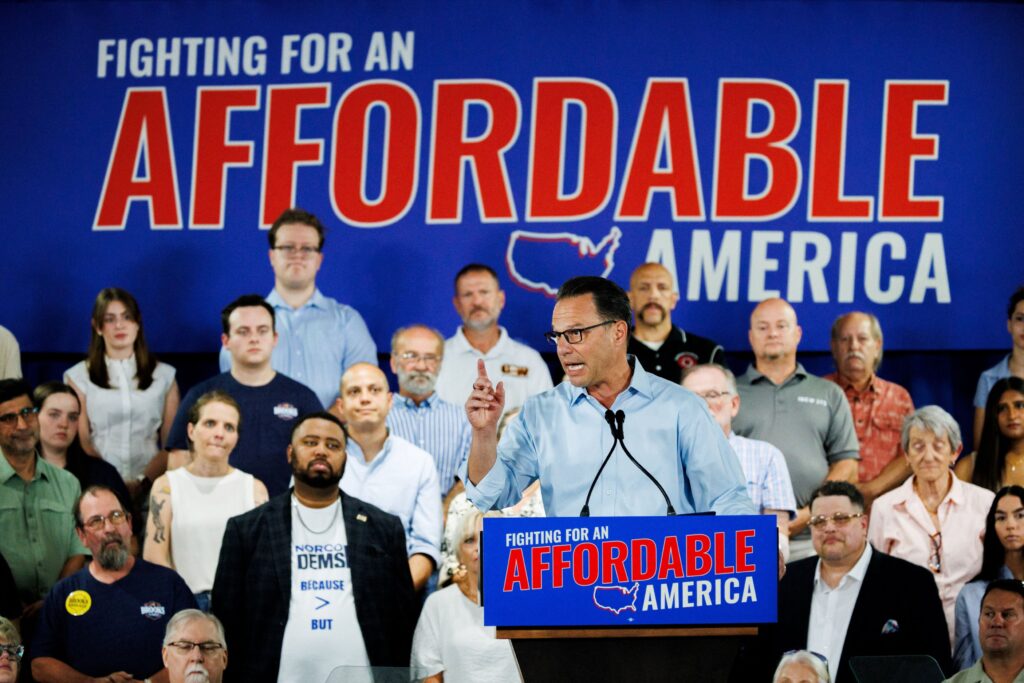
On Tuesday night, as Dukes led by fewer than 100 votes, he got a show of support from Gov. Josh Shapiro (D).
“Pennsylvanians are rising up and using their power to combat the chaos, cruelty, and corruption — and we’re not slowing down,” he wrote on X before the result was finalized.
Shapiro, widely seen as a strong contender for a 2028 presidential bid, has aimed to use Pennsylvania’s elections to show that he can push Democrats across the finish line in tough races. That skill could prove especially valuable in Pennsylvania, an essential battleground state in presidential elections.
Shapiro has sought out other Democrats in tough states and districts as he campaigns throughout the country this year, hoping to bolster his profile as a politician who can sway moderate and independent voters.
The post What it means that Democrats are winning special elections in Trump country appeared first on Washington Post.