Note: This story contains spoilers from “Lucky” Episode 7.
Welcome to the rest of your life, Lucky.
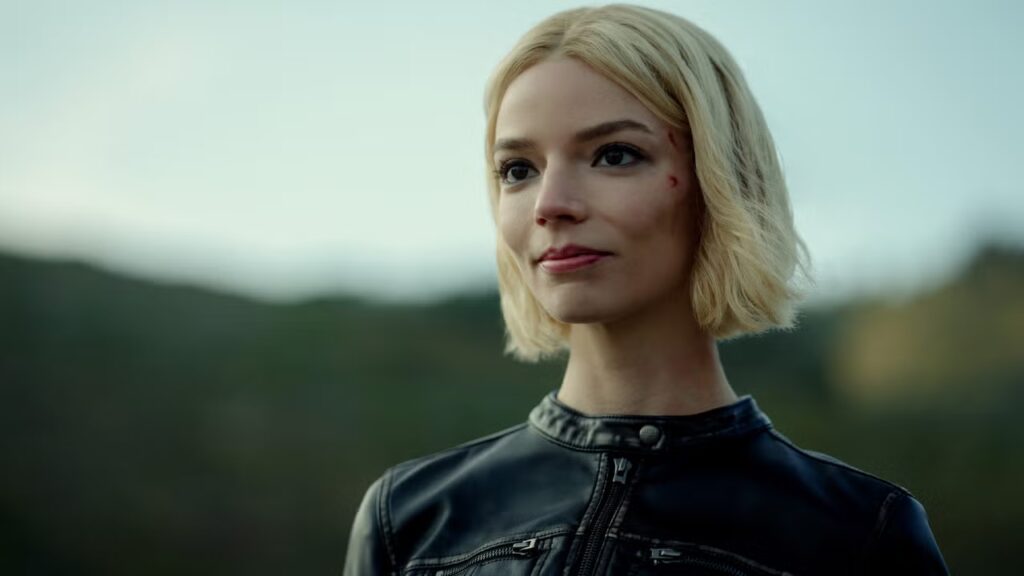
Luciana Armstrong (Anya Taylor-Joy) goes through it in the “Lucky” finale, narrowly surviving a shootout between Priscilla Masterson (Annette Bening), enforcer Dutch (Clifton Collins Jr.), mob boss Wayne Whittacker (William Fichtner) and his crew of henchmen. Lucky and her father John (Timothy Olyphant) are spared by Priscilla after the latter takes a stand and finally kills Wayne, while FBI Agent Billie Rand (Aunjanue Ellis-Taylor) survives a deadly double-cross encounter with FBI colleague Peter Kershaw (Eric Lange), who is revealed by Lucky to have been an informant for Wayne all along.
The coast is not all clear for Lucky, though. During dinner together later that night, John starts angling for the money he stole, which only Lucky has the seed phrase to unlock. In the morning, she wakes to find John gone along with the stuffed teddy bear her late husband Cary (Drew Starkey) hid the seed phrase in. John learns too late, however, that Lucky saw his betrayal coming. He finds the bear’s seed phrase recording overwritten by a farewell message from Lucky, who is revealed to have turned the money in to Rand.
“Lucky” subsequently ends on a moment of peace, as Taylor-Joy’s clever survivor stands alone on the beach, breathing in the ocean air. According to “Lucky” co-showrunner Cassie Pappas, that was not the final image she and the show’s other writers always had in mind for the Apple crime thriller.
“The opening image of the show is her flicking her dad’s lighter. It’s her thinking, ‘What would my dad do in this situation?’ He’s so in her head,” Pappas told TheWrap, revealing, “In the early days in the writers’ room, we were like, ‘When she gives the money back, should the lighter be with it? Just as a symbolic image?’ But then, in production and the shooting of it all, we lost the lighter at the end of Episode 3 [laughs]. Like, ‘Where’d the lighter go? Oh. OK. Never mind!’”
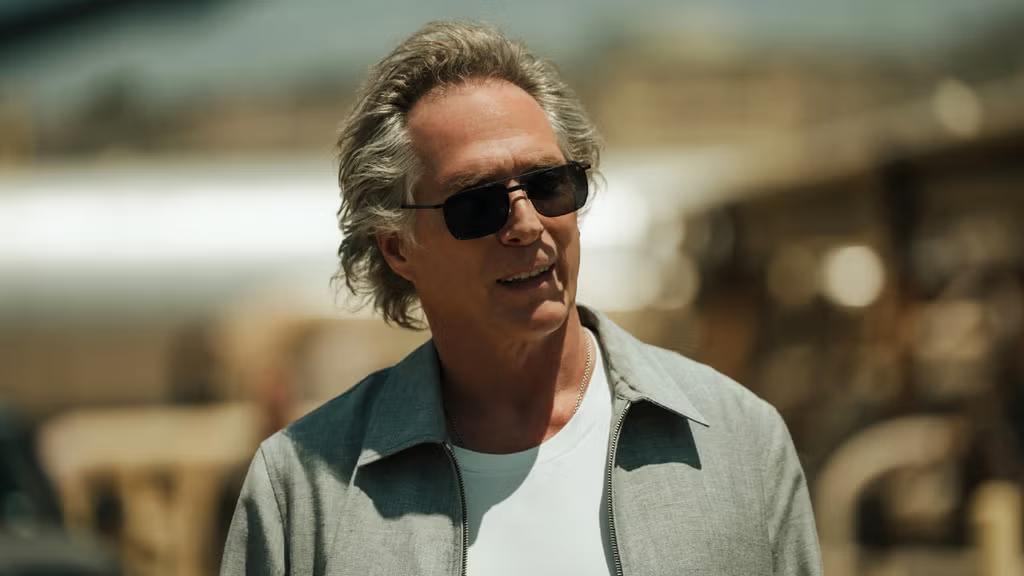
The image “Lucky” ultimately ends on may be different from what Pappas and co. originally had in mind, but the meaning is the same. In the series’ final moments, Lucky frees herself not just from the criminal lifestyle she was born into but also from her toxic relationship with her father. In doing so, she claims the dream they once shared for herself.
“Something we talked about a lot in the writers’ room was, ‘What is the shared dream that John always dangled as a carrot in front of young Lucky?’ ” Pappas said. “I imagined that, if they were living life con-to-con, motel-to-motel and she was a kid, he had to have dangled some kind of a carrot, so he promised, ‘We’re not going to live this life forever. One of these days, we’re going to run out of land and we’re going to be standing at the ocean and we’re never going to do this again, and we’ll be out.’ It’s a shared dream that she has always held onto, like, ‘One day…‘”
“What she has to go through in the finale is realize that’s never going to happen. Her dad is always going to be who he is. Her dad wants to take the money and run and she wants to give the money back and be free,” Pappas explained. “The only way she’s going to see the ocean and have her feet in the sand, have this shared dream, is if she gives it to herself.”
Below, Pappas dives further into the “Lucky” finale, including its climactic needle drop and why the series was always, in the end, about a father and daughter. This conversation has been edited for length and clarity.
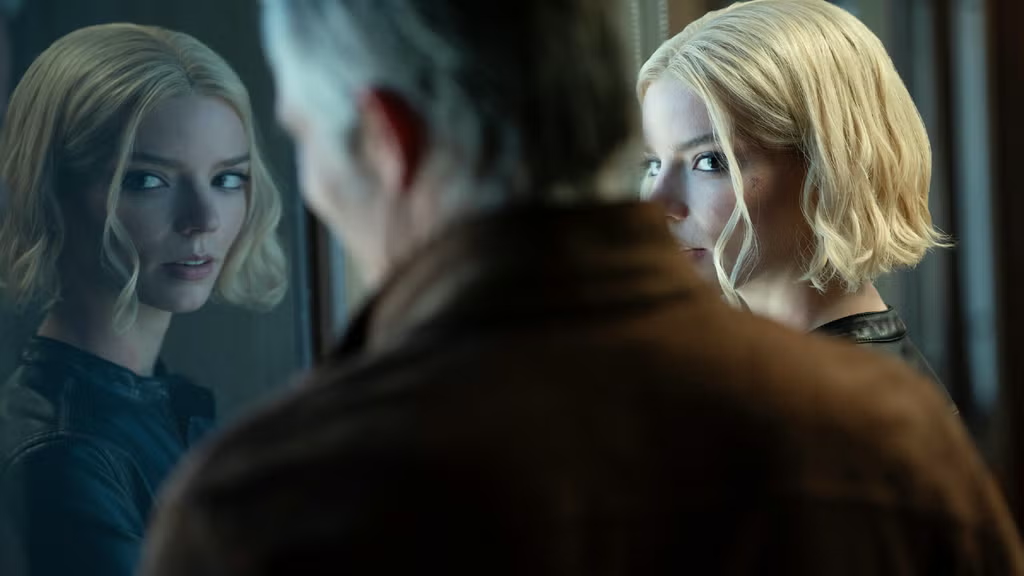
TheWrap: How much does Lucky know going into her confrontation with Whittaker? When does she figure out Kershaw is his mole? Does she have an idea of what will happen when she reveals that?
Cassie Pappas: From the moment the finale begins, she’s got the Kershaw bomb in her back pocket. She doesn’t know if it’s going to work. It’s what she says to John later. “It was either going to work or it was one hell of a bluff.” She slowly starts to put it together in Episode 6. Specifically, there’s a moment where Lucky and Priscilla have a scene in the stable, and as Lucky is about to leave, she stops, turns around, looks at Priscilla and says, “How did you guys find Cary in La Jolla?”
She starts to realize that the only way they would have found him is if Wayne Whittaker had somebody on the inside, so that’s the moment she’s like, “Huh…” But we purposely hide the ball and don’t really let the audience in on that until she decides to drop the bomb.
The last viewers see Priscilla, she is standing alone in her mansion after Rand has made it very clear she is not going to give up on taking her down. Why did that feel like the right way to leave her?
Pappas: That scene was originally much longer. They really went back and forth, and we shot it that way. It was in the edit that we cut it down. The scene worked great. It’s not that it didn’t work, but when you get to a series finale, you don’t want it to feel like you have four endings. We already knew we were going to have two climaxes: our action set piece that ends at the gas terminal and then the emotional father-daughter moment that is our real ending. So knowing that and not wanting to lose pace, we had to trim that scene.
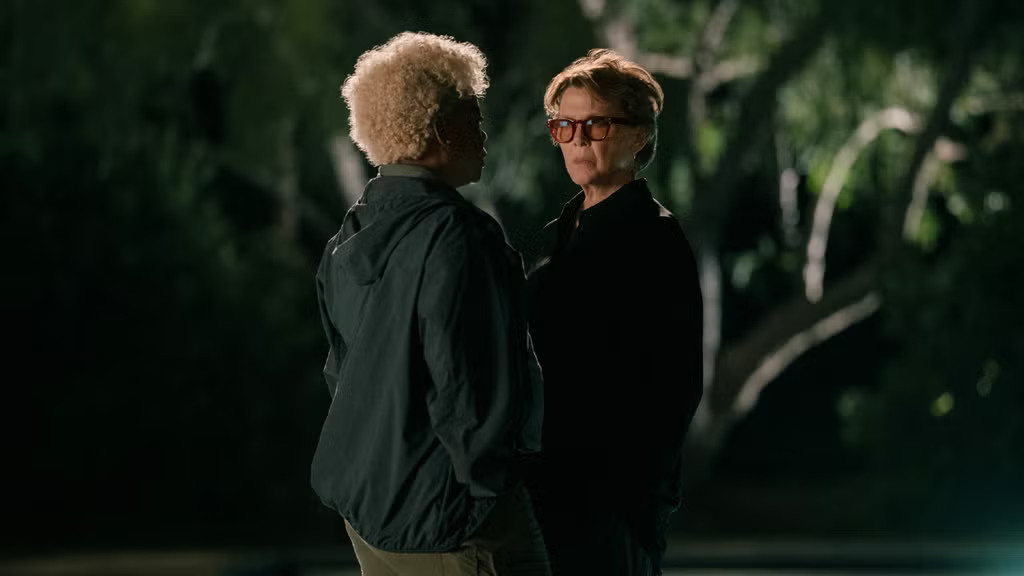
What I love about that confrontation is Priscilla essentially ascends the throne. She kills Wayne. But she is now left alone in this empty house. Her son is dead. So she ascended but at what cost? This is what happens when you live this life that Lucky has escaped. We always spoke about those two characters like, “If Lucky doesn’t make the right decisions, in 25 years she will become Priscilla.”
I think that’s what Priscilla likes about Lucky. She’s like, “I see a lot of me in you, so let me take you under my wing. Stop being such a little pain in the ass. Let me just mentor you.” There’s a cool duality there, because Lucky has a very short window of time to get out. If she doesn’t, this life is going to solidify around her and it’s going to be her life. That’s what I like most about that final image of Priscilla. She’s in her mansion alone, having lost the things that matter most in life but having won the game.
John and Lucky’s relationship really becomes the focal point of the show in its final three episodes. Was that always the plan?
Pappas: For [co-showrunner] Jonathan [Tropper] and I, what drew both of us to this project was the father-daughter dysfunctional relationship. On a character level, that’s already fascinating. But then, when you put it in this world of criminality, you get a fresh take on a trope you’ve seen a bunch, whether it’s in “Catch Me If You Can” or “Heat.” It’s a cat-and-mouse game.
But what I really liked here is that underneath this cat-and-mouse game is a young woman who has a very codependent and dysfunctional relationship with her father. She’s trying to get out of the thing that she was born into, the thing that she didn’t choose. What I really honed in on when we were writing it was, “It’s interesting if the thing Lucky is trying to outrun is actually inside her. It’s in her genetics. It’s in her blood. It’s her dad.” She’s her father’s daughter. He made her in his likeness and image, so the physical running she does becomes an interesting juxtaposition.
Why does Lucky give the money to Rand at the end?
Pappas: We talked a lot about that in the writers’ room. It was just the only way for her to truly be free and to be clean. We wanted her clean and free. We wanted her to be able to step into a life where she’s not having to look over her shoulder. So giving the money back was her way of feeding the beast, giving Rand what Rand wanted and going, “Stop looking for me. I’m giving you what you want.”
It’s an emotional cord-cutting of her father as well, because he stole that money. If she had kept that money in any way, even if it was just to buy a flight out, we just didn’t feel right about it. We wanted her to just give it back, cleanly get out and then go start to figure out who she really is.
The show concludes with a cover of Phil Collins’ “Take Me Home.” Why that song?
Pappas: Oh, man. We went round and round on that. Our music supervisor, Jen Malone, is fantastic, and we tried so many different needle drops there. That one, it was less about the lyrics. It was more about the feeling we wanted: a sort of upward, rising action. We wanted it to feel like she’s taking the first breath of her new life, and then we cut away before she even exhales because we wanted to end on that swell of rising emotion.
“Lucky” is streaming now on Apple TV.
The post ‘Lucky’ Showrunner Unpacks Finale Shootout and That Climactic Betrayal: ‘An Emotional Cord-Cutting’ appeared first on TheWrap.